If you are planning to work with Uber Eats or other delivery or ride sharing platform, then you might get asked to get a VEVO check or right to work check completed.
So in this article, we are giving you a guide about VEVO or right to work check.
What is VEVO?
VEVO stands for Visa Entitlement Verification Online.
VEVO is an online tool provided by the Department of Home Affairs to verify the visa holders’ visa conditions.
This tool can give you details about:
Type of visa granted
Visa grants date
Visa expiry date
Period of stay (how long a visa holder can stay)
Visa conditions (what the visa holder can and can’t do)
It is important to note that VEVO is current only at the time it is conducted and should only be considered valid when accessed directly through the VEVO system.
Who can access VEVO?
VEVO details can be accessed any of the following individual or organisation:
Visa holder
Employer
Education institute
Other government agencies
When you can use it?
You might also be wandering when do you actually need to use this. Most of the time, it can be used when:
signing up to work with ride-sharing of food delivery platforms like Uber Eats
looking for a job and your employer wants to confirm your visa conditions
looking for a rental property and your landlord or real estate agent wants to check your period of stay in Australia
How to check the VEVO for Uber Eats and other delivery platforms?
There are 2 ways to get your VEVO check done for Uber Eats and other delivery platforms.
First Method using private agencies
Some businesses may require people to get the VEVO check done through the private agency they work with.
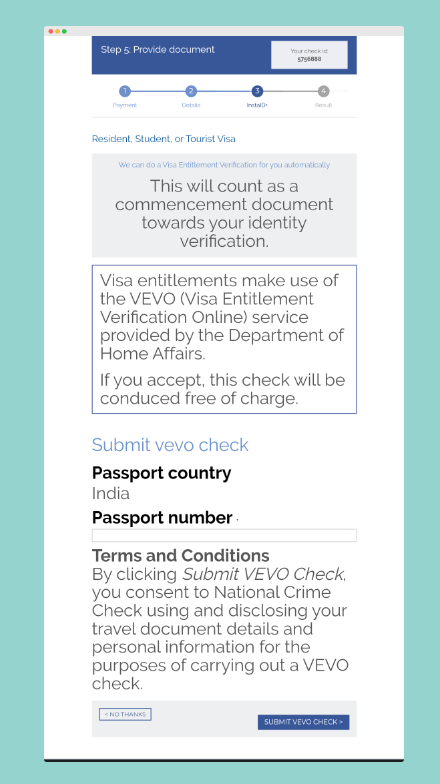
For example, if you are planning to deliver with Uber Eats, then you can get VEVO check done while completing your Background check application.
They use National Crime Check (NCC) as their background check partner. You can use the services of NCC for your VEVO Check. It costs won’t cost you anything so if you are planning to work with Uber Eats or other delivery or ride sharing platforms, then it makes sense to get the VEVO check done through NCC.
All you need to provide for this is your Passport details like your Passport country and Passport number (check the image below) and upload the photo of your Passport while completing your background check.
That’s all.
Second method using the Department of Home Affairs website
In order to check your VEVO as a visa holder from the Department of Home Affairs website, you will need to have an access to:
Passport
and any one of the following:
Transaction Reference Number (TRN)
Visa Evidence Number
Visa Grant Number
Password
Step 1: Go to Immigration website for VEVO Check here.
Step 2: Select the type of document and press submit
Step 3: In the next step, enter the following details:
Reference type
Reference number based on the reference type
Date of birth
Document number
Country of document
Agree to the terms and conditions
Press Submit
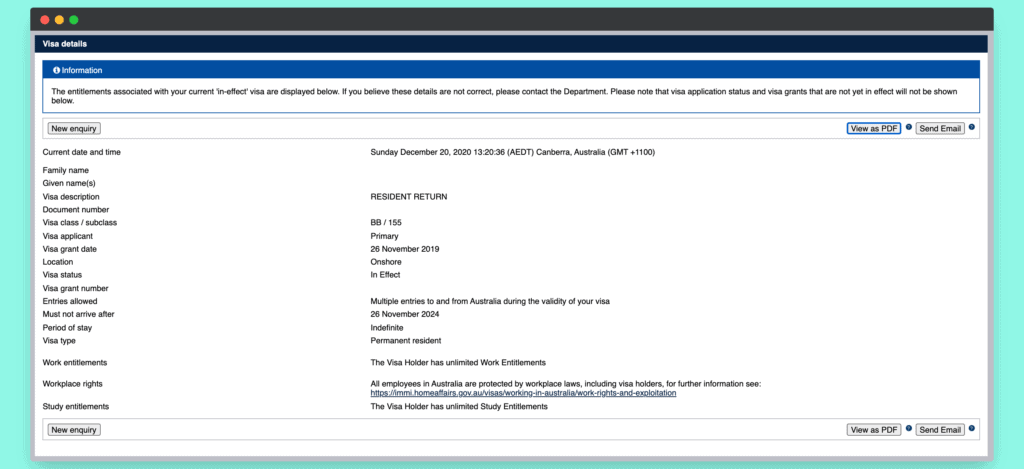
After submitting the details, you will get the VEVO details on the website something like this:
You can down this information as a PDF or you can also send it via email.
You can also check the VEVO details
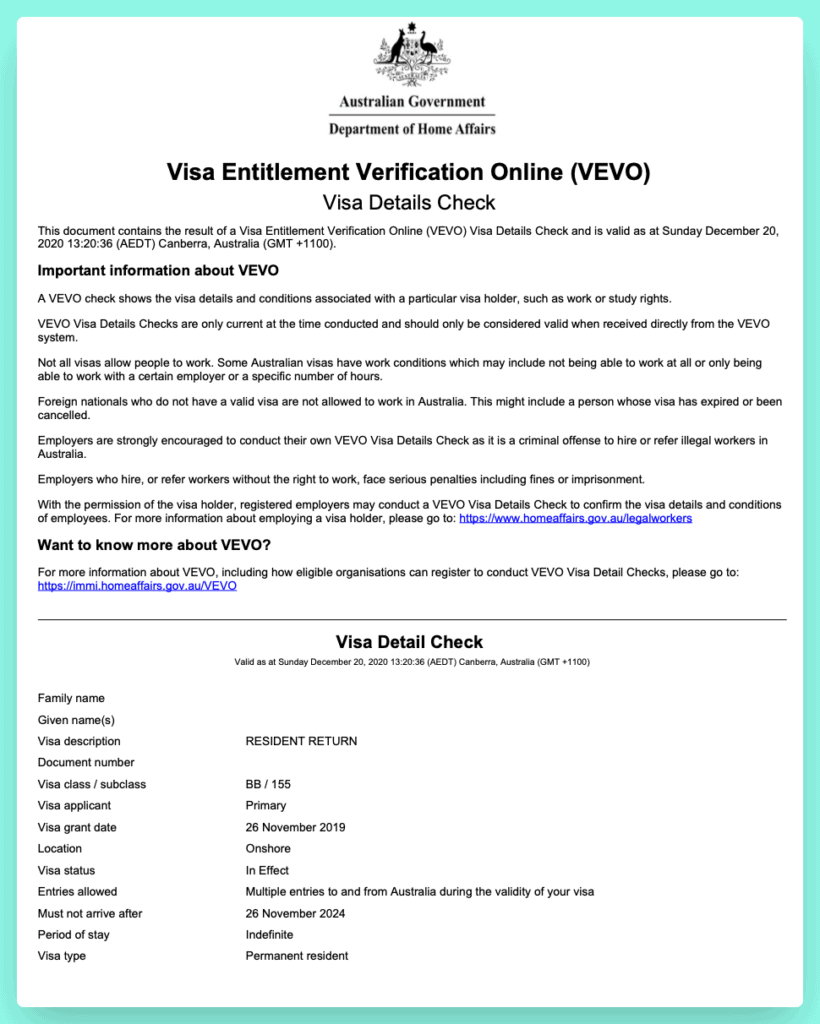
Example of VEVO Letter
Here is how the VEVO letter that you download from immigration website will look like.
Do everyone need to do a VEVO Check in Australia?
In short, the answer is No!. Not everyone needs to do a VEVO Check in Australia.
If you are a visa holder in Australia and have got your visa after 1990, then you will have access to VEVO. You will not have a VEVO access if you are:
an Australian citizen
migrated to Australia before 1990 and never travelled outside Australia
If you migrated to Australia before 1990 , you can request an electronic visa registration.
It is important to note that Australian and New Zealand citizens won’t need to do the VEVO check as long as they can prove their respective citizenship with documents like an Australian or New Zealand passport, Australian birth or citizenship certificate.
Well, we hope you find the information useful and handy on the VEVO check. Please share this article with someone else who might find this information useful.
If you’re still at school, you’re probably getting ready for a new semester to start soon. Chances are, some or all of your courses will be online while we’re still battling the COVID-19 pandemic. It’s a huge adjustment, and it also means we have to be extra careful about protecting our data and devices from hackers.
We called on the cybersecurity experts at ESET to explain the best internet safety tips for the students.
What are the main cyber threats?
With so many of us studying online now, cybercriminals have more opportunity than ever to pull off attacks. Unfortunately, they’ve been busy thinking of new and creative ways to hack into our computers and networks.
Wondering how hackers get into your computer? These are some of the most common cyber threats we’re dealing with:
Phishing emails. The pandemic has caused a lot of confusion and uncertainty, and cybercriminals are taking advantage of that by sending scam emails. There are a few types of emails doing the rounds, and the most common one asks you to download a “coronavirus tracker.” We’ve also seen emails from hackers pretending to be medical experts — and if you click on a link, it installs a virus on your computer.
Identity theft. Since we’re all online now more than ever, there’s a chance we’re filling out more digital forms with our personal and contact information, as well as banking details. Hackers often steal that data so they can sell it, so it’s really important to be as private as possible. More on that in a minute!
Webcam hacks. Hands up if you’ve lost count of how many Zoom calls you’ve had this year? Us, too. Can someone see you through your laptop camera? Usually not, but we’ve seen more cybercriminals trying to access webcams and hack into networks from there.
5 ways to boost your cybersecurity
Cybersecurity might be a pretty new concept to you, and that’s understandable. Schools have strict security measures in place, so you probably didn’t have to think about it too much before. Luckily, you can use “hacks” of your own to protect your data and devices at home.
To stay safe and secure while you’re remote learning, follow these internet safety tips for teens and students.
1. Don’t give away your personal details online
The less information you reveal, the better! One of the biggest computer safety rules for students is to only talk to people you know. If someone asks for personally identifiable information — like your address or where you go to school — double-check with your teacher or parents before responding.
Think of cybercriminals as detectives. Once they have a little bit of information about you, they can do some digging to find a lot more.
2. Secure your Wi-Fi connection
An open WiFi network is the equivalent of leaving your front door wide open. Plus, there’s no need to give other people free WiFi!
To lock down your WiFi connection and make sure no one can access it, here’s what to do:
Choose a random name for the network. Instead of naming your network “John Smith’s computer,” challenge yourself to come up with a name that can’t be linked to you at all. The more obscure, the better. Think Lion’s Lair or Dragon’s Dungeon.
Create a strong password. Your password should be hard to guess, and have a mix of capital and lowercase letters, as well as numbers and symbols.
Change your password regularly. Aim for every 60 to 90 days.
Update the security settings. In your network settings, select WiFi-Protected Access 2 (also known as WPA2) and pick AES for your algorithm.
Connect to a Virtual Private Network (VPN). We’re always asked, do I need a VPN?It’s a good idea.These secure networks encrypt the data you send and receive and hide your IP address to increase your online privacy and anonymity. Your school should be able to help you set up a VPN while you’re remote learning — and you’ll earn brownie points for being on top of cybersecurity!
3. Check all of your privacy settings
This is an easy way to amp up your privacy and confidentiality. It’s especially important if you have younger siblings using your devices, too.
Go into every app, video-conferencing software, messaging platform (like Slack) and social media site you use for school and beyond. Then, turn on the most advanced privacy settings to make it harder for hackers to find a way in.
4. Learn how to identify spam and phishing emails
Your school is probably relying on email to send learning materials and announcements. With so many more emails flying back and forth, scam emails are on the rise during this pandemic.
You might be able to spot a suspicious email before it causes damage, like installing malware on your computer. So, to avoid falling victim to a scam, follow these golden rules:
Never open emails from unknown senders. If you don’t recognise a sender, mark the email as spam and flag it with your school’s IT department. And if you’re not sure whether you know the sender, check the email address or subject line for spelling errors or weird symbols. That’s how to spot a phishing email.
Avoid clicking on links in suspicious emails. If you do open a suspicious email, try not to click on any links or download attachments.
Don’t send personal or financial details via email. Any legitimate person or business won’t ask for sensitive information through email. They’ll have encrypted platforms to store that kind of information, like online portals.
5. Say yes to all software updates
As tempting as it is to skip software updates, try not to ignore them. Software updates fix security issues and bugs so it’s harder for hackers to tap into your computer or webcam. They pop up all the time because manufacturers release patches as they find flaws to keep you — and your data — safe.
Now that you know that, it’s a good idea to install software updates right away. They usually take a few minutes and you might have to restart your computer, but it’s worth the extra effort.
You can also turn on automatic updates so you don’t have to worry about them anymore.
Protect your devices with antivirus software
For extra peace of mind, install a sophisticated anti-virus software on all your devices. by doing this, you’ll have a multi-layered defence against all those cyberthreats we talked about earlier.
The biggest sale of the year has arrived “Black Friday and Cyber Monday”.
In this article, we are going to explain what is Black Friday and Cyber Monday and some of the most popular Black Friday and Cyber Monday deals for the students in Australia in 2024.
What is Black Friday?
Black Friday is a day after Thanksgiving Day, which is celebrated on the fourth Thursday of November each year in the United States. This year Black Friday will be celebrated on 29th November 2024.
It is considered to be the start of the shopping season for Christmas in United States and many retailers start the season with exclusive deals on this day with huge discounts.
It is a day when consumers can save big money on appliances, fashion and other accessories.
While it is an American tradition, it has gained more popularity in Australia since 2013.
Many retailers like JB HI-FI, Harvey Norman, The Good Guys along with their American counterparts like Amazon and eBay launch exclusive deals for Australian consumers on Black Friday for the last few years now.
Most retailers open their stores early on Black Friday and close them late as well to make it easier for shoppers. These days you can score many deals online, so you don’t necessarily need to go to the store to get a bargain.
Cyber Monday is celebrated on Monday after the Thanksgiving holiday in the United States as well. This was primarily designed to encourage people to shop online rather than in Brick and Mortar stores.
This day started in 2005 and quickly gained popularity with the increase in number of internet users. This year Cyber Monday will be celebrated on 2nd December 2024.
How to use cashback websites to maximise your savings during this Black Friday and Cyber Monday sales?
Before you buy anything online, make sure to sign up and check if there is a cashback offer available on these websites. This will be an additional saving on top of discounts from those brands. Sign up is free and if you sign up using the links below, you can score a referral bonus of up to $15 as well.
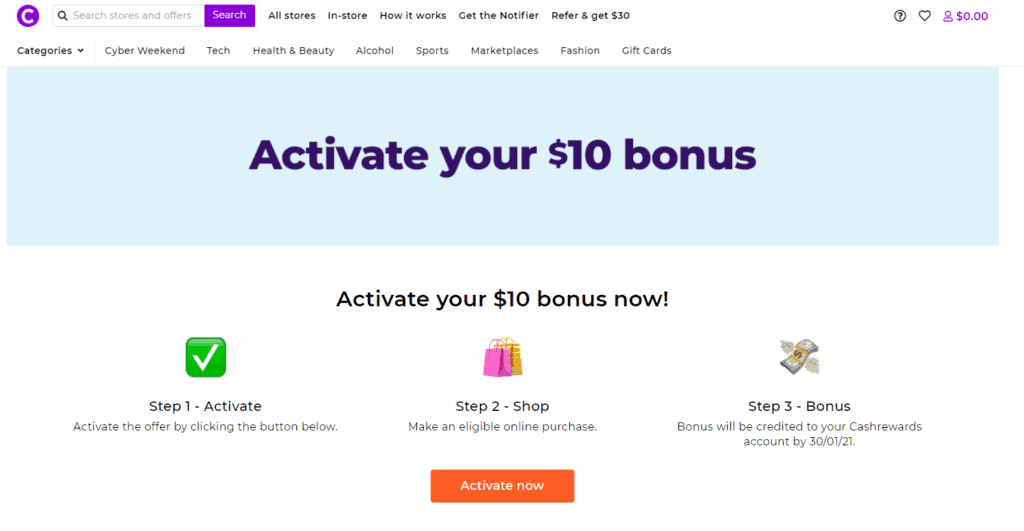
Cashrewards – Get $10 referral bonus after spending $20 or more within 14 days and additional savings using the links on the website. Sign up here.
ShopBack – Get $10 bonus when you spend $20 or more through ShopBack using the link here.
Here is a quick step-by-step guide for using cashback websites:
Step 1: Make a list of things you want to buy during the sale. It helps you to stay focused on the things you need.
Step 2: Join Cashback websites like Cashrewards and Shopback for free (using the link given above). If you are joining for the first time, you can get referral bonus when you sign up using the link above.
Step 3: Look up for the store you would like to shop and click on the link provided in the website.
Step 4: Complete your transaction.
Step 5: Repeat this process if you want to get cashback on your purchases.
Here is a list of top Black Friday and Cyber Monday deals. Please note that these deals will be updated regularly, so please come back to check out more deals here. Some deals have an exclusive discount for students, so make sure to take advantage of that.
Check all the Black Friday deals from Telstra here.
Catch Deals – Catch has reduced Apple AirPods Pro to $319 (a saving of $80). They are also offering Apple AirPods 2nd Gen at $209 (with a saving of $40). Plus don’t miss out on exclusive 10% student discount. Get your exclusive code here.
Dell – Dell 24″ 1080p IPS 75hz AMD FreeSync for $138.93 Delivered (was $249) using the code: LOVEKEANU More details are here. Upto 35% on other products like laptops, monitors etc here.
The Good Guys – Dyson V7 Motorhead Cordless Vacuum for $379 (was $599). Check out this deal here.
Microsoft Store – Up to 20% off on Microsoft Surface from $974 here, Up to 40% off on Gaming and other accessories at Microsoft store here.
Lenovo – Lenovo Thinkpad E595 8GB 512GB SSD for $799 Delivered and up to 55% off Black Friday Sale at Lenovo here.
Becextech – 60% off sitewide + Extra $20 off student discount here.
Dick Smith – Take an Extra 20% Off Top Appliances using code: COOLBF here.
Fashion Deals
Boohoo – 60% off everything and 10% student discount when using this link here.
Missguided – 50% off everything + Extra 10% Student Discount here.
The Iconic – 30% off selected styles on Black Friday sales here.
Boohoo Man – 50% off menswear + extra 5% student discount here.
Crocs – 40% off sitewide and free shipping with orders from $50. More here.
Adidas – 30% off storewide here. Early access to the sale for Creators Club members.
Nasty Gal – Massive 60% off on Nasty Gal. Details here.
Cotton On – 30% off everything on the website here.
Bonds – 40% off sitewide on Bonds website from 27th November here.
Click on the “Shop Now” button, next to ” 3 Year Plan + Bonus 3 Months for $121.29 (83% off) – New CyberGhost VPN Customers”. You will be directed to Cyber Ghost VPN Deal
Press “Claim Deal Now” on the Cyber Ghost deal page.
Choose the 3 Years + 3 Months Plan and pay for the service.
Once paid, check back on the Shopback for the tracked link.
Get your cashback for the deal within 60 to 90 days.
Enjoy Free VPN for next 3 years and 3 months.
Make sure to cancel the plan befoore the expiry to avoid recurring payments in the future.
Amaysim – 1-year Prepaid Plan with Unlimited calls and text with 120 GB data for $100 but use the Shopback to get $60 cashback making it $40 for a whole year. And with sign up bonus of $15, it will be only $25 for the year worth of plan. Use this link to get a $15 sign up bonus now.
Chemist Warehouse – 10% off storewide in Store and online on Black Friday. Some exclusions apply. More details here.
Koala Mattresses – Up to 20% off on Koala’s mattresses and other accessories here.
Booktopia – Up to 80% off on millions of books at Booktopia here.
DISCLAIMER: This list may contain links from our affiliates like Amazon and others, sponsors, and partners. If you use these products, we will get compensated – but there’s no additional cost to you.

One of the key question many international students have is What is Destination Australia Scholarship, how does it work and how to apply for this scholarship?
So in this article, we are going to give a complete guide about Destination Australia Scholarship
What is Destination Australia Scholarship?
On 20th of march 2019, Australian government announced this scholarship known as Destination Australia. The aim of this scholarship is to encourage both domestic and international students to study in regional Australia.
Over a 1000 scholarships are offered each year to support the study and living expenses for these students in the regional area.
In 2020 around 1180 scholarships were awarded at 35 different institutes across regional Australia.
This new scholarship program delivers on the Government’s commitment to attract more students – both domestic and international – to study in regional locations.
How much is Destination Australia scholarship?
As discussed earlier, there will be 1000 scholarships available each year for this scholarship. It is planned to split these 1000 spots between both international and domestic students (500 each) equally.
The value of this scholarship is $15000 per year and it will be paid for the minimum number of years that are required to complete a course.
So, let’s say, you are planning to undertake a Bachelor’s degree in the regional area and it will take you 3 years to complete this bachelor’s program. For each of these 3 years, you will get $15,000, which means a total of $45,000 for the duration of the course.
Who is eligible to apply for this scholarship?
There are few eligibility requirements you need to meet when you are planning to apply for this scholarship. Some of them include:
You must be planning to study a full-time course in regional Australia. So it can’t be for the part-time study.
It is available only for eligible institutions – Only certain institutions in regional areas can offer the Destination Australia scholarship. You can check the complete list of institutions here.
It is available only for eligible courses – when it comes to courses you can choose to do either vocational courses or a degree programs.
Some of vocation courses include: Certificate IV, Diploma and Advanced diploma. The degree programs include: Bachelor degree, Master’s degree and PhD. programs
Please note that each institute that you are applying for may only have a specific type of courses eligible for this scholarship. They may not be offering this scholarship for all the courses available in that education provider.
You must maintain your student visa throughout the duration of the course
You must be studying in a regional area to be eligible for the scholarship
Also keep in mind that the institute you’re applying for may have their own criteria’s and own eligibility requirements when you’re applying for the scholarship.
What are the benefits of this scholarship?
There are many benefits of this scholarship including:
Financial support which is up to 15 000 per year
Lower cost of living in regional areas as compared to the city areas
Chance to experience the lifestyle of regional Australia
Additional migration benefits like extra time for the post study work visas etc.
If you want to know more about the benefits of studying in regional Australia, then we suggest you to check this video out or you can read more about regional areas in this article.
How to apply for this scholarship?
Before you get to apply for this scholarship, it is important to understand that institutes and universities in regional areas must apply for this scholarship to the Department of Education each year.
Then, Department of education will allocate these places for the eligible institutions in a regional areas.
Once these institutions are announced, then students can apply directly to these institutes for the Destination Australia scholarship. You can look up for these institutions on the Department of Education’s website.
Please note that these educational institutions might change each year based on their application and eligibility.
As a student, you can directly apply this scholarship to the institute by completing an application forms available on their website.
Now the selection of this scholarship will be based made on your application.
Usually many institutes require you to write a personal statement when you’re applying for this scholarship. It is around 600 words and you may have to include information like:
Why you are applying for this scholarship?
Why are you choosing to study in this specific regional area?
Why are you choosing the specific institute?
How this scholarship might benefit your career?
Once applied your application will be assessed by the selection committee of the institute and if your application is accepted then there could be further interviews or video interviews before they finally award you this scholarship.
Again, this personal statement requirement may vary from one education provider to other. Education providers can have their own criteria’s and interview requirements.
We highly recommend you to check the website of your education provider’s website for complete eligibility requirements and application process.
How do you get the scholarship money?
If you get awarded this scholarship from your educational provider, the money will be directly deposited into your Australian bank account every year as per the agreed payment schedule.
As per our observations, many education providers actually pay this scholarship money in a half-yearly installments, which is $7,500 every six months.
This payment schedule may vary depending upon your agreement with the education provider.
While, there are only 1,000 spots available for this scholarship, $15,000 is a substantial amount of money as an international student. So, we highly recommend you to look for your options to apply for this scholarship.
You can also check our article on 6 steps for applying for a scholarship in Australia here.
We would love to hear which regional area or institute are you planning to study in 2021 and beyond. Please put your thoughts in the comment below.
It is that time of the year again when students start worrying about their exams. It is certainly one of the most stressful times in any students life.
But there are ways to manage the stress, anxiety and be well prepared for the exams.
So in this article, we are going to give you top 12 tips for your exam preparation
1. Prepare Nice and Early
Now, our parents, grandparents, teachers and every one who have been through exams will say this to you “Prepare Nice and early for your exams. Don’t leave anything for a last minute”.
And to your disappointment, they all are telling you the right thing.
Having prepared well in advance for your exams make life so much easier.
Of course, there will be still some anxiety and nervousness for the exams but that is very normal.
2. Get organised
It is important that you get the things organised before start preparing for the exams.
There are many things you will need to organise like your study space, books, notes, stationery, computer, comfortable chairs, etc.
One of the other stressful thing is to find things on or a day before the exam. Some of the common things that can cause stress include:
“I can’t find my Student ID card!”
“Where is the exam hall?”
“I forgot to my stationary kit for my exam tomorrow”
These little things can cause more chaos than the exams themselves.
Make sure you have all the things you need to carry along with you when going for an exam. Also locate your exam halls, address and work out how to get there as well. Unless, the exam is online, then you may not need to worry about these things but still might need to be aware about the login details etc.
Create a checklist of things you need to prepare for the exam day.
3. Have clear goals
When you start preparing for the exams, it is important that you set clear goals for your study session.
For example, you might want to set a goal like in next hour, i will cover 3 topics of this chapter.
Having a clear goals for your study sessions helps you to stay focused and it helps you measure your progress.
Remember, “What can’t be measured, can’t be done”
4. Eat healthy food
Having a quick unhealthy meal is always an easy option, especially during exam times.
Buying a $2 cheeseburger from Macca’s or just having that MSG filled noodles again.
Sounds familiar, right?
While, certainly the convenience is there for eating junk/unhealthy food but it doesn’t help your exam preparation.
Eating healthy and nutricious food can help you stay active and be more focused than eating unhealthy food.
Planning your menu ahead before the exams can be great idea for those healthy options.
If you don’t feel like cooking during the exam time, then freeze some home cooked food in advance for those long study sessions.
Also, you eat more fruits as they don’t require the same efforts as cooking a full meal.
Avoid sugary and energy drinks too. They might give you a quick boost but you will feel tired after it lose its effect.
5. Work with your peers
That can be quite fun for studies but challenging at the same time.
If you can find a study buddy and work together to study and motivate each other, that can be great positive thing. Not only for your studies but your mental well bring as well.
You can discuss topics together, work on each other’s strengths and learn from each other too.
But, having friends over for studies can also means distractions and not getting much studies done, rather lots of chit chat for random things.
So, the idea will be to plan this session with your buddy before catching up and work out which topics will you discuss or learn during the session.
6. Visualise everything
It is a proven strategy to memorise and learn some key concepts.
Now, we don’t suggest you to cram but there are some things you will need to remember to do well in our exams.
If you can actually draw charts, diagrams, mind maps of the content you need to memorise, then it can help you remember those key concepts.
The idea here is “a picture can say 1,000 words”.
Having a visuals for your learning during exams can be great. So we suggest you to create these visuals from your lecture notes and resources like books etc.
7. Use technology
When planning, preparing for your exams, technology can be a great help.
Let’s talk about lecture notes first.
Imagine, having all the lecture notes in hand written notebook and trying to find those key things lecturer said in that pink coloured highlighted notebook.
Now compare that to simple note taking app like Google Docs or Notion, you can easily and quickly find your notes using search options there.
Don’t get it wrong, we are not against handwritten content at all but we are giving you exam tips, so every minute counts in this time.
Having a planned layout of the notes in these softwares can be very efficient way to go.
There are other aspects related to your exam preparations like bookmarking on the websites, timers on the phone, etc.
8. Get a break
Studying for a very long time can be exhausting.
It is important to have breaks in between the study session in order to keep yourself fresh and be ready for those longer sessions.
Ideally, you should be taking breaks every hour or so during those study sessions. Looking too long in screen can be harmful for your eyes anyways.
So split your study sessions and have some break and do some simple exercises or just go for a quick walk.
Have you hear about Pomodoro technique?
It has worked wonders for our founder, Sam and he explains in bit more details here:
https://youtu.be/UFDktPQGZLM
9. Limit distractions
Aka Phone usage. Aka Social Media. Aka Friends. And the list goes on!
You will need to limit all your distractions while studying for your exams.
In a perfect world, you should be studying in a distraction free space. So, if you live with lots of mates in the same house and they don’t have exams, then consider to study in quieter space like library.
For the phone usage, pretty easy, turn it off.
Unless you are expecting some emergency/important calls, there will not much that you will miss.
Having it on mute can be still tempting to check it. So, just switch that thing off and focus on your study.
May be reward yourself by checking after every successful study session.
Or if you want to check the time, then no problem, buy this alarm clock from Ikea for $5.
10. Get moving
As mentioned briefly in the one of the previous points, you study to get yourself moving by doing some simple exercises or a walk.
The basic aim is not to get stuck behind the desk for hours but rather during your break time, try to move around and so some streching.
Don’t also go for a hardcore exercise as well as you might feel too tired for studying and will be falling asleep during study.
So, some strectching, excercise or walk will do.
11. Get help
Don’t hesitate!
If you are stuck and need help, then don’t hesitate to do so.
Most of the schools, institutes, universities will have support services available for their students.
So, if you need some assistance for your exam preparation, then reach out to these services.
Also, speak with your lecturers, tutors, family and friends and get some help from them.
There are paid counselling and tutoring services available for the students, so if you can afford, you can use those services as well.
12. Be creative
Well, we gave you a whole list of tips in the article, but this last tip is as important.
You can come up with your own strategies and ideas when preparing for the exams.
While the above mentioned tips have worked wonders for many, it is not always suitable for everyone’s lifestyle.
So, if you are comfortable in doing certain things in your own way, then you should go for it.
And now, over to you.
What other tips or strategies, do you use for your exam preparations? We would love to hear your ideas. Please put them in the comment section below.
Check our infographic on 5 effective ways to study here.
So you are applying for the jobs in Australia but you’re not getting any response back or getting a rejections in all the job applications.
You might be wondering what are you doing wrong in your job applications that you are not getting a job here.
We went and did some research and we found there are 7 main reasons you are not getting a job in Australia as an international student.
In this article, we are going to talk about all these seven reasons and how to address them as well.
1. Poor Resume
📃
One of the first reason we identified that the students are not getting a job is because of poor resumes.
Resume is the most important part of your job application in Australia and you could be doing some of the mistakes in your resume that you probably are not aware about.
Some of the common mistakes that international students make in their resume includes:
Not following the correct format
Australian style resume could be really different then the resume is used in your home country. In Australia, we don’t include some of the personal information in our resume like:
Date of birth
Gender
Religion
Race
Photo
It is vital that you follow Australian style resume when you’re applying your jobs here and making sure that your resume looks professional all times.
Generally, an Australian style resume will follow this pattern:
Contact details
Key Strengths
Work expereince
Education
References
Skills
Availability
Australian Resume Template Sample
But it can vary a bit based on the whether you are applying for a part-time, casual or a full-time job.
You can download a free resume template here and see how it looks likes. You can and should customise this resume for your job applications here.
We also got this quick video on how to write an Australian style resume for part time and casual jobs in Australia.
Same generic resume to all the job applications
It is very tempting and easy to send the same resume again and again because let’s be honest it saves you heaps of time.
But in reality if you customize your resume before sending it for your job application, you actually have a higher chance of getting an interview rather than sending a same generic sort of resume.
In order to address this situation, all you need to do is make sure that you customise your resume for every job application.
So let’s say if you’re applying for a job in McDonald’s or supermarket or for a job role in reception area, the resume should look different for job application.
Spelling errors and grammar mistakes
Another mistake that a lot of students make in the resume is not checking the spelling errors and grammar.
We completely understand that English might not be your first language but sending a resume which has lots of spelling errors and mistakes doesn’t help you cause of getting a job.
To address this situation, if you’re not confident about your grammar and English then we suggest you to get someone else to have a look at it before you submit it.
So get someone else to proofread your resume before you send it for your job application. You can get support from your institute or student bodies. Some government agencies like Gold Coast Student Hub also can help you to check your resume.
Unprofessional email address
Believe it or not but your unprofessional email address like ([email protected]) does not impress your prospective employer.
Now think about it for a moment, if your resume looks really great and the recruiter is really impressed with your resume and work experience and they’re about to send you an email and if your email address does not look professional it might put them off.
So you could lose a job opportunity just because of your email address. You certainly don’t want that happen to you.
So make sure that your email address looks professional. It is very easy and free to get yourself a new email address if you don’t have one that looks professional like ([email protected]).
2. Poor communication skills
💬
Although, there is no official language in Australia. English is most commonly spoken language.
But we do understand that your English may not be up to scratch when you come here for the first time. Apart from English language, other reason could be understanding the Australian accent.
Obviously, Australians love to use their slang and they like to shorten everything they say.
To address your communication problems, it is recommended not to hang out too much with your own community when you are here.
We’re not saying that you should completely disconnect from your own community but try to maybe find a accommodation where you can stay with the people from other countries or cultures.
In that way, you won’t have any option other speaking English with them and you will be forced to learn the lanaguge.
Another way to address this situation is by watching English TV shows or English movies and making sure you are watching them without captions.
Other ways to improve English includes reading newspapers, reading information online, reading books.
Also, we suggest you to go out meet as many people as you can so that will not only increase your network but it will also help you to improve your communication skills.
If you want to learn some Australian slang we’ve got you covered in this video:
3. Lack of local work experience
💼
You might be applying different sort of job roles in Australia but if you don’t have any work experience at all and you haven’t included that in your resume then it can be very difficult for you to get a job in Australia.
Lot of employers actually prefer if you have a local work experience in your resume.
To address this, we suggest you to look for some volunteer opportunities around your work areas if you don’t have any work experience.
There are many volunteer organisations that always look for some volunteers to help the community with various tasks.
Even though it’s not a paid job, you still get some work experience that you can include in your resume
Volunteering, not only helps you to get a work experience but it also helps to improve your overall personality.
You can also learn other soft skills like teamwork, communication, organising, management and other interpersonal skills. So we highly recommend you to do that in order to address this lack of work experience in your resume.
4. Lack of references
🤝
As mentioned in the first point earlier, you need to include some work references in your resume and if you have no work experience it becomes really difficult for you to first of all get any sort of work references.
To address this situation, we suggest ask your teachers or professors or lecturers if they can become your reference for your work.
If you can show to your lecturers or tutors that you are a good student more likely they are going to give you a reference.
So make sure to have a good relationship with your tutor trainer and demonstrate or show that you are a good student.
Again, volunteering can help here again, if you work with specific supervisors or managers, then they can become your referee’s.
We do not suggest you to include any fake work experience or any fake work references in your resume.
5. No Cover Letter
📄
Part of the job application usually will require you to send a cover letter along with our resume.
If you’re not sending any cover letter at all then that could be the reason you are not getting a job in Australia or
The other reason could be that you are sending a same generic cover letter for all your job applications.
To address this, we suggest sending a customised cover letter for your job applications.
If you customise your cover letter along with your resume, then you have a high chance of getting a job interview than the other job applicants.
Even if the job application does not require you to submit a cover letter, we actually suggest that you send a cover letter with your resume.
The main reason for this is that many other job applicants will not be sending their cover letter so if you do send your cover letter, you actually have a better probability of scoring that job
If you don’t know how to write a good cover letter, we got a free template for an Australian style cover letter here.
Please customise your cover letter before you send it to any employer basically every job you apply you need to customize your cover letter and your resume as well.
If you want a guide on how to write a good cover letter, then we suggest you watch this quick video:
6. Lack of networking
🌏
Most of the jobs these days are advertised online and you are required to apply for them online as well.
But that doesn’t mean that you should not go out and meet people and do networking with our peers and professionals in your industry.
One of the common reason for international students not getting a job is because they are not going out and meeting the people and creating their network within Australian community.
Networking is still one of the most popular way of scoring a job in Australia. It might be surprise for some of you that 70% of the jobs are never advertised as people get hired due to references or their network.
To address this situation, we suggest you to join some student associations, english speaking clubs, sports clubs, industry bodies or other organisations.
These clubs and organizations usually organise events every week or monthly. So make sure you attend these events and network with the like minded people.
Also make sure to check the calendar of activities that your college, Institute or university is planning for the next few weeks.
Especially if you don’t have any other job to do, we highly recommend you to attend as many networking sessions as you can.
There are many apps like Eventbrite, Meetup where you can find local events happening around your area.
We highly recommend you to join some Facebook groups in your local city or community and be part of their Facebook group and attend some of the events that these Facebook groups organise.
Again, volunteering is one of the other way to network with people from all walks of life.
Networking is one of the most important way you can score a job here in Australia. So don’t hide behind the closed doors, don’t be shy, go out and meet people.
7. Lack of availability
⏰
The last reason is the lack of availability especially if you are applying for a part-time jobs in Australia.
In your resume, you will usually need to include availability.
So let’s say you’re looking for a job in a hospitality industry, if you are not giving enough availability during the weekends or during the evenings to the employers, then that could be the reason why you’re not getting a job here in Australia.
You might be wondering how on earth I have no availability if I don’t have any job at all.
As per your study schedule, you will have to study for around 20 hours per week here in Australia on a student visa.
And some time a timetable from your Institute or University spreads out on 4 to 5 days or it spreads out in the evenings that can certainly affect your availability to work.
To address this situation, many institutes and universities give you a chance to choose your own timetable when you start studying here.
So the ideal way to handle this situation is to choose your timetable nice and early because usually there are very limited time slots available in each classroom.
So instead of studying over 4 to 5 days you can choose a time table where you can finish all your classes in 1 to 2 days and then you can provide an additional availability to your employers.
Well these are the 7 main reasons why you as an international student might not be getting a job in Australia and we hope the strategies can help you to fix these issues.