International students looking to work in the farms or agriculture industry can be eligible for a total of up to $2,430 bonus cash payments.
In this article, we are covering information on what exactly this $2,430 bonus is and how international students can get this bonus.
What is this $2430 bonus?
Victorian government is giving bonus to work in the local farms.
Basically, shortage of farm workers in Victoria and across Australia due to border restrictions.
Usually, workers from Pacific Islands and backpackers do this farm work.
Job seekers who take up a seasonal harvest job on a Victorian farm on or after Wednesday 17 February 2021 can apply for a Seasonal Harvest Sign-on Bonus.
The $2,430 bonus is paid in two instalments:
First Bonus: $810, after 10 days’ work within a 30-day period
Second Bonus: $1,620, after an additional 30 days’ work within a 90-day period
Source: Victorian Government
International students can work more than 40 hours per fortnight if they are working in farming/agriculture industry.
Especially if your classes are running online, then you should consider this opportunity to score extra bonus on top of your salary.
It is definitely not an easy work as it requires physical efforts but nearly $300 per week for 8 weeks of work on top of your salary is a pretty sweet deal.
More information on the seasonal bonus can be found here.
Job duties in farms
Some of the common job duties in the farms includes:
fruit picking in the field
packing & preparing the fruit in sheds
pruning and thinning fruit trees
driving forklifts, tractors, and other machinery.
Minimum Wage
In the farming sector, you can earn an hourly wage or a piecework rate. It is based on Horticulture Award
Hourly wage
$19.84 for an adult full-time employee
$24.80 for an adult casual employee.
Piecework rate
It is based on the amount you have picked, packed, pruned or made.
This rate has to allow the ‘average competent employee’ to earn at least 15 per cent more per hour than the relevant minimum hourly rate
Eligibility for this bonus
To be eligible for the bonus you must:
have work rights in Australia
be working on a farm that produces fruit, dried fruit, vegetables, olives, nuts or wine grapes
be working on-farm in picking, packing and harvesting activities, including operating harvest machinery
start work on a Victorian farm on or after 17 February 2021
not be employed under the Pacific Labour Scheme or Seasonal Worker Programme.
What do you need to apply?
These are some of the documents required to apply for this sign-in bonus
Payslips
Timesheets
Name and contact details of your employer
The addresses of the farm sites you worked at.
How to get a harvest Job?
You can register your interest to work in the farms here.
Victorian government has a dedicated website to find work in local farms.
You will also get free training to understand the nature of work on the farms. Most of this training is done online.
On top of victorian government bonus, there is additional assistance available if you are moving to work in the remote farming industry.
Relocation assistance will be available for people to move and take up jobs in agriculture, including harvest work. This financial assistance can help you cover your costs of travel and accommodation expenses.
The eligible international job seekers including international students can claim a reimbursement of up to $2,000.
To search harvest trail work, check this government website.
Eligibility
To eligible for relocation assistance, you must:
be at least 18 years of age
relocate within Australia to a regional, remote or Harvest Area
take up a short-term agricultural work including harvest work placements through a HTS provider
work for at least 6 weeks and at least 120 hours in agricultural work.
For more information on this relocation package, check the Australian government website here.
If you are looking for work in Australia, then we suggest you check our guide on finding work here.
Finding a job as an international student in Australia is never an easy task.
Whether it’s your first part-time job or a job after your graduation.
So in this article, we are going to give you top 9 tips on how to get a professional job after graduation in Australia.
1. Prepare your Resume and Cover Letter
It goes without saying that Resume and Cover Letter are the most important documents in your job applications.
And obviously your resume and cover letter has to be top notch in order to have any chance of scoring a job in Australia.
There are some key things you need to keep in mind when writing your Resume or Cover Letter.
If you don’t know how to write your resume or cover letter, we’ve got plenty of information regarding that on our website.
We also got a free resume and cover letter template as well. You can download and customise it as per your needs.
2. Be ready to fail
Now you might be wondering why are we talking about failing.
Well it’s very important for you to be psychologically prepared when applying for jobs and be rejected. It is quite certain that you might not be able to score your professional job straight away after graduation.
So here to illustrate this better, here is an example of a friend of mine. He finished his Bachelor’s Degree in IT and although he applied for many jobs he was getting tons of rejections in most of them.
It wasn’t until year and a half after completing his graduation he managed to score a job. While in this year and a half he did his best to make sure that he was learning, updating and being mentally ready and prepared to go out every single time and look for job.
Once he scored his first professional job, his career really had a great boost and now he’s earning six figure salary and very successful in his career.
So this tip is a very critical for you that you must be able to persist these rejections and failures.
It can be a frustrating journey but you have to continue to persevere.
3. Work on your soft skills
So you already have completed your graduation and have got some skills and knowledge for your industry. But, it’s equally important for you to have these soft skills which includes things like:
communication
teamwork
leadership
critical thinking
decision making
and many more
The company’s recruiters understand that you may not have that much knowledge or work experience as a fresh graduate but they surely want to see that if you have some soft skills that you can bring to the table when you applying for the very first professional job.
There are plenty of free courses available that you can take in order to improve your communication skills and other soft skills.
It will be even better if you can improve these soft skills while you are still studying.
So when choosing a university, make sure to ask if they have any programs for students that can be helpful for the employment in Australia.
4. Grow your Network
It is a fact that many jobs in Australia don’t even get advertised and as many of them come through the referrals or through the network of existing employees.
Basically if you know someone in the company, you have a very good chance to score a job in that business as long as you meet the criteria and you have the skills and knowledge to do it.
So, it’s important for you to start looking at how you can grow your network. You can certainly attend some networking events that are organised by your university or institute.
We highly recommend you that you should print out your own business cards especially after your graduation and go and attend these networking events and try to build a relationship with the people coming to those events.
It certainly take a while to get used to these networking events but once you get used to it, it can help you to grow your network.
5. Polish up your social accounts
Apart from the networking sessions, it’s important that you have a strong online presence as well.
Majority of the the recruiters these days look up to your social media accounts. One of the most popular social media network when it comes to professionals is Linkedin and having a Linkedin account for any graduate is a must.
If you already have a LinkedIn account, then you should definitely look at polishing it up. Many students have ended up getting jobs through LinkedIn.
Apart from LInkedIn, other social media accounts which includes facebook and instagram or other accounts, you need to be very careful in what you are putting on those accounts as well.
As recruiters might end up finding you through those social media accounts and if you got some personal content that you think you shouldn’t be there then we highly recommend you to tidy it up.
6. Be a volunteer
It’s always good idea to help people. We don’t suggest you to do volunteering only for the sake of getting a job.
But if you can get some volunteer experience that can be a great thing for your career. There are specific platforms available for finding volunteering positions in Australia and most of the charity organisations (like Salvation Army, Vinnies, Red Cross) look for some volunteers all year round.
So you should try to reach out to these organisations or you can check a platform like Go volunteer or Seek volunteer.
7. Find an internship
Internships can be paid or sometimes unpaid as well.
Before completing your degree, you should try to reach out to your university to see if they have any internship opportunities available for the graduates.
Sometimes there are opportunities available for graduates in companies that have partnership with your universities. So the first step is to find those opportunities if they are available.
If not, then many businesses in Australia post their internship opportunities on their websites. You need to keep an eye out on any internship opportunities available in your industry. Check on Seek and company websites for these opportunities.
If you like some specific organisation, then reach out to them to see if they have any internship opportunities. There is no harm in trying.
Once you do end up getting an internship opportunity, try to make the best use out of it. So that you might end up getting you a full-time position.
As there are chances that some of these organisations will actually hire their own interns after their completion of internship.
8. Contact recruitment agencies
There is a reason why the recruitment agency services exist.
Sometimes you have to reach out to these agencies in order to help you score a professional job. They can certainly help you to touch up your resume, your cover letter and get you ready for these job interviews as well.
Usually these are paid services and you may have to invest some money in this. There are plenty of recruitment agencies in Australia in order to get you a professional job like:
Michael Page
Hudson
Addeco
You might not need these recruitment agency services if you already scored the job before that but it’s something to consider as well.
9. Be innovative and creative
You will be competing against thousands of other graduates for the same job you’re applying for.
So it’s important to standout from the crowd and be innovative and creative when you’re applying for the jobs.
So let’s take an example here, let’s say you are working in a restaurant and you have just completed your Master’s degree in marketing.
You can actually help out the restaurant you work in by setting up their digital marketing, social media accounts, marketing campaigns etc. This can help you and your career in long run.
Remember, it’s not only about taking but giving as well.
Think from other person’s perspective who’s probably going to hire you. So you might have to go out of your way in order to help some businesses and that can certainly boost up your career.
The mantra here is “Think out of the box”
Source: unknown
If you can provide some value to some other businesses or individuals or may be sending your resume in a different way than most of the other candidates might do.
So these were some tips we wanted to discuss with you in regards to finding a job after your graduation in Australia. Let us know in the comments if you find any specific tip useful or you might have some other tips to share.
Covid-19 has brought many challenges in our lives. But for some people it has brought opportunities as well. One of those groups are scammers.
The scam artists are using various techniques to take advantage of various vulnerable people in Australia.
As per ACCC, more than 6100 scams has been reported with more than $8,400,000 lost since the outbreak of Covid-19 (coronavirus).
So in this article, we are going to give you a information on some common international students scams in Australia and how to avoid them.
Types of International Students Scams in Australia
Thes are some of the common types of scams that international students could face in Australia:
Covid-19 vaccination scams – Some scammers are calling people and asking them to pay money if they want to get the vaccination ahead of other people.
Getting a transcript from Australian university – Some people who pretended to be an education agent promise students they can get them an Australian transcript from an Australian university.
Offering huge university scholarships – Some pretending agents also get students to pay them in exchange for getting a extra university discounts.
Offering amazing discount on accommodation – Similar story like university scholarship, students get offers for unbelievable accommodation rates in exchange of money.
Promise to book ticket – While borders remain closed to foreigners, some scammers ask students to pay them to book a flight to Australia.
Fake property scams – It does happen on gumtree and some other real estate websites where property shown on the websites either does not exist or look significantly different than advertised.
Asking for payment of Taxes – Some group of scammers pretending to be an ATO (Australian Taxation Office) calling people in Australia to pay the taxes to them.
Fake jobs offers – Offering jobs to international students after paying for a course or promise to get a job after payment to these scammers.
Virtual Kidnapping – Some students from Chinese backgrounds were targeted in this scam where they were asked to kidnap themselves in exchange of ransom from their parents. Pretty bizarre but real scam.
Most of these scammer will try to use threats, make your fearful and then ask you for either money or personal details which can be used for scams by these people.
How to do avoid getting scammed
Calls related scams
If you are getting calls from the scammers, then we suggest you take the following actions:
Disconnect the call. Avoid calls if they call back
Do not give any personal or sensitive information
Check with Scamwatch website. You can check different types of scams going in Australia
Check with organisation/business directly by calling them
We also suggest you register your number with Do not call register. Registering your number can help to reduce the number of unsolicited marketing calls from Australian businesses.
Although, please be mindful that scammers can still try to reach out to you as some of them could be based overseas.
Emails related scams
If you are getting emails for
Don’t click on hyperlinks in the suspected emails
Don’t reply back to these emails
Always check the email address of the sender.
Contact the business directly via email or call
Go to the website through the browser rather than link from a website
Agency related scams
Some pretending agents will lure international students for scams as well. You can avoid them by:
Doing a proper research
Confirm with at least 2 to 3 other agents in your area
Contacting university college directly
Contacting Department of Home Affiars
Searching on migration agent details on Mara Website
You can lodge a complaint against a migration agent on Mara website
We hope you find this information useful and if this can help someone else avoid getting scammed then please share this article with them.
You can also watch a video on this on our YouTube Channel
As the Australian borders remain closed for the time being, many international students are considering their options for studying in Australia and one of the key thing they have to consider is whether they want to defer a course or to start studying online.
So in this article we are going to discuss about some of the pros and cons of deferring a course
Pros or benefits of deferring a course
1. Study in Australia
One of the first and most important benefit is that when you defer course, most likely you might be able to come back to Australia and start your study when the borders reopen. So deferring a semester or two does make a perfect sense if you can come to Australia and start studying in Australia.
Studying in your home country online to studying in Australia will be a completely different experience, so that is an obvious benefit of deferring a course.
2. Face-to-Face study
While online study can be good for some students, other students might struggle when they are studying online and study experience is completely different in class and online.
So you really can’t compare those two study options and that is another benefit if you defer a course there is a possibility that when you come back to Australia you can complete your study in class.
3. Access to campus facilities
When you do come back to Australia and start studying here, you will have access to the campus facilities and other facilities offered by your university or college. Lots of universities have got great campus facilities including gyms, swimming pools, libraries, computer labs and many other.
So deferring a semester or two could mean that you will have access to these facilities when you come back in Australia.
4. Australian lifestyle
Australia is a multicultural country. So when you start study in Australia, you will have a chance to meet new people, make new friends, mix up with other cultures and understand the lifestyle in Australia.
Lifestyle in your home country could be really different to the lifestyle in Australia and that can be a great learning curve as an international student for you. It is one of the most important element of studying abroad, so consider this factor for deferring your course.
5. Work in Australia
As an international student you are allowed to work 40 hours per fortnight and unlimited hours during your school holidays.
If you defer your course and when you come back to Australia, you can start working as per your visa requirements along with your studies. It can be great for your career to get some work experience and some cash to meet some of your expenses.
6. Time to reconsider your options
Last but not the least, it gives you time to reconsider your options for studies. So obviously, you will have time to rethink regarding your goals, your institution, course or even your country you have chosen to study.
The deferment of the course certainly gives you time to rethink all these options and consider what’s the best option for you as student as you are investing time, money and efforts.
Cons or drawbacks of deferring a course
1. Extension of a visa
One of the key concern for many international students is that once they defer a course, there is a possibility that they may have to extend their visas at the end of their course.
Usually, when your visa is granted by the Department of Home Affairs, it will end on a specifc date. So if you do end up deferring a semester or two, it could mean that your study could end up after the expiry of your visa which means you may need to apply for a new student visa.
For more information on this, please consult with your educational consultant or registered migration agent.
2. Impact on career Progression
Now, deferring a course could mean that there is an issue with your career progression. It could directly impact your long-term plans and career goals.
So for example, after your studies, if you become eligible to apply for a skilled migration visa and deferring a course means that you could lose some points based on your age, then it could impact your career goals and progression.
Please note that the primary aim of the student visa is to come and study in Australia and not only seeking a migration benefit. But you still need to keep in mind that deferring a course could impact your career.
3. Deferral fees
Some universities or colleges can charge a deferral fee for deferring a course.
While some universities or colleges might wave it off but there is a possibility that your university or college will charge that fees. So consider that fees as well when you are making a decision whether to defer or not defer the course.
4. Condition of the course
Some courses or universities may have a very specific entry requirements to the course, which includes english testing, entry requirements, age or some other specific requirements.
If that’s the case, then you may have to reconsider your options for differing as the deferral here could mean that you may have to meet those requirements again or you have to do some specific things again in order to get entry into the course.
There could be issues regarding intakes as well because some universities have a specific intake during the year for a particular courses.
If you miss that intake or you defer that intake that could mean you may have to wait longer in order to get entry to that course again.
5. Conditions of the scholarship
Last but not the least, if you have got a scholarship for your course, some universities will have a condition as a part of your scholarship that if you defer a course it could mean no grant of the scholarship.
So it’s very important to read the terms and conditions of your scholarship to understand what does a deferral of the course means for your scholarship.
Summary
Obviously, it is a huge decision to defer a course for any international student and there are many factors you will need to consider whether to defer or not defer a course.
Apart from the pros and cons we discussed above, every individual may have their own personal circumstances to consider as well.
So we certainly can’t give you an answer whether you should defer or not defer a course as it depends on lot of factors and your personal circumstances but hopefully this information has given you some ideas on what factors you should consider when deferring a course.
We would love to hear from you regarding what options are you considering for deferring or not deferring a course. Please leave your thoughts in the comment section.
How does getting the full tuition fee, living expenses and even getting money to study in Australia sounds? Great, right.
Well, Australia Awards Scholarship can make this dream come true.
In this article, we are covering everything you need to know about the Australia Awards Scholarship 2027.
What is an Australia Awards Scholarship?
Australia Awards is an Australian Government’s prestigious scholarship offered to students from developing nations to study in Australia.
This scholarship covers not only tuition fees but airfares, living costs, OSHC and provides students stipends also.
In 2023-24, Australian government invested $270 million in Australia Awards programs.
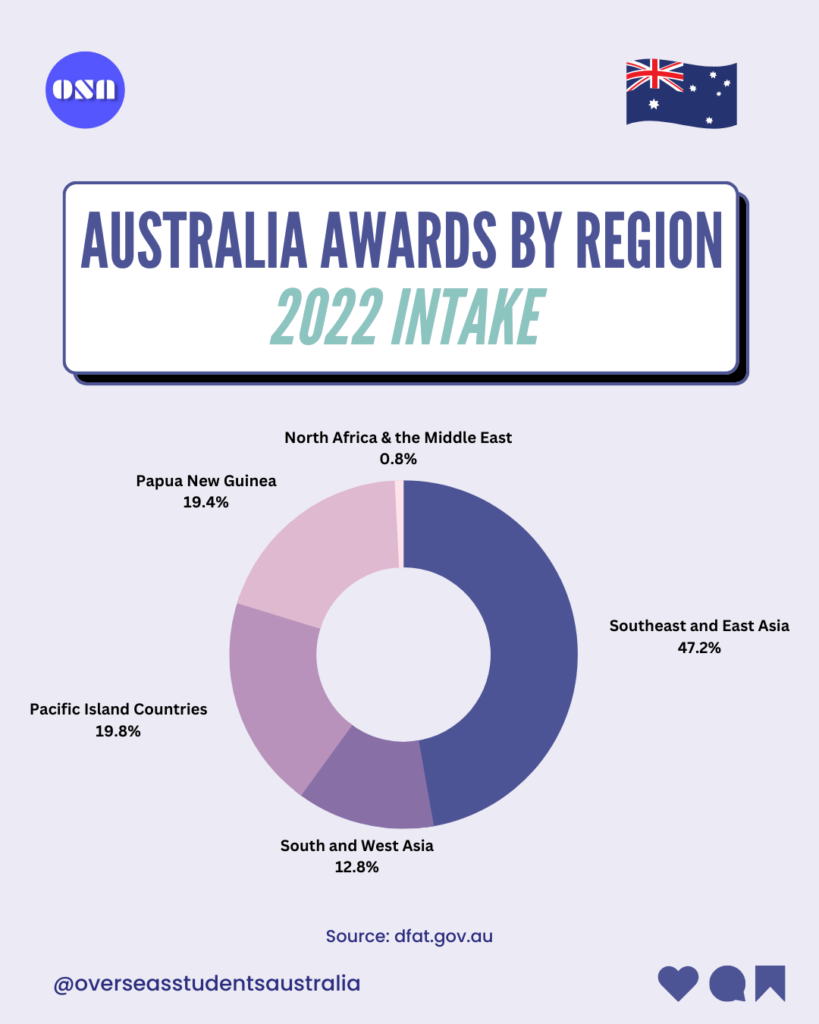
In 2025, Department of Foreign Affairs and Trade offered 1551 scholarships to students from 55 different countries.
The purpose of this scholarship is to help Australia’s partner countries to develop and promote growth and stability in the region.
Opening Date and Closing Date
The application for Australia Awards Scholarships usually opens around from Feb till April every year. The actual dates can vary based each year.
Applications for the year 2027 are open from 1 February 2026 09:00am AEDT to 30 April 2026 14:00pm AEST. If you are planning to get this scholarship, then you must apply between this timeframe.
Benefits
If you are awarded with Australia Awards scholarship, you can be receive the following benefits:
Full Tuition Fee
Return airfare expenses
Establishment expenses
Health Cover (Overseas Students Health Cover)
Introductory Academic Program
Living expenses contribution
Additional academic support
Pre-course English fees
Fieldwork costs (for research students)
Documents Required to Apply
You might be required to submit these documents when applying for an Australia Award scholarship:
Passport
Birth Certificate
CV or Resume
Reference letters
Academic transcripts
Copy of certificates
IELTS results (if available)
Plan to return home
Additional documents might be required by the Australian government in order to assess your application. The documents required can also vary for the each eligible country.
Selection process
The selection process for Australia Award scholarships is very competitive. Only eligible and shortlisted are contacted for this scholarship.
You will need to go through an interview as well if you get shortlisted.
The selection criteria are based on the three main aspects:
Your academic competence
Potential outcome for your home country after your studies
Professional and personal leadership attributes, including relevant work experience.
This handbook gives you all the information you need to apply this scholarship including participating institutions, the selection process, your entitlements, responsibilities and general ideas about the eligibility requirements.
After that, you will need to apply for this scholarship via OASIS portal (Online Australia Scholarships Information System) except for Indonesian and Philippines Students.
If you are a student from Indonesia, you need to apply here and if you are student from Philippines, you need to apply here.
Let’s talk about the students applying via the OASIS portal.
First, you will need to register online via the portal.
After registration, you will be issued a unique registration number, username and password in your email. It can take a few minutes for this email to arrive.
Once you log in after changing your temporary password, there will be a few questions to ascertain your eligibility for this scholarship.
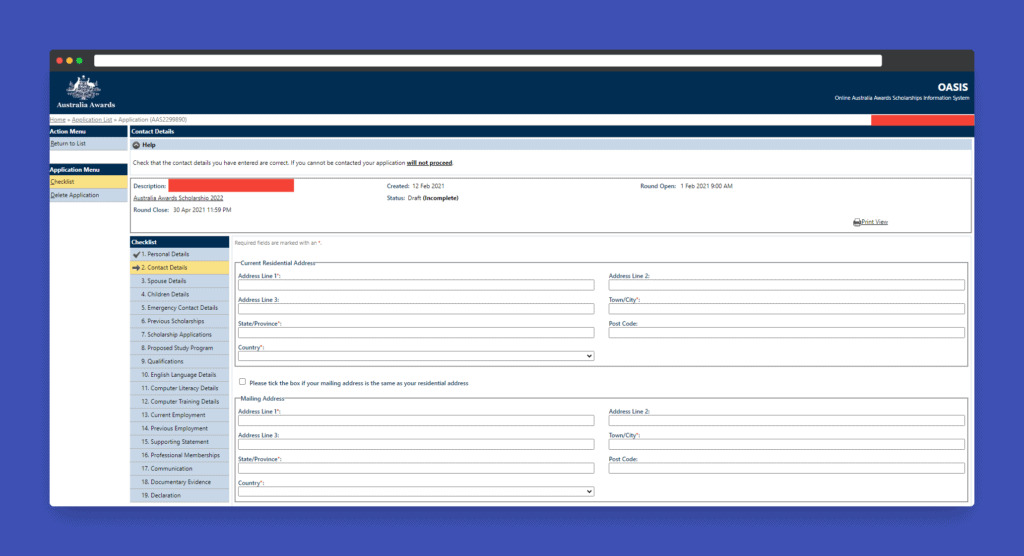
Then you need to start a new application for this scholarship and complete the details for all the parts of the application.
The sections of the application you will need to complete include:
Personal Details
Contact Details
Spouse Details (if applicable)
Children Details (if applicable)
Emergency Contact Details
Previous Scholarships
Proposed Study Program
Qualifications
English Language Details
Computer Literacy Details
Computer Training Details
Current Employment
Previous Employment
Supporting Statement
Professional Memberships
Communication
Documentary Evidence
Declaration
You will be required to submit all the supporting documents for your application via OASIS portal.
Note: You don’t need to complete the application immediately. You can save the draft and complete the application at a later stage. Although you must submit the application before the closing date.
Here are some tips that might help you in preparing your application:
As the selection process is very competitive, Ideally you should be spending time and efforts preparing your application.
Explain your motivation to study in Australia and your course selection.
Highlight your English language skills
Provide any relevant information for work experience
Show any leadership qualities
Challenges faced by your home country and how the study can help you make an impact in your professional area in your home country
Participating countries for this scholarship
Please note that each year the Australian government decides to choose various developing countries for this scholarship. The list of countries can vary each year.
If your home country is not on the list this year, please check back next year for that.
Alternatively, you can check other fully funded scholarships for international students here.
For the year 2027, students from these countries are eligible to apply for this scholarship:
These are the participating instutues for Australia Awards scholarship:
Adelaide University
Australian Catholic University
Aviation Australia
Bond University
Box Hill Institute of TAFE
Canberra Institute of Technology
Central Queensland University
Chisholm University of TAFE
Charles Darwin University
Charles Sturt University
Curtin University of Technology
Deakin University
Edith Cowan University
Federation University
Flinders University
Griffith University
Holmesglen Institute of TAFE
James Cook University
Kangan Batman Institute of TAFE
La Trobe University
Macquarie University
Monash University
Murdoch University
Northern Melbourne Institute of TAFE
Queensland University of Technology
RMIT University
Southern Cross University
Swinburne University of Technology
TAFE NSW
TAFE Queensland Brisbane
TAFE SA
The Australian National University
The University of Melbourne
The University of New England
The University of New South Wales (UNSW)
The University of Newcastle
The University of Queensland
The University of Sydney
The University of Western Australia
University of Ballarat
University of Canberra
University of Southern Queensland
University of the Sunshine Coast
University of Tasmania (including the Australian Maritime College)
University of Technology Sydney
University of Wollongong
Victoria University
Western Sydney University
William Angliss Institute of TAFE
Important Conditions
If you wish to apply and receive this scholarship, then you need to meet these important conditons:
You will need to sign a contract with the Commonwealth of Australia that you will meet the conditions of the scholarship.
You will be required to leave Australia for a minimum of 2 years after completing this scholarship.
If you fail to meet these conditions, then you will need to pay back the total cost of the scholarship back to the Australian government.
In order to get the complete picture of the scholarship, please check the policy handbook for the Australia Awards Scholarship here.
Are there any courses that I can’t study under this scholarship?
Yes, there are certain courses and areas that you can’t study under this scholarship, including:
Flying aircraft
Nuclear technology
Military training
Importantly, the study program you choose must be related to your country’s priority areas for development. Check the links above (in the participating countries) for your country.
Want to prepare a good application for your scholarship? Check all the 6 steps to make your application stand out by clicking here.
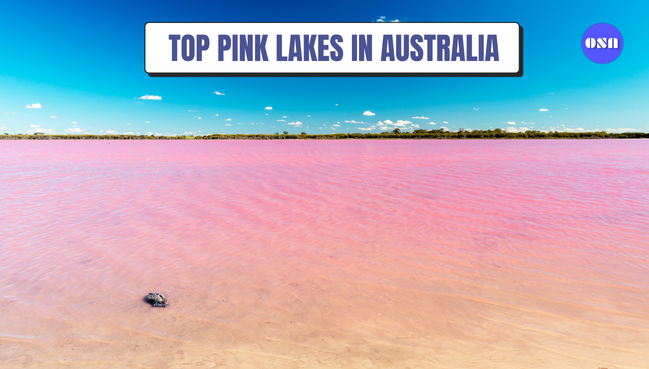
Australia is certainly a lucky country when it comes to Pink Lakes.
There are not one or two but more than 10 pink lakes that can be found here in Australia.
While, some of these lakes are very well known, others are not so much.
So in this article, we are revealing our Top 11 Pink Lakes in Australia.
Why is the Pink Lakes Pink?
Some of you might wonder why these lakes are pink in colour?
A genuine question.
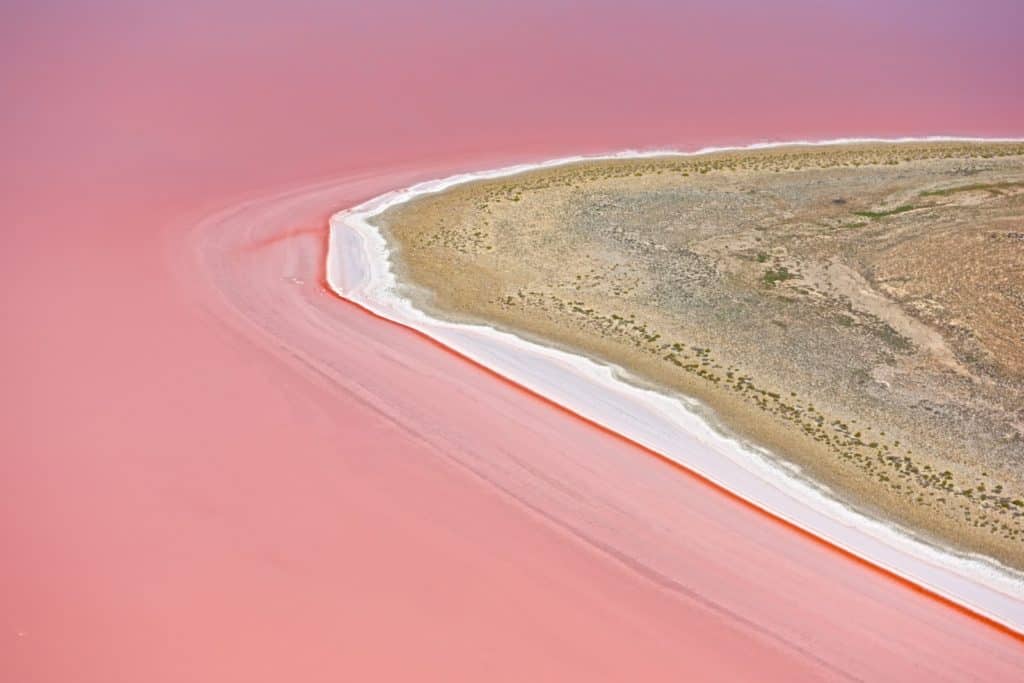
To explain it simply, this natural phenomenon occurs due to the type of algae (Dunaliella salina) and the type of bacteria (Salinibacter ruber) living in the saltwater.
When these three things (saltwater, algae and bacteria) combine, it gives a various shades of pink (from pastel to bubblegum).
If you want to have the best experience for your pink lake visit, then plan to visit it on clear sky day during 10 am to 3 pm while the sun is high in the sky.
Also, it is a very important to check the local conditions and other restrictions in place before visiting any pink lake. We suggest you check the local Parks website in the area you are planning to visit for more information.
Due to Covid-19 restrictions, we also suggest you check the local travel restrictions in each state and territory before deciding to travel to visit these pink lakes.
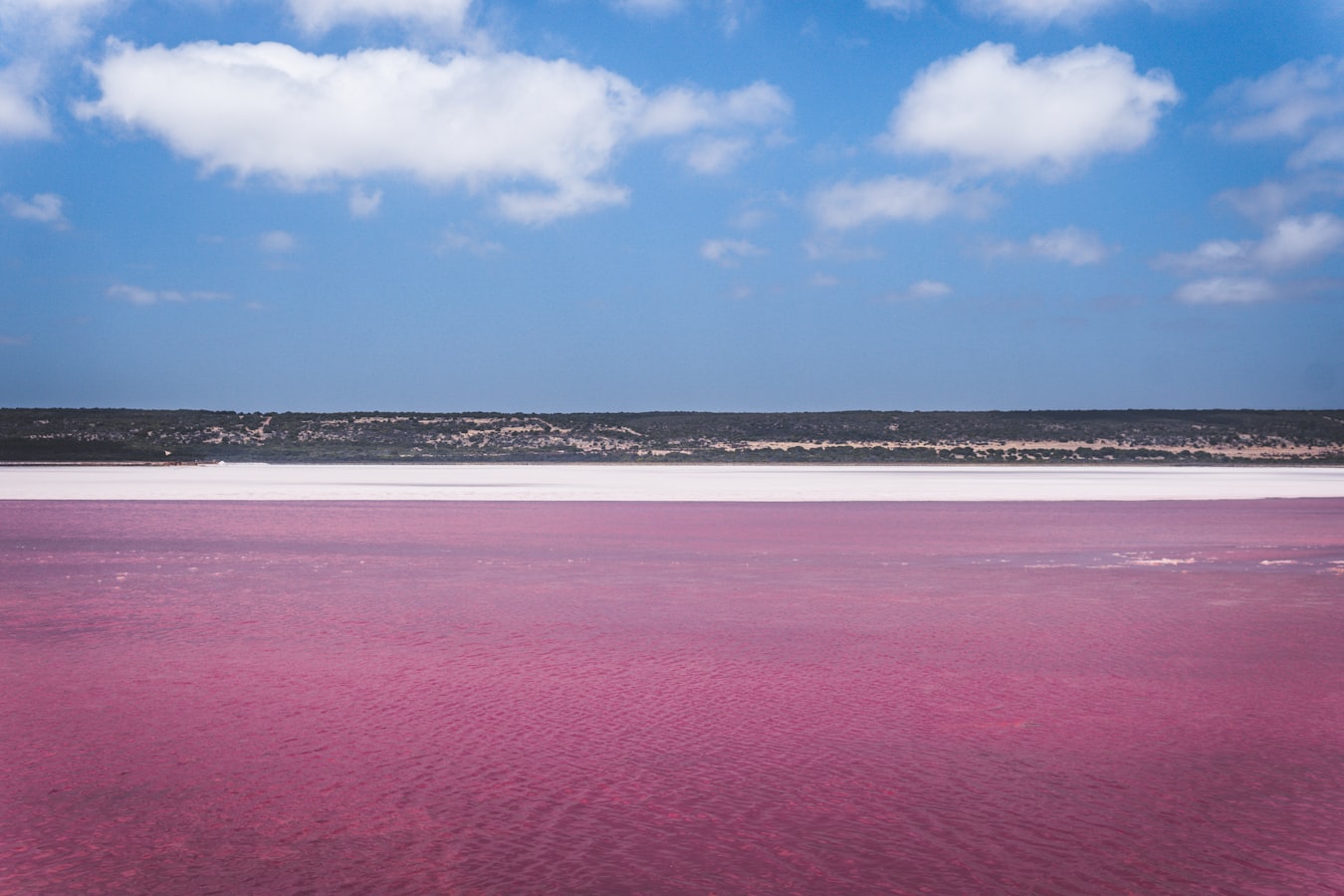
Lake Hillier is without a doubt the most popular and world-famous Pink lake. It stays pink throughout the year, so you can visit this lake throughout the year.
Unfortunately, it is also one of the most difficult pink lakes to access as well as it is located off the Western Australian coast, around 150 kms from the nearest town, Esperance.
🚗 How to get here: You can visit this lake by catching cruise boat (take around 2 hours) or scenic flight (take 1 hour 30 mins) altogether. Costs for boats starts from $300 and $425 for scenic flight.
📌 Nearest capital city: Perth
🕛Best time to visit: Anytime during the year
🚦 Access to the lake: Very difficult
2.Hutt Lagoon
The next most popular lake is also in Western Australia. It is located on Australia’s coral coast in Port Gregory and known as Hutt Lagoon.
🚗 How to get here: You can get here by driving around 5 to 6 hours from Perth. You can also take a scenic flight from Geraldton.
📌 Nearest capital city: Perth
🕛 Best time to visit: Anytime during the year but on a clear day (During middle of the day)
Lake Warden is another lake around Esperance area in Western Australia. It is located five mins away from other Pink Lake (Lake Spencer), which is no longer a Pink lake.
🚗 How to get here: Around 10 mins drive from the town centre of Esperance in Western Australia. To reach Esperance, it takes around 7 to 8 hours drive from Perth or 40 minutes flight from Perth Airport.
📌 Nearest capital city: Perth
🕛 Best time to visit: All year round
🚦 Access to the lake: Medium
4. Rottnest Island Salt Lake
Rottnest Island Pink Lake is located just off the coast of Perth and in the middle of the island itself. It’s not as glamorous as other lakes in Western Australia, but it certainly has its own vibe for sure.
🚗 How to get here: Once you are in Rottnest Island, you can cycle right close to the lake in Oliver Hill Battery.
📌 Nearest capital city: Perth
🕛 Best time to visit: Summer months
🚦 Access to the lake: Easy
5. Pink Lake in Quairading
Well, one more pink lake in Western Australia. But this one is not all pink throughout the year. The road divides this lake in the middle and, to the surprise of many, one side of the lake turns light pink while the other remain dark.
🚗 How to get here: It is around 2 hours drive from Perth.
📌 Nearest capital city: Perth
🕛 Best time to visit: Summer
🚦 Access to the lake: Medium
Pink lakes in Victoria
6. Westgate Park, Port Melbourne
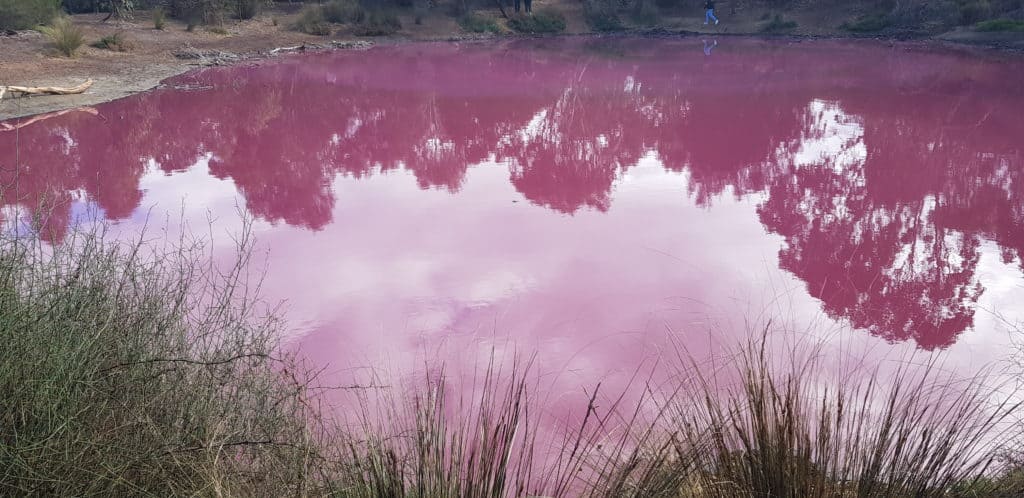
The easiest Pink Lake to access in Australia is only 15 mins from Melbourne CBD. Westgate Park lake in Port Melbourne has been turning pink since 2012-13 during the warmer months.
Please note during the colder months, this lake is not pink in colour.
🚗 How to get here: 15 to 20 mins drive from the downtown Melbourne. You can also catch a bus 235 or 606 to get to the Entrance of the park.
📌 Nearest capital city: Melbourne
🕛 Best time to visit: Summer Months (between December to March)
🚦 Access to the lake: Very Easy
7. Pink Lake, Dimboola
Victoria’s another popular lake is around 340 km north west of Melbourne. It is in Dimboola and the lake is known as Pink Lake. Interesting fact about this lake is that salt is still harvested by the company names Mount Zero Olive.
🚗 How to get here: It takes around 4 hours to get there from Melbourne by car.
📌 Nearest capital city: Melbourne
🕛 Best time to visit: Summer Months (During the day time)
🚦 Access to the lake: Medium
8. Lake Tyrell
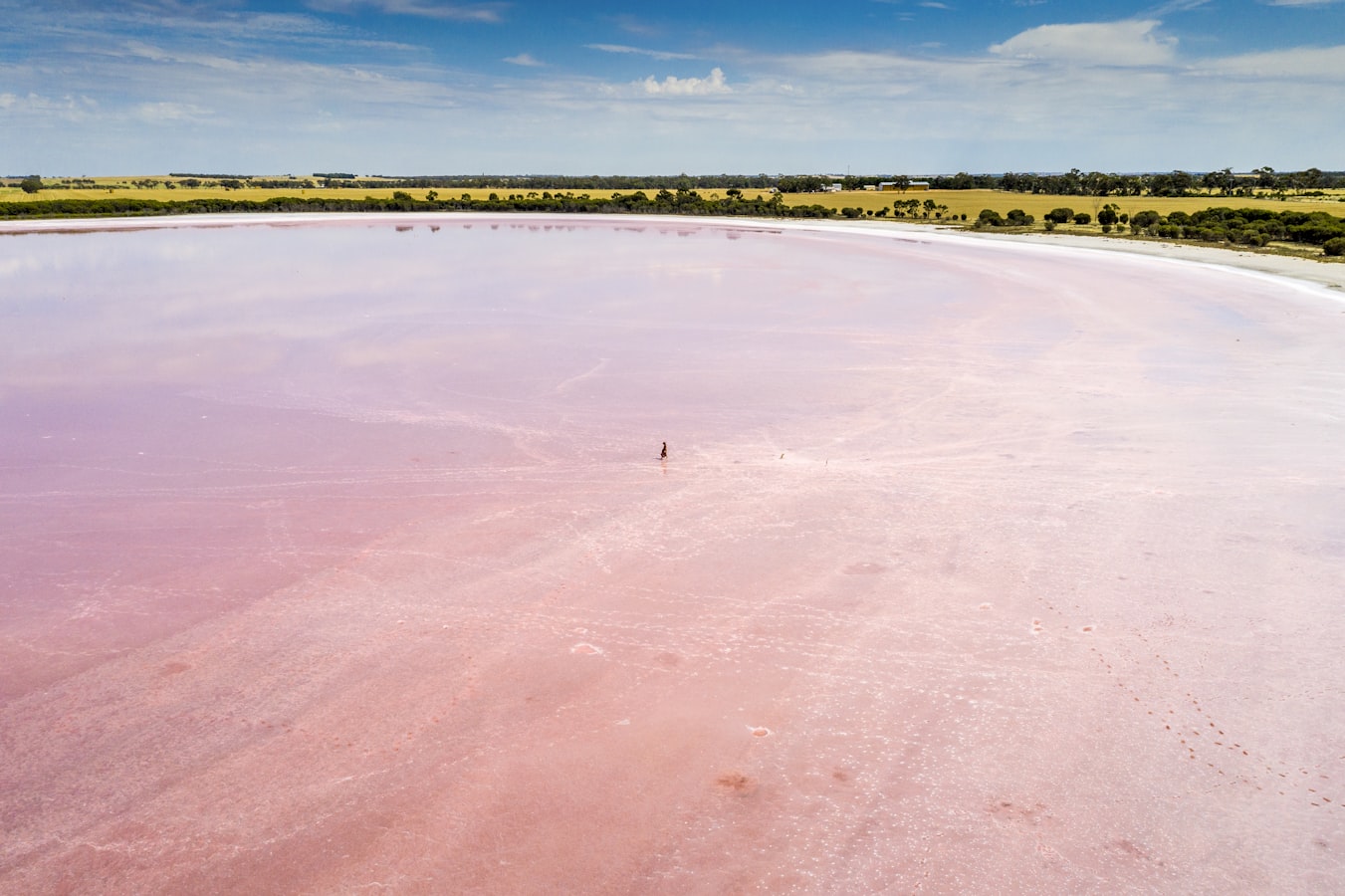
Lake Tyrell is the largest Salt Lake in Victoria. It covers more than 20,800 hectares and has history of more than 120,000 years old. Impressive! This light pink lake provides an amazing views of the sky reflections during sunsrise and sunset.
🚗 How to get here: The lake is in the Mallee region and takes 5 hours to get there from Melbourne.
📌 Nearest capital city: Melbourne
🕛 Best time to visit: Sunrise and Sunset (preferable during summer months)
🚦 Access to the lake: Difficult
9 to 12. Murray-Sunset National Park Lakes
Image Courtesy: Tourism Australia / Time-out Australia
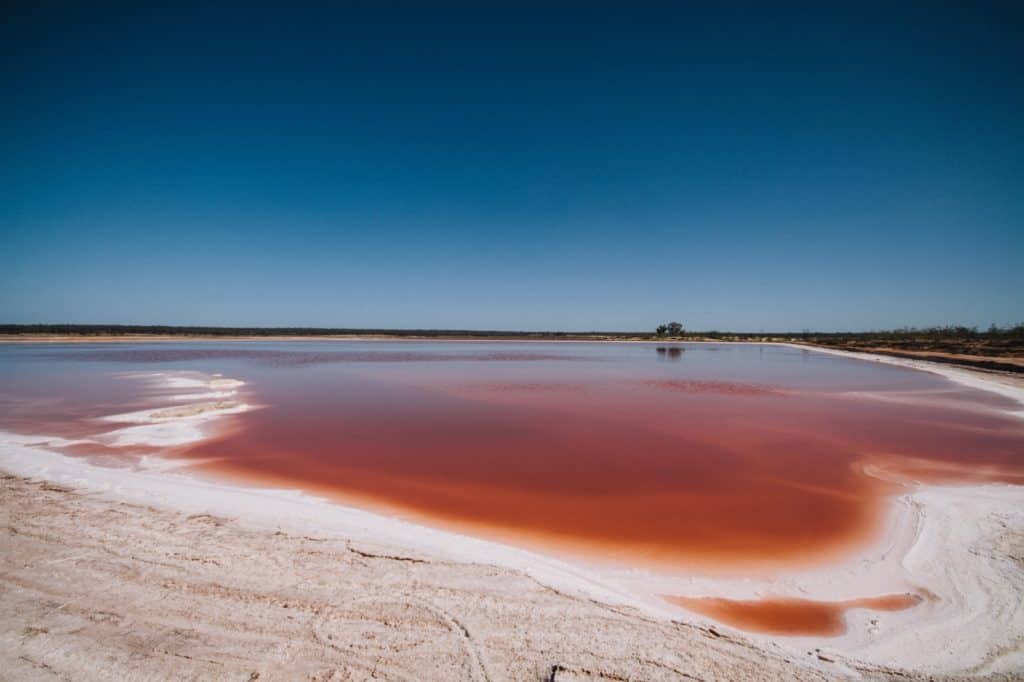
50 kms from Mildura, Murray-Sunset National Park have got not 1 but 4 pink lakes. These are:
Lake Crosbie
Lake Kenyon
Lake Becking
Lake Hardy
You can also camp at Lake Crosbie or Lake Becking. Although Murray-Sunset National Park is located in Victoria, it is actually closer to South Australian capital, Adelaide than Melbourne.
You can get further information and updates about these lakes on Parks Victoria’s website.
🚗 How to get here: You can get here driving from Adelaide for 4 hours or 5 and half hours from Melbourne.
📌 Nearest capital city: Adelaide
🕛 Best time to visit: Autumn and Winter Months (between April to August)
Lake Macdonnell is a very unique lake as one side of the causeway is pink in colour and the other side is green. It is close to the Nullarbor Plain and around 15 km south of Penong on the Eyre Peninsula.
🚗 How to get here: The lake is located around 850 kms from Adelaide and takes around good 9 to 10 hours drive. You can also fly into
📌 Nearest capital city: Adelaide
🕛 Best time to visit: May to September
🚦 Access to the lake: Medium
14. Lake Bumbunga
Located 130 kms from Adelaide city, Lake Bumbunga is one of the easiest pink lakes to get to (can’t beat Westgate Park Lake though). Lake Bumbunga is famous for its changing colour throughout the year from pink to white to blue depending on the time of the year.
🚗 How to get here: It is only around couple of hours drive from Adelaide
Lake Hart is perfect lake to see during the day and night with pastel pink reflections. It might be further out with more than 500km drive from Adelaide but it is certainly worth the effort.
You can also see the glimpse of this pink beauty from The Ghan (Luxury train travel between Adelaide to Darwin).
🚗 How to get here: To reach here by car from Adelaide, it will take around 5 to 6 hours.
📌 Nearest capital city: Adelaide
🕛 Best time to visit: All year round
🚦 Access to the lake: Medium
16. Lake Eyre
Image Courtesy: Grant Hunt Photography
Lake Eyre is the Australia’s largest salt lake. It is located 650 kms north of Adelaide. It is interesting to know that the lakes gets filled with 1.5 metre flood every 3 years and 4 metres floods every 10 years.
It costs around $11 for your vehicle entry fee in the Kati Thanda-Lake Eyre National Park.
It is also important to note that there is no mobile phone coverage in the park.
🚗 How to get here: It is around 8 hour drive from the nearest capital city, Adelaide. You can also take a plan ride from Adelaide to outback town Coober Pedy and then take another tour over the lake with local flight tour operators.
📌 Nearest capital city: Adelaide
🕛 Best time to visit: April to October
🚦 Access to the lake: Very difficult
17. Lake Albert
Lake Albert is a freshwater lake near Murray river in South Australia. The area serves as the gateway to the Coorong National Park.
🚗 How to get here: It is around 2 hours drive south east from Adelaide.
📌 Nearest capital city: Adelaide
🕛 Best time to visit: Varies based on rainfall during the year
🚦 Access to the lake: Easy
Let us know which pink lake would you like to visit in the comment section below.