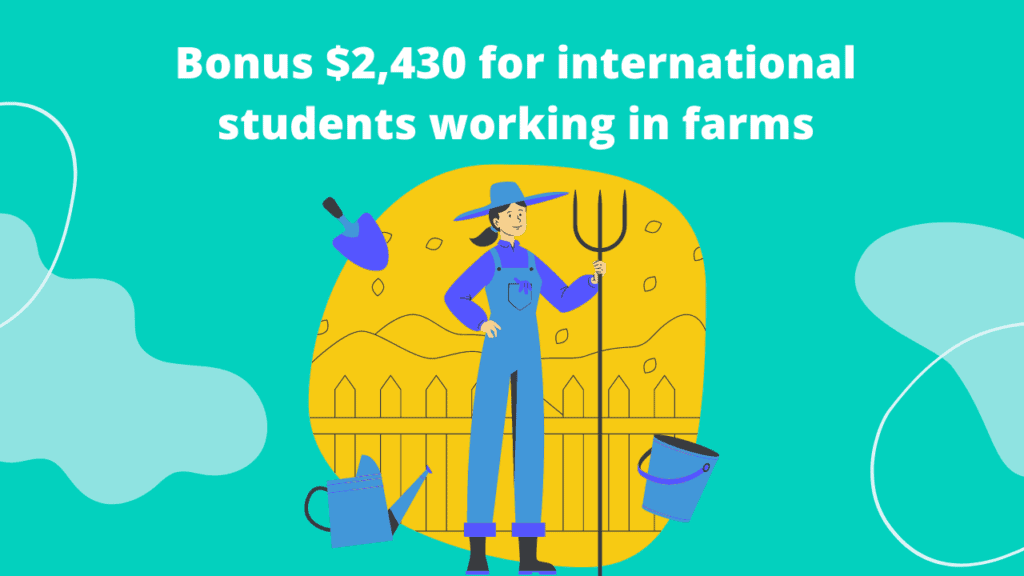
International students looking to work in the farms or agriculture industry can be eligible for a total of up to $2,430 bonus cash payments.
In this article, we are covering information on what exactly this $2,430 bonus is and how international students can get this bonus.
What is this $2430 bonus?
Victorian government is giving bonus to work in the local farms.
Basically, shortage of farm workers in Victoria and across Australia due to border restrictions.
Usually, workers from Pacific Islands and backpackers do this farm work.
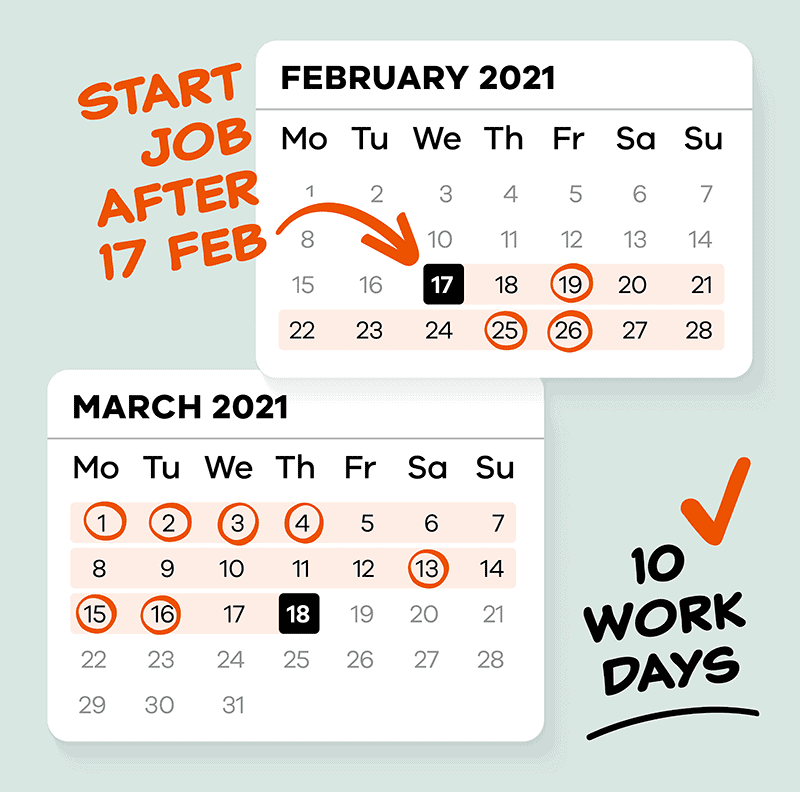
Job seekers who take up a seasonal harvest job on a Victorian farm on or after Wednesday 17 February 2021 can apply for a Seasonal Harvest Sign-on Bonus.
The $2,430 bonus is paid in two instalments:
First Bonus: $810, after 10 days’ work within a 30-day period
Second Bonus: $1,620, after an additional 30 days’ work within a 90-day period
Source: Victorian Government
International students can work more than 40 hours per fortnight if they are working in farming/agriculture industry.
Especially if your classes are running online, then you should consider this opportunity to score extra bonus on top of your salary.
It is definitely not an easy work as it requires physical efforts but nearly $300 per week for 8 weeks of work on top of your salary is a pretty sweet deal.
More information on the seasonal bonus can be found here.
Job duties in farms
Some of the common job duties in the farms includes:
fruit picking in the field
packing & preparing the fruit in sheds
pruning and thinning fruit trees
driving forklifts, tractors, and other machinery.
Minimum Wage
In the farming sector, you can earn an hourly wage or a piecework rate. It is based on Horticulture Award
Hourly wage
$19.84 for an adult full-time employee
$24.80 for an adult casual employee.
Piecework rate
It is based on the amount you have picked, packed, pruned or made.
This rate has to allow the ‘average competent employee’ to earn at least 15 per cent more per hour than the relevant minimum hourly rate
Eligibility for this bonus
To be eligible for the bonus you must:
have work rights in Australia
be working on a farm that produces fruit, dried fruit, vegetables, olives, nuts or wine grapes
be working on-farm in picking, packing and harvesting activities, including operating harvest machinery
start work on a Victorian farm on or after 17 February 2021
not be employed under the Pacific Labour Scheme or Seasonal Worker Programme.
What do you need to apply?
These are some of the documents required to apply for this sign-in bonus
Payslips
Timesheets
Name and contact details of your employer
The addresses of the farm sites you worked at.
How to get a harvest Job?
You can register your interest to work in the farms here.
Victorian government has a dedicated website to find work in local farms.
You will also get free training to understand the nature of work on the farms. Most of this training is done online.
On top of victorian government bonus, there is additional assistance available if you are moving to work in the remote farming industry.
Relocation assistance will be available for people to move and take up jobs in agriculture, including harvest work. This financial assistance can help you cover your costs of travel and accommodation expenses.
The eligible international job seekers including international students can claim a reimbursement of up to $2,000.
To search harvest trail work, check this government website.
Eligibility
To eligible for relocation assistance, you must:
be at least 18 years of age
relocate within Australia to a regional, remote or Harvest Area
take up a short-term agricultural work including harvest work placements through a HTS provider
work for at least 6 weeks and at least 120 hours in agricultural work.
For more information on this relocation package, check the Australian government website here.
If you are looking for work in Australia, then we suggest you check our guide on finding work here.
Finding a job as an international student in Australia is never an easy task.
Whether it’s your first part-time job or a job after your graduation.
So in this article, we are going to give you top 9 tips on how to get a professional job after graduation in Australia.
1. Prepare your Resume and Cover Letter
It goes without saying that Resume and Cover Letter are the most important documents in your job applications.
And obviously your resume and cover letter has to be top notch in order to have any chance of scoring a job in Australia.
There are some key things you need to keep in mind when writing your Resume or Cover Letter.
If you don’t know how to write your resume or cover letter, we’ve got plenty of information regarding that on our website.
We also got a free resume and cover letter template as well. You can download and customise it as per your needs.
2. Be ready to fail
Now you might be wondering why are we talking about failing.
Well it’s very important for you to be psychologically prepared when applying for jobs and be rejected. It is quite certain that you might not be able to score your professional job straight away after graduation.
So here to illustrate this better, here is an example of a friend of mine. He finished his Bachelor’s Degree in IT and although he applied for many jobs he was getting tons of rejections in most of them.
It wasn’t until year and a half after completing his graduation he managed to score a job. While in this year and a half he did his best to make sure that he was learning, updating and being mentally ready and prepared to go out every single time and look for job.
Once he scored his first professional job, his career really had a great boost and now he’s earning six figure salary and very successful in his career.
So this tip is a very critical for you that you must be able to persist these rejections and failures.
It can be a frustrating journey but you have to continue to persevere.
3. Work on your soft skills
So you already have completed your graduation and have got some skills and knowledge for your industry. But, it’s equally important for you to have these soft skills which includes things like:
communication
teamwork
leadership
critical thinking
decision making
and many more
The company’s recruiters understand that you may not have that much knowledge or work experience as a fresh graduate but they surely want to see that if you have some soft skills that you can bring to the table when you applying for the very first professional job.
There are plenty of free courses available that you can take in order to improve your communication skills and other soft skills.
It will be even better if you can improve these soft skills while you are still studying.
So when choosing a university, make sure to ask if they have any programs for students that can be helpful for the employment in Australia.
4. Grow your Network
It is a fact that many jobs in Australia don’t even get advertised and as many of them come through the referrals or through the network of existing employees.
Basically if you know someone in the company, you have a very good chance to score a job in that business as long as you meet the criteria and you have the skills and knowledge to do it.
So, it’s important for you to start looking at how you can grow your network. You can certainly attend some networking events that are organised by your university or institute.
We highly recommend you that you should print out your own business cards especially after your graduation and go and attend these networking events and try to build a relationship with the people coming to those events.
It certainly take a while to get used to these networking events but once you get used to it, it can help you to grow your network.
5. Polish up your social accounts
Apart from the networking sessions, it’s important that you have a strong online presence as well.
Majority of the the recruiters these days look up to your social media accounts. One of the most popular social media network when it comes to professionals is Linkedin and having a Linkedin account for any graduate is a must.
If you already have a LinkedIn account, then you should definitely look at polishing it up. Many students have ended up getting jobs through LinkedIn.
Apart from LInkedIn, other social media accounts which includes facebook and instagram or other accounts, you need to be very careful in what you are putting on those accounts as well.
As recruiters might end up finding you through those social media accounts and if you got some personal content that you think you shouldn’t be there then we highly recommend you to tidy it up.
6. Be a volunteer
It’s always good idea to help people. We don’t suggest you to do volunteering only for the sake of getting a job.
But if you can get some volunteer experience that can be a great thing for your career. There are specific platforms available for finding volunteering positions in Australia and most of the charity organisations (like Salvation Army, Vinnies, Red Cross) look for some volunteers all year round.
So you should try to reach out to these organisations or you can check a platform like Go volunteer or Seek volunteer.
7. Find an internship
Internships can be paid or sometimes unpaid as well.
Before completing your degree, you should try to reach out to your university to see if they have any internship opportunities available for the graduates.
Sometimes there are opportunities available for graduates in companies that have partnership with your universities. So the first step is to find those opportunities if they are available.
If not, then many businesses in Australia post their internship opportunities on their websites. You need to keep an eye out on any internship opportunities available in your industry. Check on Seek and company websites for these opportunities.
If you like some specific organisation, then reach out to them to see if they have any internship opportunities. There is no harm in trying.
Once you do end up getting an internship opportunity, try to make the best use out of it. So that you might end up getting you a full-time position.
As there are chances that some of these organisations will actually hire their own interns after their completion of internship.
8. Contact recruitment agencies
There is a reason why the recruitment agency services exist.
Sometimes you have to reach out to these agencies in order to help you score a professional job. They can certainly help you to touch up your resume, your cover letter and get you ready for these job interviews as well.
Usually these are paid services and you may have to invest some money in this. There are plenty of recruitment agencies in Australia in order to get you a professional job like:
Michael Page
Hudson
Addeco
You might not need these recruitment agency services if you already scored the job before that but it’s something to consider as well.
9. Be innovative and creative
You will be competing against thousands of other graduates for the same job you’re applying for.
So it’s important to standout from the crowd and be innovative and creative when you’re applying for the jobs.
So let’s take an example here, let’s say you are working in a restaurant and you have just completed your Master’s degree in marketing.
You can actually help out the restaurant you work in by setting up their digital marketing, social media accounts, marketing campaigns etc. This can help you and your career in long run.
Remember, it’s not only about taking but giving as well.
Think from other person’s perspective who’s probably going to hire you. So you might have to go out of your way in order to help some businesses and that can certainly boost up your career.
The mantra here is “Think out of the box”
Source: unknown
If you can provide some value to some other businesses or individuals or may be sending your resume in a different way than most of the other candidates might do.
So these were some tips we wanted to discuss with you in regards to finding a job after your graduation in Australia. Let us know in the comments if you find any specific tip useful or you might have some other tips to share.
If you are planning to work with Uber Eats or other delivery or ride sharing platform, then you might get asked to get a VEVO check or right to work check completed.
So in this article, we are giving you a guide about VEVO or right to work check.
What is VEVO?
VEVO stands for Visa Entitlement Verification Online.
VEVO is an online tool provided by the Department of Home Affairs to verify the visa holders’ visa conditions.
This tool can give you details about:
Type of visa granted
Visa grants date
Visa expiry date
Period of stay (how long a visa holder can stay)
Visa conditions (what the visa holder can and can’t do)
It is important to note that VEVO is current only at the time it is conducted and should only be considered valid when accessed directly through the VEVO system.
Who can access VEVO?
VEVO details can be accessed any of the following individual or organisation:
Visa holder
Employer
Education institute
Other government agencies
When you can use it?
You might also be wandering when do you actually need to use this. Most of the time, it can be used when:
signing up to work with ride-sharing of food delivery platforms like Uber Eats
looking for a job and your employer wants to confirm your visa conditions
looking for a rental property and your landlord or real estate agent wants to check your period of stay in Australia
How to check the VEVO for Uber Eats and other delivery platforms?
There are 2 ways to get your VEVO check done for Uber Eats and other delivery platforms.
First Method using private agencies
Some businesses may require people to get the VEVO check done through the private agency they work with.
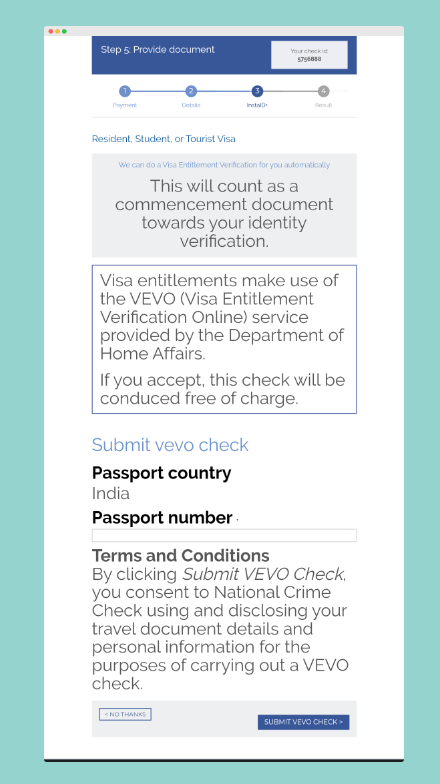
For example, if you are planning to deliver with Uber Eats, then you can get VEVO check done while completing your Background check application.
They use National Crime Check (NCC) as their background check partner. You can use the services of NCC for your VEVO Check. It costs won’t cost you anything so if you are planning to work with Uber Eats or other delivery or ride sharing platforms, then it makes sense to get the VEVO check done through NCC.
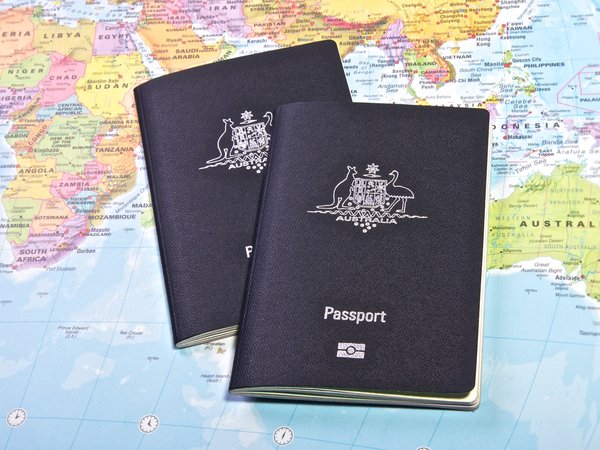
All you need to provide for this is your Passport details like your Passport country and Passport number (check the image below) and upload the photo of your Passport while completing your background check.
That’s all.
Second method using the Department of Home Affairs website
In order to check your VEVO as a visa holder from the Department of Home Affairs website, you will need to have an access to:
Passport
and any one of the following:
Transaction Reference Number (TRN)
Visa Evidence Number
Visa Grant Number
Password
Step 1: Go to Immigration website for VEVO Check here.
Step 2: Select the type of document and press submit
Step 3: In the next step, enter the following details:
Reference type
Reference number based on the reference type
Date of birth
Document number
Country of document
Agree to the terms and conditions
Press Submit
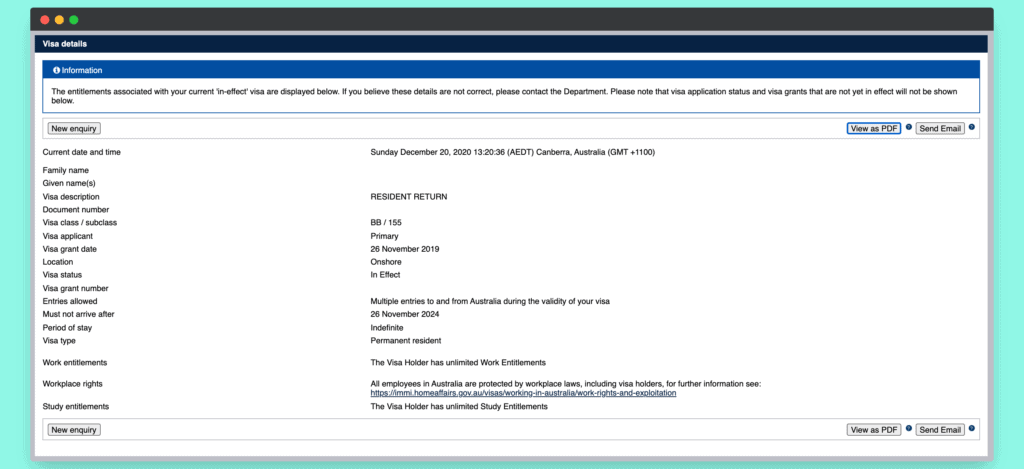
After submitting the details, you will get the VEVO details on the website something like this:
You can down this information as a PDF or you can also send it via email.
You can also check the VEVO details
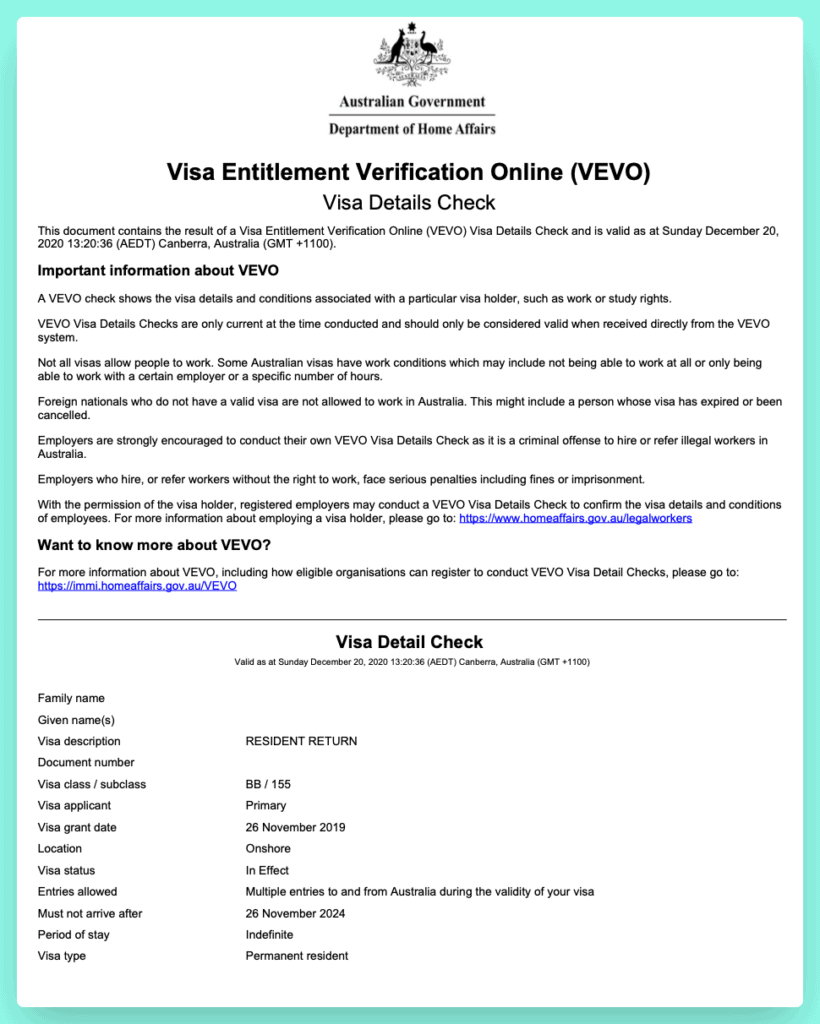
Example of VEVO Letter
Here is how the VEVO letter that you download from immigration website will look like.
Do everyone need to do a VEVO Check in Australia?
In short, the answer is No!. Not everyone needs to do a VEVO Check in Australia.
If you are a visa holder in Australia and have got your visa after 1990, then you will have access to VEVO. You will not have a VEVO access if you are:
an Australian citizen
migrated to Australia before 1990 and never travelled outside Australia
If you migrated to Australia before 1990 , you can request an electronic visa registration.
It is important to note that Australian and New Zealand citizens won’t need to do the VEVO check as long as they can prove their respective citizenship with documents like an Australian or New Zealand passport, Australian birth or citizenship certificate.
Well, we hope you find the information useful and handy on the VEVO check. Please share this article with someone else who might find this information useful.
So you are applying for the jobs in Australia but you’re not getting any response back or getting a rejections in all the job applications.
You might be wondering what are you doing wrong in your job applications that you are not getting a job here.
We went and did some research and we found there are 7 main reasons you are not getting a job in Australia as an international student.
In this article, we are going to talk about all these seven reasons and how to address them as well.
1. Poor Resume
📃
One of the first reason we identified that the students are not getting a job is because of poor resumes.
Resume is the most important part of your job application in Australia and you could be doing some of the mistakes in your resume that you probably are not aware about.
Some of the common mistakes that international students make in their resume includes:
Not following the correct format
Australian style resume could be really different then the resume is used in your home country. In Australia, we don’t include some of the personal information in our resume like:
Date of birth
Gender
Religion
Race
Photo
It is vital that you follow Australian style resume when you’re applying your jobs here and making sure that your resume looks professional all times.
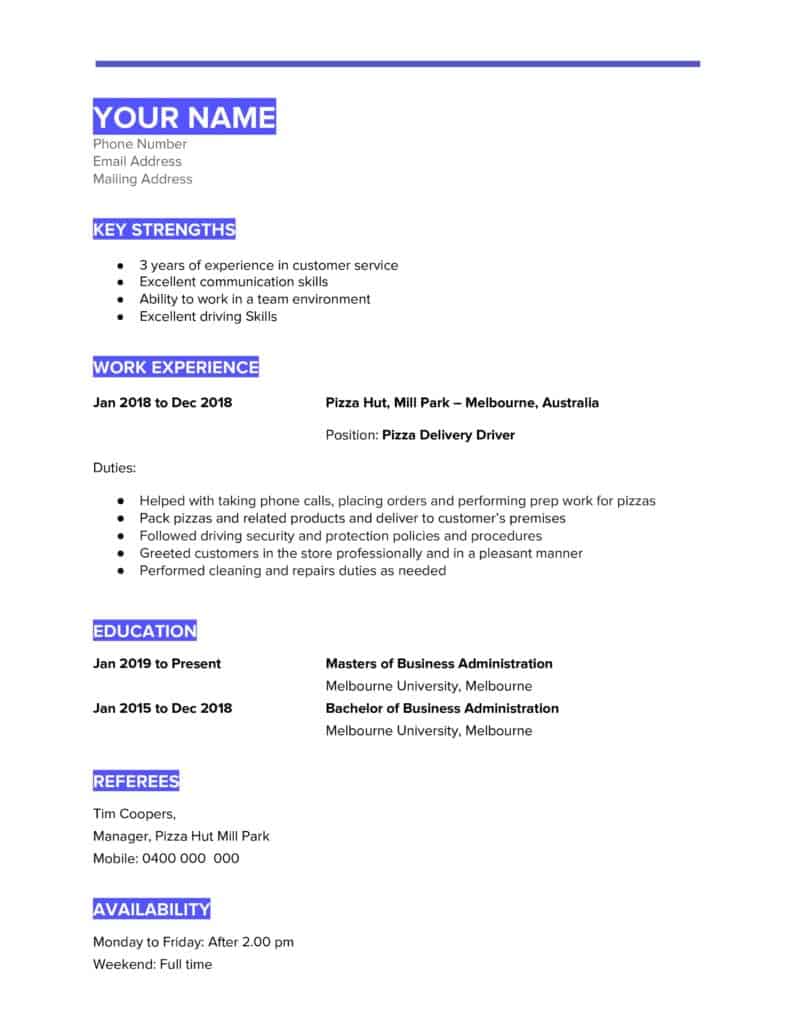
Generally, an Australian style resume will follow this pattern:
Contact details
Key Strengths
Work expereince
Education
References
Skills
Availability
Australian Resume Template Sample
But it can vary a bit based on the whether you are applying for a part-time, casual or a full-time job.
You can download a free resume template here and see how it looks likes. You can and should customise this resume for your job applications here.
We also got this quick video on how to write an Australian style resume for part time and casual jobs in Australia.
Same generic resume to all the job applications
It is very tempting and easy to send the same resume again and again because let’s be honest it saves you heaps of time.
But in reality if you customize your resume before sending it for your job application, you actually have a higher chance of getting an interview rather than sending a same generic sort of resume.
In order to address this situation, all you need to do is make sure that you customise your resume for every job application.
So let’s say if you’re applying for a job in McDonald’s or supermarket or for a job role in reception area, the resume should look different for job application.
Spelling errors and grammar mistakes
Another mistake that a lot of students make in the resume is not checking the spelling errors and grammar.
We completely understand that English might not be your first language but sending a resume which has lots of spelling errors and mistakes doesn’t help you cause of getting a job.
To address this situation, if you’re not confident about your grammar and English then we suggest you to get someone else to have a look at it before you submit it.
So get someone else to proofread your resume before you send it for your job application. You can get support from your institute or student bodies. Some government agencies like Gold Coast Student Hub also can help you to check your resume.
Unprofessional email address
Believe it or not but your unprofessional email address like ([email protected]) does not impress your prospective employer.
Now think about it for a moment, if your resume looks really great and the recruiter is really impressed with your resume and work experience and they’re about to send you an email and if your email address does not look professional it might put them off.
So you could lose a job opportunity just because of your email address. You certainly don’t want that happen to you.
So make sure that your email address looks professional. It is very easy and free to get yourself a new email address if you don’t have one that looks professional like ([email protected]).
2. Poor communication skills
💬
Although, there is no official language in Australia. English is most commonly spoken language.
But we do understand that your English may not be up to scratch when you come here for the first time. Apart from English language, other reason could be understanding the Australian accent.
Obviously, Australians love to use their slang and they like to shorten everything they say.
To address your communication problems, it is recommended not to hang out too much with your own community when you are here.
We’re not saying that you should completely disconnect from your own community but try to maybe find a accommodation where you can stay with the people from other countries or cultures.
In that way, you won’t have any option other speaking English with them and you will be forced to learn the lanaguge.
Another way to address this situation is by watching English TV shows or English movies and making sure you are watching them without captions.
Other ways to improve English includes reading newspapers, reading information online, reading books.
Also, we suggest you to go out meet as many people as you can so that will not only increase your network but it will also help you to improve your communication skills.
If you want to learn some Australian slang we’ve got you covered in this video:
3. Lack of local work experience
💼
You might be applying different sort of job roles in Australia but if you don’t have any work experience at all and you haven’t included that in your resume then it can be very difficult for you to get a job in Australia.
Lot of employers actually prefer if you have a local work experience in your resume.
To address this, we suggest you to look for some volunteer opportunities around your work areas if you don’t have any work experience.
There are many volunteer organisations that always look for some volunteers to help the community with various tasks.
Even though it’s not a paid job, you still get some work experience that you can include in your resume
Volunteering, not only helps you to get a work experience but it also helps to improve your overall personality.
You can also learn other soft skills like teamwork, communication, organising, management and other interpersonal skills. So we highly recommend you to do that in order to address this lack of work experience in your resume.
4. Lack of references
🤝
As mentioned in the first point earlier, you need to include some work references in your resume and if you have no work experience it becomes really difficult for you to first of all get any sort of work references.
To address this situation, we suggest ask your teachers or professors or lecturers if they can become your reference for your work.
If you can show to your lecturers or tutors that you are a good student more likely they are going to give you a reference.
So make sure to have a good relationship with your tutor trainer and demonstrate or show that you are a good student.
Again, volunteering can help here again, if you work with specific supervisors or managers, then they can become your referee’s.
We do not suggest you to include any fake work experience or any fake work references in your resume.
5. No Cover Letter
📄
Part of the job application usually will require you to send a cover letter along with our resume.
If you’re not sending any cover letter at all then that could be the reason you are not getting a job in Australia or
The other reason could be that you are sending a same generic cover letter for all your job applications.
To address this, we suggest sending a customised cover letter for your job applications.
If you customise your cover letter along with your resume, then you have a high chance of getting a job interview than the other job applicants.
Even if the job application does not require you to submit a cover letter, we actually suggest that you send a cover letter with your resume.
The main reason for this is that many other job applicants will not be sending their cover letter so if you do send your cover letter, you actually have a better probability of scoring that job
If you don’t know how to write a good cover letter, we got a free template for an Australian style cover letter here.
Please customise your cover letter before you send it to any employer basically every job you apply you need to customize your cover letter and your resume as well.
If you want a guide on how to write a good cover letter, then we suggest you watch this quick video:
6. Lack of networking
🌏
Most of the jobs these days are advertised online and you are required to apply for them online as well.
But that doesn’t mean that you should not go out and meet people and do networking with our peers and professionals in your industry.
One of the common reason for international students not getting a job is because they are not going out and meeting the people and creating their network within Australian community.
Networking is still one of the most popular way of scoring a job in Australia. It might be surprise for some of you that 70% of the jobs are never advertised as people get hired due to references or their network.
To address this situation, we suggest you to join some student associations, english speaking clubs, sports clubs, industry bodies or other organisations.
These clubs and organizations usually organise events every week or monthly. So make sure you attend these events and network with the like minded people.
Also make sure to check the calendar of activities that your college, Institute or university is planning for the next few weeks.
Especially if you don’t have any other job to do, we highly recommend you to attend as many networking sessions as you can.
There are many apps like Eventbrite, Meetup where you can find local events happening around your area.
We highly recommend you to join some Facebook groups in your local city or community and be part of their Facebook group and attend some of the events that these Facebook groups organise.
Again, volunteering is one of the other way to network with people from all walks of life.
Networking is one of the most important way you can score a job here in Australia. So don’t hide behind the closed doors, don’t be shy, go out and meet people.
7. Lack of availability
⏰
The last reason is the lack of availability especially if you are applying for a part-time jobs in Australia.
In your resume, you will usually need to include availability.
So let’s say you’re looking for a job in a hospitality industry, if you are not giving enough availability during the weekends or during the evenings to the employers, then that could be the reason why you’re not getting a job here in Australia.
You might be wondering how on earth I have no availability if I don’t have any job at all.
As per your study schedule, you will have to study for around 20 hours per week here in Australia on a student visa.
And some time a timetable from your Institute or University spreads out on 4 to 5 days or it spreads out in the evenings that can certainly affect your availability to work.
To address this situation, many institutes and universities give you a chance to choose your own timetable when you start studying here.
So the ideal way to handle this situation is to choose your timetable nice and early because usually there are very limited time slots available in each classroom.
So instead of studying over 4 to 5 days you can choose a time table where you can finish all your classes in 1 to 2 days and then you can provide an additional availability to your employers.
Well these are the 7 main reasons why you as an international student might not be getting a job in Australia and we hope the strategies can help you to fix these issues.
But it’s still good idea to know how much money you might earn after completing a certain degree or qualification.
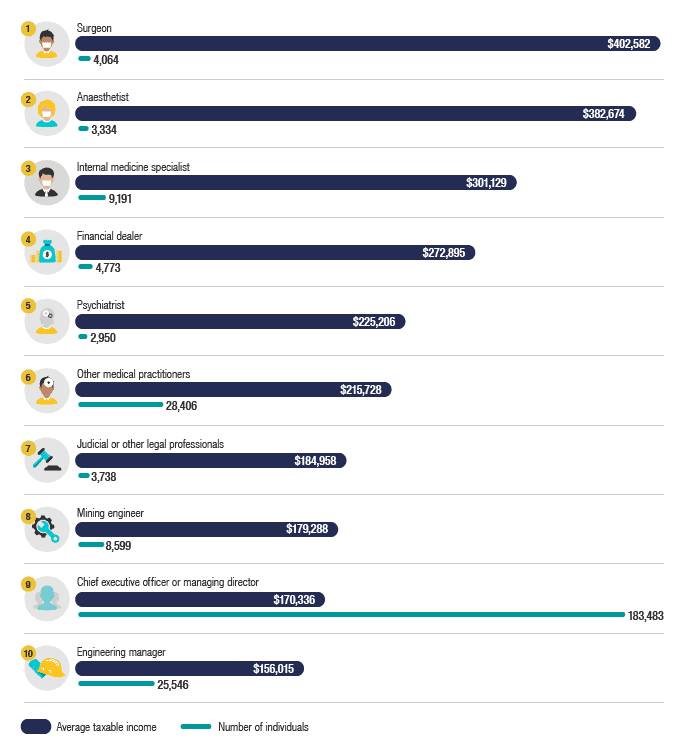
The Australian Tax Office (ATO) recently revealed statistics for the highest-paid jobs in Australia based on their average taxable income.
In this guide, we are going to talk about Australia’s top 10 highest paying job in 2020.
It’s important to note that these top 10 jobs are based on average taxable income which means it’s based on average and people might be earning more or less depending upon their skills and experience in the industry.
10. Engineering manager
📄 Field – Engeering
💪🏼 What they do – Engineering Managers are responsible for planning, organising, controlling and coordinating the engineering and technical operations of the business.
💼 Number of professionals working – 25,546
💵 Average Pay – $156,015
📈 Future Growth – Strong
🎓 Qualifications required – Engineering managers will need a bachelor or postgraduate degree in a relevant engineering field. Some engineers might a Certificate or Diploma qualifications as well.
9. Chief executive officer or managing director
📄 Field – Business/ Management
💪🏼 What they do – Chief Executives and Managing Directors are responsible for determining , creating and reviewing the business strategies, policies and programs. They also provide the overall direction and management to the business.
💼 Number of professionals working – 183,483
💵 Average Pay – $170,336
📈 Future Growth – Stable
🎓 Qualifications required – To become a CEO or a managing director, there is no specific need for a formal qualification. But a bachelor’s or masters degree in accounting, business and management field can be highly regarded.
8. Mining engineer
📄 Field – Engineering
💪🏼 What they do – Mining is a huge industry in Australia. The typical role of a mining engineer includes planning, coordinating and directing the extraction of minerals, petroleum and other natural resources from the earth.
💼 Number of professionals working – 8,599
💵 Average Pay – $179,288
📈 Future Growth – Strong
🎓 Qualifications required – To work a mining engineer, you’ll need a bachelor’s degree in engineering with specialisation in mining. Postgraduate degrees are also very useful.
7. Judicial or other legal professionals
📄 Field – Law
💪🏼 What they do – These professionals are responsible for hearing and making judgements on legal matters in courts. They also providing advice based on the law and draft legislations.
💼 Number of professionals working – 3,738
💵 Average Pay – $184,958
📈 Future Growth – Moderate
🎓 Qualifications required – You must complete a Degree in law and been licensed to more than 8 years of practice.
6. Other Medical practitioners
📄 Field – Healthcare
💪🏼 What they do – These include professionals like:
Dermatologists,
Emergency Medicine Specialists,
Obstetricians and Gynaecologists,
Ophthalmologists, Pathologists,
Diagnostic and Interventional Radiologists,
Radiation Oncologists.
Depending on their area of expertise, these professionals are required to treat human illness.
💼 Number of professionals working – 28,406
💵 Average Pay – $215,728
📈 Future Growth – Very Strong
🎓 Qualifications required – You will be required to have a degree in your area of specialisation and a specialist training. A registration with the Medical Board of Australia is a must.
5. Psychiatrist
📄 Field – Healthcare
💪🏼 What they do – Psychiatrists are mental health professionals who specialists in the assessment, diagnosis and treatment of various human mental, emotional and behavioural disorders. They can administer medication to patients.
💼 Number of professionals working – 2,950
💵 Average Pay – $225,206
📈 Future Growth – Strong
🎓 Qualifications required – You will be required to complete a medical degree and a training with Royal Australian & New Zealand College of Psychiatrists to become a psychiatrist. You will be required to have a Australian Health Practitioner Regulation Agency registration.
4. Financial dealer
📄 Field – Finance
💪🏼 What they do – Financial dealers work with clients to conduct market transactions and advise on financial matters.
💼 Number of professionals working – 4,773
💵 Average Pay – $272,895
📈 Future Growth – Stable
🎓 Qualifications required – To become a financial dealer, you will be required to complete a degree in finance, accounting commerce. Some financial dealers might have a vocation qualification only.
3. Internal medicine specialist
📄 Field – Healthcare
💪🏼 What they do -These professionals also known as specialists physicians. They are responsible for diagnoses and treatment of internal human disorders and diseases using specialist testing, diagnostic and medical techniques.
💼 Number of professionals working – 9,191
💵 Average Pay – $301,129
📈 Future Growth – Moderate
🎓 Qualifications required – A medical degree and a fellowship with the Royal Australasian College of Physicians.
2. Anaesthetists
📄 Field – Healthcare
💪🏼 What they do – They are usually responsible for managing the levels of anesthetics when the surgery is going on and they have a very important role to play before and after the surgery is over as well. Their primary duty is to make sure that the levels of general or local anesthetic are as per the requirements.
💼 Number of professionals working – 3,334
💵 Average Pay – $382,674
📈 Future Growth – Strong
🎓 Qualifications required – A medical degree is required to become a anaesthetists, followed by 1 year internship, then hospital training as resident doctor. In Australia, an anaesthetist will undergo five years of specialist training with the Australian and New Zealand College of Anaesthetists.
1. Surgeon
📄 Field – Healthcare
💪🏼 What they do – They are responsible for conducting various surgeries for treating diseases, repairing injuries and appearance. All surgeons begin their training as general surgeons and then have the option to enter into a specialty.
💼 Number of professionals working – 4,064
💵 Average Pay – $402,582
📈 Future Growth – Strong
🎓 Qualifications: A 4-year medical degree and then complete further training with the Royal Australasian College of Surgeons before you can specialise as a Surgeon.
Drinking alcohol is a part of Australian culture. Most of the celebrations, parties events and catchups are not complete without having an alcohol.
If you get caught serving alcohol to an intoxicated person or minor (under 18s) you could face thousands of dollars of penalties and the business you work for could face the same consequences as well.
While as strict as Australian liquor laws are it can be a great opportunity for an international student to have an RSA certificate which will help them find a part-job in hospitality or any other industry that involves serving, selling or supplying liquor.
So in this article, we are going to give you a comprehensive guide regarding RSA certificate for international students in Australia.
What is RSA?
RSA stands for Responsible Service of Alcohol.
RSA is a short training that you will need to complete if you are going to serve, supply or sell alcohol in Australia.
At the end of this training, you will receive a certificate which states that you know how to serve alcohol in a responsible manner.
Put it simply as soon as you’re going to work with alcohol in Australia you will need to have this certificate.
You cannot legally work in a licensed premises in Australia without having an RSA certificate.
Most of the hospitality jobs where you are going to serve or work with alcohol will require you to have this certificate before you start working over there.
Who needs to have this certificate?
As mentioned earlier, anyone who is going to sell, offer, supply or serve alcohol in any of these premises are required to have this certificate. The premises including, but not limited to:
Bar
Restaurant
Nightclub
Casinos
Liquor stores
Events
Even if you work as a security staff member or just collecting or washing those glasses at the bar or nightclub, you still need to have this certificate.
There could be other settings or workplaces as well where you might need this RSA certificate.
What do I learn in the RSA course?
The name of the unit you are going to complete is SITHFAB002 Provide Responsible Service of Alcohol.
RSA course focuses on many aspects like:
the laws related toserving alcohol in australia
how to sell how to serve alcohol responsibly
how to help customers to drink within appropriate limits
assessing alcohol affected customers and how to deal and refuse serving alcohol
the standard drink sizes
The main aim of this course is usually trying to teach you how to be responsible while serving alcohol to any person in the licensed premises.
Can international students do an RSA certificate?
Yes, you can certainly do an RSA certificate even if you are an international student in Australia.
Previous restrictions
if you are going to do this course, you must do it face to face.
You cannot do this course online.
We have compiled a list of some providers for each state and territory in Australia.
Where to do an RSA course in Australia?
You can do the RSA certificate in classroom environment or online as well.
If you want to do an RSA course, then we suggest checking accredited provider Express Online Training (links below).
If you would like to undertake this course, you can use one of the link below to register:
Please note that if you’re going to work in the hospitality industry for a long time, then you need to refresh the RSA certificate every three years or so. Usually, you can do it online and mostly it is free to do it.
How to get an RSA certificate?
In order to get your RSA certificate, you will need to follow these steps:
First thing, you will need to find out a training provider for RSA certificate in your state territory.
You can find them online or we have some list of education providers listed above.
Once registered, you will need to go and attend the training on the day you have registered for.
After the training is over, there will be a short test that you will need to complete and pass. The test is quite easy to complete.
After completing the test successfully, the test you can get the certificate on the day itself. Some providers might send it to you through post.
But if you are in New South Wales, you get an interim certificate after the successful completion of the training.
Although, you can start working after having this interim certificate, but you will need to get a photo competency card within 90 days of completing the course.
You will need to bring this interim certificate to the Services New South Wales service centers along with an application form and 100 point ID.
You can use the following documents to meet 100 point ID requirement:
25 points – Any card on which your name appears: Medicare card/Library card/Student card
25 points – Documents on which your name and address appear: Car registration/Utility bill/Rental receipts
They will take your photo on the day and after that you will receive your competency card within four weeks of your application.
While in the other states and territories, you can get your RSA certificate on the day itself and you can certainly start working right away after getting ****this certificate.
How long does it take to complete RSA?
As international students are required to do this course face to face so it is different from online providers. Usually, face to face course can be anywhere from 4 to 6 hours depending on the providers.
Online RSA course can be completed within 3 to 6 hours but you get around 4 to 6 weeks to complete it.
How much does RSA costs?
The cost of RSA course varies from one provider to the other.
As an international student you need to do this course face to face and it can cost you anywhere between from $50 to $200.
However if you are not an international student and you want to do this course, it can be done online depending upon the state or territory you are in. The cost of an online RSA course can be anywhere from $30 to $60.
How long does this certificate last?
Interestingly, there is no one specific certificate for the whole Australia.
The laws related to serving liquor varies also from one state to the other.
Usually RSA certificates don’t expire but you might need to do a refresher course after three years or so depending upon your state or territories laws. Please note that these laws can change anytime, so you need to check them with your state and territory.
So if you decide to move interstate, you might need to complete this course again in the state you’re moving in.
All the best with your RSA training and certificate. Let us know in the comments if you have already got RSA certificate or planning to get one.
For more information on different short courses you can do as an international student in Australia, please check this article.
Do international students need to complete the RSA certificate from CRICOS registered provider?
While, there was a requirement for international students to complete RSA and some other short courses from CRICOS registered provider, this requirement has been lifted on 29 June 2021.
It means international students can now complete the RSA certificate and some other short courses in Australia without needing them to study at CRICOS registered providers only.