If you are packing your bags to come to Australia you might be thinking, what sort of documents should I bring along with me to Australia?
In this article, we are going to discuss what sort of documents you should bring when you’re coming to Australia as an international student.
Before we get started, it is ideal that you should have at least a couple of copies of all the documents mentioned in this article.
It is also a good idea to keep these documents in your carry-on bag or handbag. Alternatively, if you’re bringing a laptop bag, you can keep those documents in it as well.
Now, let’s kick off with the documents!
1.Passport
We don’t really need to explain much about why you need to bring your passport when coming to Australia for your studies. It is obviously a very important document for travelling overseas.
Important thing to keep in mind is that your passport must be valid for at least six months, which means that it cannot be expiring within the next six months. So please double-check the expiration date on your passport before traveling to Australia.
If it is expiring within the next 6 months, then you will need to renew it before coming to Australia for your studies.
2. Airline Tickets
You must have printed copies of your airline tickets, itinerary, boarding pass (if checked in online). Again, this is another obvious document, but we still need to mention it.
3. Student Visa
You must have a student visa when arriving in Australia. There are various types of visas available, but whatever type of visa you have, make sure you have a copy of it.
4. Academic Transcript
It’s a good idea to bring documents that contain any qualifications you have completed in your home country, as well as any other document that contains your marks in those qualifications e.g marksheets.
You’ll probably need it a few times while you are studying in Australia, especially if you are going to apply for further visas.
So ideally, you should bring your year 10 or year 12 certificates. If you have completed your degrees, like a bachelor’s or master’s, you need to bring all those documents as well.
5. Confirmation of Enrollment (COE or ECOE)
You should bring your E-COE or COE which is a document that is given to you by your university or institute when you apply for that course.
It is a confirmation that you have been enrolled into that specific course at that specific university or institution, so make sure you have a copy of your ECOE or COE.
Important note: You should always have a valid COE when you are studying in Australia.
5. IELTS or PTE Certificate
Some students who are going to study in Australia will be required to complete an English test. It could be IELTS, PTE, or some other English test.
Whatever test you have completed, make sure that you have a valid certificate and bring this certificate along with you.
Of course, not every student will need to complete this test, so if you don’t need to complete this test, you don’t need to bring this document.
6. Receipts of Payments
You may have paid your tuition, airfare, overseas student health insurance (OSHS), or accommodation. Make sure you get the receipts for all of these documents and bring them with you.
You might also need to exchange some currency, so if you are bringing some Australian dollars, make sure you get a receipt from your local exchange institutions (e.g banks or money exchangers).
7. Accommodation Booking Documents
Whether you are going to book a short term accommodation like hostel, hotel or Airbnb or booking a long term accommodation with university, please bring along those booking emails or itinerary or any other document received as a confirmation of booking.
You might not need these documents if you are coming to stay with your family or friends but you still need to know their address as you need to write that in your incoming passenger card when arriving in Australia.
8. Driving License
As an international student, you are considered a temporary resident, which means you can drive in Australia while your overseas license is still current and valid.
Please keep in mind that some states and territories may have their own regulations governing how long you can drive in Australia with an overseas license, so we recommend that you check the details in the state or territory where you will be driving.
While some students from certain countries can easily transfer their overseas license to an Australian license, other students from some countries will need to undertake tests in order to get an Australian license.
If you are planning to deliver food with delivery apps like Uber Eats, then having an overseas license is a must (Especially if you are going to use a motorbike or car for delivering).
Read our complete guide on how to deliver with Uber Eats here.
9. Medical Records or Prescriptions
If you have some specific health conditions, and you’re carrying some medicines along with you, it’s always a good idea to bring those prescriptions as well.
Also, you need to bring other prescriptions like your glasses or some other medical trackers.
10. Work Related Certificates
If you’re planning to work in Australia, it is a good idea to bring along your work certificates.
It could be a reference letter in your home from your employer, or it could be a work experience certificate.
11. Other Certificates
If you have completed any short courses, like an IT course or any trade course, it’s a good idea to bring those certificates along.
Also, if you have completed a barista course in your home country, it might be a good idea to bring that along.
12. Personal Identification Documents e.g. National ID Card or National Tax Number Card
If your country issues a National ID Card, then please make sure to bring that along as well as they can help to identify you or prove your age or citizenship of a country when needed.
If you don’t have a National ID Card, then other documents like Tax Number Card or any other relevant document that can help prove your identity can be great to bring.
13. OSHC (Overseas Student Health Cover) Policy
Most of the students who are going to study in Australia will need to purchase OSHC policy for covering any health related issues while studying in Australia.
You will be given an OSHC policy or deed by your OSHC provider, so it will be good for you to bring that document.
14. Vaccine Certificate
It is not required to be vaccinated for COVID-19 if you are coming to Australia anymore but if you already have been vaccinated, then it will be good to bring along that certificate with you.
So these are the important documents that we suggest students to bring along when coming to Australia for their studies. Let us know which other documents you are bringing along with you.
Did you know that completing a two-year master’s degree in Australia could cost you more than AUD $100,000?
In this article, we are going to give you a complete breakdown of how much it costs to study in Australia along with an infographic example.
Keep reading!
Factors that affect the costs to studying in Australia
The cost of studying in Australia basically depends on these five major factors:
1. Your Country
The country in which you’re applying for your student visa matters a lot, because each country has different requirements for a student visa to Australia.
2. The City You are Planning to Study
The cost of living varies among cities in Australia. For example, the cost of living in Sydney is quite high, while comparatively the cost of living in Adelaide is low.
3. Educational Institute
There are more than 1200 institutions delivering different sorts of courses to international students in Australia. It ranges from private colleges to tech or universities. Choosing one of those institutions is a huge factor in determining the cost of studying in Australia.
4. Cost of Studying
If you’re planning to do a certificate course or a bachelor’s degree or a master’s degree. All these courses have different costs, so you have to be mindful of that.
5. Scholarship
It would be great if you can score a scholarship because it will help to reduce the cost of studying in Australia. And if you don’t get a scholarship then you will obviously be paying a higher cost for your studies.
There are different types of scholarships available for international students studying in Australia; you can check them out here.
Breakdown of the total cost of studying in Australia
1. Passport Fee
The first thing you will need to travel overseas for your study is the passport. For that, you will need to consider the passport fee, and again it varies from the country you are in.
It can cost you anywhere from $15 to $300 for getting a passport..
2. English Test
If you’re not from an English-speaking country, you will need to take an English test. It could be IELTS, PTE or other English tests. The cost of English tests varies depending on the country you are in. But to give you an idea, it can cost around $300.
If you really want to brush up on your English skills before sitting for this English test, then you will be paying around $200 to $400 per month for your English preparation.
3. Educational / Immigration Consultant Fee
Once you get started with the process of applying for your student visa, you’d have to choose an educational consultant.
You can certainly apply for the course and the visa by yourself but it is helpful to get professional advice for your course selection and the visa process.
If you want to know further about how to choose an educational consultant you can check out this video here: https://youtu.be/xcyyn71QFCA .
These days most educational consultants don’t charge any fee for your student visa application, as they make money from the commissions they get from these educational institutes based in Australia.
But they might charge you some fees for the documentation that they will have to prepare for you, and that can be anywhere from $20 – $200.
4. Course Fee
Your course fee will depend on the course you are planning to undertake in Australia.
English Courses Fee in Australia
If you’re planning to study an English course in Australia, it can cost you around $200 to $300 per week. And it depends on the length of the English course that you’re doing.
You’ll have to multiply it out with the number of weeks you’re planning to do this course. For example, if you’re planning to do a 12 week English course it can cost anywhere from $2400 to $3600.
Vocational Courses Fee in Australia
You can do some vocational courses like certificates, Diploma or Advanced Diploma courses in Australia. You can do these courses in a private college or a TAFE.
These courses can range from 3 months to 2 years and can cost around $4000 to $22,000 for the course.
Degree Program Fee in Australia
For your bachelor’s master’s and postdoctoral degrees, it costs anywhere from $20,000 to $50,000 per year.
Be mindful that this is a yearly cost and your course fee will vary depending on how long your course is. if it’s a two-year course you can multiply it by two, and if it’s a three-year course then you have to multiply it by three.
Want to search for the course in Australia that is right for you, check our search courses tab on the website here.
5. Medical Examination
To apply for a student visa, first you may need to undertake a medical test, and it can cost you anywhere from $200 to $300.
6. Visa Application Fee
This is the standard fee for all student visa applications. Every year the Department of Home Affairs reviews these fees, and they usually increase them by some dollars.
In 2022, the cost of visa application is $650. We highly recommend you visit the Department of Home Affairs website to know the current visa application fee..
7. Overseas Student Health Cover (OSHC)
Students who are coming from certain countries may not need this insurance cover because of their government’s agreement with the Australian government. But if you don’t have such an arrangement, you will need to get Overseas Student Health Cover (OSHC), which is to cover you for your health issues in Australia.
On a yearly basis it costs around $550 for OSHC and if you’re bringing your partner, then it is significantly higher around ($3500 for couples) or ($6500 for families with 1 child) in 2022. You can apply for this insurance by yourself; you don’t need to go through an educational consultant when applying for OSHC.
8. Packing
As you’re planning to come to study in Australia, you may need to buy luggage, a bag, handbags, a laptop, clothing, phone and some other accessories.
It will certainly vary depending on your budget, and even if you are on a tight budget you might still be spending around $500 to $1,000.
9. Flights
Like mentioned in other costs, the cost of your flights will vary depending on the country you’re coming from, the time of the year you’re coming in, and the type of the airline you’re choosing.
For example, if you’re coming from Jakarta to Melbourne you could be spending $500 on a one-way ticket. But if you are coming from New Delhi to Melbourne you could be spending around $1,000 one-way. If you’re coming from cities like Bogota, you could be spending around $2,000 for a one-way ticket.
10. Airport Transfer
Once you arrive in Australia, you’ll be needing an airport transfer or pickup. The cheapest option is usually to choose public transport for the airport transfers, or something like a Sky bus which will cost you around $20-$30 to get to the city center from the airport.
But some universities or institutions have a free pickup service available from the airport, so you can also make use of that as well. If you have family or friends who can also pick you up from the airport, it can also save you some money.
11. Cost of Living in Australia
The cost of living will depend on the city you’re planning to live in, but you should be budgeting from $1,000 to $2,000 per month.
Check out our popular YouTube video for the complete breakdown on the Cost of Living in Australia:
Estimated Total Cost of Studying in Australia
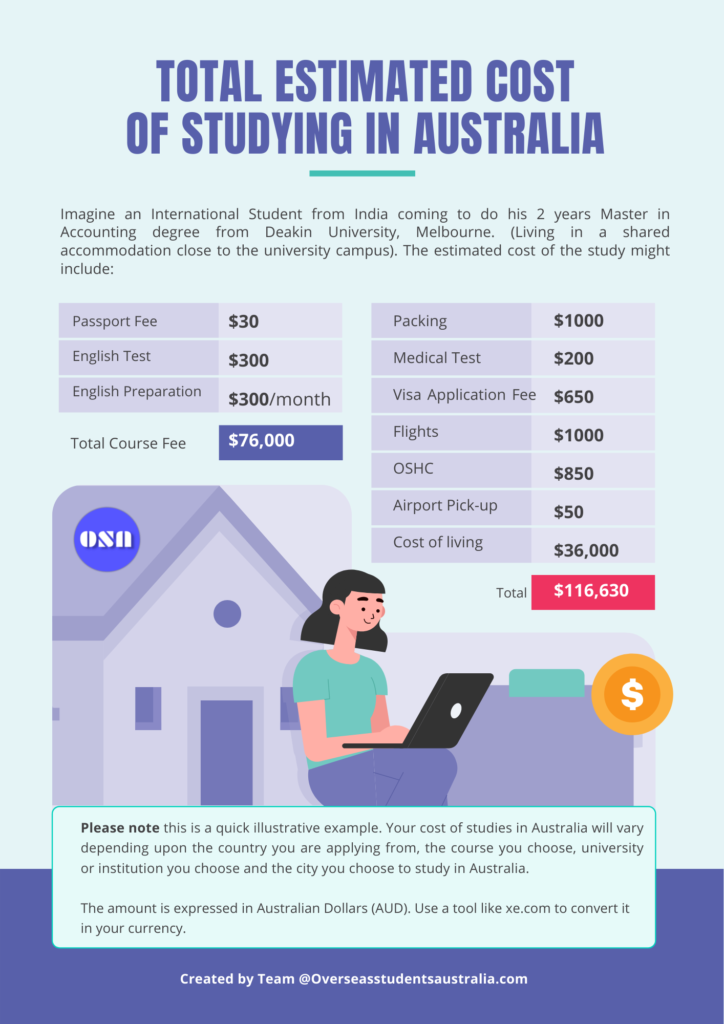
Here’s an example to give you a better idea of the cost of studying in Australia for international students:
An international student from India is coming to do his Masters in Accounting from Deakin University in Melbourne, Australia. These are the costs that will be involved as he is planning to study in Australia:
Passport Fee: $30
English Test: $300
English Preparation: $300 (1 month)
Total Course Fee without scholarship: $76,000 (2 years)
Medical: $200
Visa Application Fee: $650
OSHC: $1100
Packing: $1000
Flights: $1000 (one-way)
Airport Pick-up: $50
Cost of Living for 2 years – $36,000
Total – $116,630
This is a very specific example; your cost of studying in Australia will vary depending on the factors we have discussed earlier.
Note: All the information that we’ve given you in this article is in Australian dollars. If you want to convert this into your own currency, we highly recommend you to use a tool like https://www.xe.com, where you can convert any currency from Australian currency to your home currency or vice versa.
We hope you find the information about total cost of studying in Australia useful and let us know if you are already studying here, how much it is costing you to study?
We often get asked about the first week expenses in Australia that international students should budget before arriving to study here.
Now, your first week’s expenses as an international student in Australia will vary depending on the city you’re moving to, the type of accommodation you’ll be staying in, and your lifestyle.
In this article, we will provide a rough estimate of how much you will need to pay for these expenses.
1. Airport Transfer
First thing first, you would need to go to your accommodation from the airport.
You can use various types of airport transfer options like public transport, charter buses, airport buses, taxis and ride sharing services like Uber.
There may be a free airport pickup service offered by the university or institution you will be attending. Make sure you verify that with your university or institution.
For public transport transfers, it can cost around $10 to $25. You can also use private buses like Sky Bus which can cost around $30 or alternatively you can also use a taxi service or a ride-sharing service like Uber, Ola, or Didi. You will be paying anywhere from $20 to $200 for these services depending on the distance you need to travel.
If you have friends or family that can pick you up at the airport, that would be great as it would help you save money for the airport transfer..
2. Accommodation
Many international students coming into Australia will be booking temporary accommodation at the start.
It could be a hotel, an Airbnb, or a hostel, and during that time you should be prepared to pay between $250 and $400 for the week.
However, if you have made arrangements to stay in long-term accommodation, you will be expected to pay at least a two-week bond, which is a security deposit and is refundable at the end of your tenancy. You would also be required to pay one month’s rent.
If you have friends or family who you will be staying with in Australia, that would be awesome as it can help you save money and share the accommodation expenses. You could be paying anywhere from $150 to $300 per week for the shared accommodation.
3. Mobile SIM and Internet
You should be able to get a prepaid SIM when you first arrive in Australia. Prepaid SIMs cost between $15 and $30 a month.
They come with unlimited calling within Australia and a lot of data that can help you access the internet. Some of the sims also come with free international calling to certain countries as well.
For the internet, you can also ask your accommodation provider if they provide these services as a part of the accommodation. Sometimes they might require you to pay extra fees for using these internet services.
Good home internet plans start from around $50 per month. But you can share these expenses if you are living in shared accommodation.
4. Transport Expenses
Most of the states and territories you will be coming into have specific transport cards that you need to use for travelling on public transport.
It is completely free in some states or directories, but most of the time you will be required to pay $5 to $10 to purchase this card.
For example, in Melbourne, they make use of the Myki card, which costs $6.
During your first week, you might also be traveling a lot as you need to visit your university, you might start looking for a job or accommodation or just travelling to see around the area.
So you might be spending $20 to $50 for your first week of travel, and this varies based on the city you’re coming into and how many times you use public transport.
5. Food Expenses
If your accommodation provides you with facilities where you can cook food then we highly recommend that you cook your own meals as it is a cheaper option than eating out.
You will also need to buy groceries and that can cost you around $80 to $150 for your first week, and it varies based on what you intend to cook and how much you know about cooking.
If you are going to be eating out, especially lunch and dinner, it can be an expensive affair in Australia.
Even if you stay on budget. you will still be spending about $20 to $30 per day if you eat out most of the meals.
Food delivery services like Uber Eats are also very popular in Australia but it can be an expensive exercise as well.
You can check out our blog post that walks you through what you can eat under $10 in Melbourne Australia here and more blogs of other cities are coming soon. So make sure to follow us on Instagram for updates here.
6. Study Material Expenses
Each semester, you might need to buy some new books.
You can start with secondhand books or books available from the previous students, as this will obviously be much cheaper.
But you will be expected to pay between $50 and $100 for each book.
You can borrow some books from the library, however it can be really challenging for everyone to borrow those books at the same time. So you must be quick in getting these books loaned from the library.
Estimated Total First Week Expenses in Australia for International Students
In total, our estimated total cost as your first week expenses in Australia will be around $500 to $1200.
Again keep in mind that these numbers can vary based on the factors like city, lifestyle, accommodation and personal preferences.
Here is a quick summary of how these expenses might look like:
1. Airport transfer fee – Free – $10 to $200
2. Accommodation rent –
Hotels, Airbnb, Hostels – $250 to $400 per week
Long term accommodation (Including Bond ( 2 weeks rent + 1 month rent) – $700 to $1000 for the month
friends and family – Free to $300 per week
3. Mobile sim and internet – Prepaid Sim – $15 to $30
4. Transport
Transport card – $5 to $10
Transport Travel cost – $20 to $50
5. Food
Cooking – $80 to $100,
Eating out – $20 to $30 per day
6. Books – $50 to $100 per book
7. Total Estimated Cost- $500 to $1200
Other things you need to do in first week
Here are some things you also need to do in your first week that don’t require spending money:
Opening your bank account
Applying For TFN
Applying For ABN
Creating your Resume
Orientation at your school
We have several videos on our YouTube channel that can walk you through some of these things you need to do in your student life.
Students looking at their options for higher education abroad should give serious thought to Australian colleges and universities. It’s hardly surprising since the country has a top-notch educational system and awards degrees that are respected internationally.
When academic quality is top-notch, it is not easy to get admission to one of these institutions.
To begin with the process, you need to check if you already have the credentials required to continue your studies in Australia.
In general, institutions set out the academic criteria and English proficiency standards.
The English language requirements are tailored to non-native speakers, given that all courses and other kinds of communication are taught in English at Australian institutions.
Apart from that, there are requirements for things like visas and medical insurance.
The minimum required level of English proficiency and academic achievement level vary from institution to institution and degree to degree.
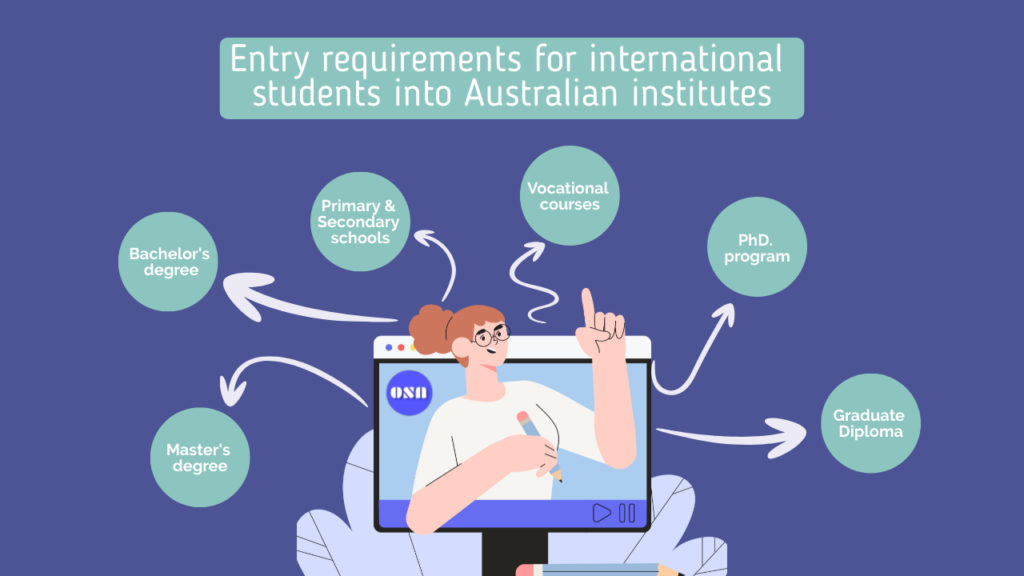
In this article, we will discuss the basic entry requirements for international students enrolling in Australian schools, colleges, and universities.
A brief guide for applying for admission into Australian educational institutes
You may start the application process after you’ve chosen a program and an institution.
Before submitting an application, prospective students should verify that they meet the minimum educational and English proficiency standards.
The majority of Australian overseas students apply directly by mail or online or through an educational agent. The application form will include the course(s) you want to enroll in, as well as provide required information and documentations.
The basic information required in most of the application forms are:
Your personal information;
Verified proof of English language proficiency;
Transcripts of past academic qualifications
References.
Many schools need a non-refundable application fee, often between $50 and $100 Australian Dollars (AUD), to be sent with the application.
Make sure you meet the criteria for a student visa on the Department of Home Affairs website before submitting an application.
Once you’ve submitted your application, the educational institution will examine it. It can take a few weeks before your application is processed (or longer for post graduate programs).
You will get an offer letter and an acceptance form if you are chosen. You should read the complete offer letter before making a choice in order to be well-informed about the conditions.
You must first fulfill the conditions in the offer letter in order to get a Confirmation of Enrollment from the institution (CoE).
After being approved and receiving the CoE from your educational institution, the next step is to apply for a student visa. Use your letter of offer or your CoE to apply for a student visa.
You will also be required to submit a GTE statement and get OSHC cover for your studies in Australia.
Now let’s look into more specific entry requirements into different courses in Australia.
Entry Requirements to study in primary and secondary school in Australia
Each school might have different admission criteria but to give you a general idea, following are the entry requirements.
Students in Prep through Year 6 can enroll in the Primary School program by meeting the following criteria:
The program must run for a minimum of six months.
Students whose first language is not English must either participate in a Young Learners Program or present documentation of their proficiency in the language.
Whereas if we talk about secondary education in Australia, it is offered by government and non-government institutes. Depending on the state or region and the duration of elementary school, it is offered for five to six years.
In Australia, secondary education consists of two study levels and starts in years 6 or 7.
Secondary school (lasts 3 to 4 years – Years 7 to 10 or 8 to 10)
Senior secondary school (lasts for two years – Year 11 and Year 12)
The requirements for enrolling in secondary school in Australia vary from one state or territory to the next, as do the specific schools you want to attend.
The application procedure considers several elements, including your academic record, extracurricular activity, athletic abilities, and other factors.
Candidates from other countries will be judged on how well they meet the English language standards. The student may enroll in a high school preparatory course to improve their English proficiency if they do not already fulfill the standard. We have already covered a separate article on getting secondary education in Australia; check it out here.
English Requirements:
Year 7 & 8 = IELTS 4.0 – TOEFL = 31
Year 9 = IELTS 4.5 – TOEFL = 32
Year 10 = IELTS 5.0 – TOEFL = 35
Year 11 = IELTS 5.5 – TOEFL = 46
Year 12 = IELTS 6.0 – TOEFL = 60
If you are under the age of 18, you will also need to have welfare arrangements sorted before arriving in Australia for your studies.
Entry Requirements for VET (Vocational courses) in Australia
Instead of going to university, international students can choose to undertake vocational education programs. These vocational programs are offered by various Tafes and private institutions, which both public and private universities offer, providing real-world learning experiences.
These programs provide real world experiences to the students, which hence equip them with skills to start working as soon as they graduate.
In order to ensure quality education in these programs, Government agencies keep an eye on these education providers and audit them regularly for compliance purposes.
Typically, students will attend 15 to 20 hours of in-person training weekly.
When students graduate from VET institutions, their credentials are recognised in Australia and often in other nations worldwide
Some basic entry requirements for vocational programs are as follows:
International students who want to enroll in the VET system must complete a level of study comparable to years 10, 11, and 12 in Australia. In your native country, you must have attended and graduated from at least the third year of high school.
International students may need to pass an English exam to enroll in a vocational program.
While some courses would need job experience, others could have prerequisite subjects.
A portfolio might be required for admission to courses like painting and design.
For English Proficiency, you must provide proof that you are at least at the following levels of English proficiency:
IELTS: You will need to score an overall of 5.5, no band less than 5.0
TOEFL: You will need to score an overall of 55 with individual section scores no less than (Listening: 9, Speaking: 16, Reading: 10, Writing: 18)
PTE: You will need to score an overall of 42-49 with no section score less than 40
CAE: You will need to score an overall of 162 with no individual band less than 154
Entry Requirements for Graduate Diploma and Graduate Certificate in Australia
A Graduate Certificate program is a 6 months full time program (one semester) and usually includes 3 to 4 units of study. The typical length of study for a graduate diploma at a university is 12 months and usually includes 8 units of study (two semesters).
A Graduate Certificate and Graduate Diploma is the next step for students after finishing a Bachelor’s degree in Australia.
The entry requirements for Graduate Certificate is a Bachelor’s degree and for Graduate Diploma is a Bachelor’s degree along with Graduate Certificate.
Apart from that, international students are usually required to provide proficiency of their English levels by providing a result for one of the following:
IELTS: You will need to score an overall of 6.5, no band less than 6.0
TOEFL: You will need to score an overall of 79 with individual section scores no less than (Listening: 19, Speaking: 19, Reading: 18, Writing: 22)
PTE: You will need to score an overall of 58-64 with no section score less than 50
CAE: You will need to score an overall of 176 with no individual band less than 169
Entry Requirements for Bachelor’s degree in Australia
International students can only apply for a bachelor’s degree in Australia after twelve years of elementary and secondary school.
International students are suggested to apply for admission early, so they have plenty of time to get necessary visas and arrange travel arrangements.
Standard admission entry requirements for a Bachelor degree in Australia are as:
Application fee: Most universities will require application fee of around $100 to $200 to apply for their courses
Academic Transcripts: You will also need a score of between 60% and 70% on the Australian equivalent of the High School Leaving Exam (HSLE) to apply to a Bachelor degree program in Australia (12th grade).
English Test Results: A good score on an internationally recognised English language test that proves you’re proficient enough to study in Australia.
Others: Further requirements such as surveys, letters of recommendation, work experience, portfolio’s etc.
In regards to the English proficiency, as a general guide, you will be required to provide a proof of one of the following levels:
IELTS: You will need to score an overall of 6.0, no band less than 6.0
TOEFL: You will need to score an overall of 67 with individual section scores no less than (Listening: 12, Speaking: 18, Reading: 15, Writing: 21)
PTE: You will need to score an overall of 50-57 with no section score less than 50
CAE: You will need to score an overall of 169 with no individual band less than 169
Entry Requirements for Master’s Degree in Australia
For getting into Master’s degree in Australia, having an undergraduate degree is a must.
The typical cutoff for eligibility to apply for a Master’s degree at Australian universities and Institutions is 60% or GPA of 4.0. The Australian Bachelor (Ordinary) Degree equals a foreign undergraduate degree such as a B.Sc., B.Com., or B.A.
If you are planning to do a Masters degree by research, then you might be required to have an equivalent to the Australian Bachelor (Honors) Degree or previous research experience.
Some other requirements are as follows:
Application Fee: You will expected to pay $100 to $200 as an application fee
Academic Transcripts: You must present the results of your earlier academic life. At the time of admission, you must present your Secondary School Certificate (Year 10 transcripts), High School Certificate (Year 12 transcripts). In addition, you must submit the Transcript of Records, which lists all of the subjects you studied for your Bachelor’s and the marks and grades you earned in each of them.
Entrance Exam Results: You may also submit your results from any university entrance exams you’ve taken as evidence if you have! Some university courses like MBA might need students to undergo an entrance exam like GMAT, GAMSAT, LSAT etc.
English Test Results: A good enough score is required in an internationally recognised English proficiency test for an overseas student. Most universities in Australia accept the IELTS, PTE, or TOEFL examinations to measure your proficiency in English. A letter from your former university that confirms that you completed your undergraduate degree entirely in English and don’t need to take any additional exams may also be accepted by certain universities.
Attending Interviews: Interviews could be conducted by some universities in order to check the communication skills, professionalism and reasons for those specific courses.
Here is a general guide for the English proficiency scores that you need to provide for your Master’s degree in Australia. Please note that these numbers can vary from one institution to the other :
IELTS: You will need to score an overall of 6.5, no band less than 6.0
TOEFL: You will need to score an overall of 79 with individual section scores no less than (Listening: 19, Speaking: 19, Reading: 18, Writing: 22)
PTE: You will need to score an overall of 58-64 with no section score less than 50
CAE: You will need to score an overall of 176 with no individual band less than 169
Entry Requirements to PhD (Professional Doctorate Degree) in Australia
Getting entry into PhD programs in Australia is different from getting entry into most other courses. Most of the PhD programs in Australia are research based.
Before you submit your formal application to the university, you will need to find a research supervisor. This will be someone who will be the lead researcher in your preferred institution and area of study.
Then you need to submit a brief research proposal to this prospective supervisor. If the supervisor accepts your research topic, then you will receive an expression of interest from this provisional supervisor.
From here, you can start a formal application to the university. But if the supervisor doesn’t accept or support the application, then you will need to find another supervisor.
Most universities will not accept the formal application from PhD students until they have a research supervisor.
Once you have expression of interest, then you will need to meet the following requirements. Please note that each university sets its own requirements and might require you to meet further requirements than listed below here:
A Bachelor’s and a Master’s degree in the relevant field of study.
Evidence of your prior research experience certified from your previous university or universities.
Approved expression of interest for your research proposal from academic supervisor
References from the academic or professional world
Universities might require students to go through an interview for getting accepted into Doctorate degrees.
Provide proof of your English proficiency by undertaking IELTS/PTE/TOEFL/CAE test.
You must provide proof that you are at least at the following levels of English proficiency:
IELTS: You will need to score an overall of 6.5, no band less than 6.0
TOEFL: You will need to score an overall of 79 with individual section scores no less than (Listening: 19, Speaking: 19, Reading: 18, Writing: 22)
PTE: You will need to score an overall of 58-64 with no section score less than 50
CAE: You will need to score an overall of 176 with no individual band less than 169
We hope we were able to give you a general idea of what it looks like to apply for an admission to different programs in Australia. You can also check out the following related articles that we covered regarding studying in Australia.
Before travelling out of your country as an international student, there are certain essential skills you need to learn.
In this article, we’re going to discuss the top 7 practical skills you need to learn before coming to Australia.
1. Cooking Skills
As an international student, you must learn to cook some basic foods for yourself.
Many students are already familiar with some cooking, but there are many international students in Australia who do not know how to cook their own food when they arrive. Most of the students don’t even have any family or friends who can assist them in cooking.
When you arrive here without cooking skills, it becomes a nightmare as it is extremely expensive to eat outside.
You’ll have to prepare food for yourself and most of the time, many students end up eating only noodles, pastas, and cereals to survive, which isn’t healthy to eat on a regular basis.
To ensure that you survive as an international student and not eat out or prepare unhealthy meals regularly, make sure you get some cooking lessons from your mother or other family members who are good cooks before coming to Australia.
2. Driving Skills
If you’re going to study in the suburban or city areas, you will be perfectly okay travelling around using public transport.
Having a bicycle can also be helpful, however you’ll eventually need to drive a car. If you can obtain a full driving license before coming to Australia, that would be extremely helpful.
If you can afford to buy a car, it will help you save time commuting from home to work or university.
Some jobs may even require you to have a car because they begin too early in the morning or too late at night when public transport is unavailable.
So it is ideal if you can get some driving lessons or preferably a driving license from your home country before coming to Australia.
3. Computing Skills
Most of the students who arrive in Australia usually have decent computing skills. However, there are few students who shy away from learning new technologies and new software programs.
In Australia, you won’t be able to get away without having at least some basic computing skills.
You will need these basic skills to apply for anything online, including your TFN, ABN, job applications, your bank accounts and many other government services.
Most universities and colleges will expect you to submit assessments online, so learning about some basic software like Word Excel, PowerPoint can really help in your studies.
Improving your typing skills will help you to save a lot of time. It will even be better if you can learn some advanced shortcuts that can make your life easier so that you can do your assessments faster.
Even if you are not into technology, it is still a must-have skill for international students planning to study in Australia.
4. Laundry Skills
As an international student, it is important to learn how to clean your house, clean your bed, tidy up your room and do your own laundry.
The laundry itself is a big exercise which includes cleaning, drying, folding and ironing your clothes, linens etc.
All these things are basic skills, unfortunately many international students don’t know about them or don’t learn them while they are at home.
You can get that laundry done from various laundry services but it is a very expensive exercise which many international students can’t afford to use.
5. Time Management Skills
As an international student, you will need to learn how to manage your time effectively as you will be juggling between your work, your studies and your life.
You will be on your own most of the time and you won’t have family members to help you with certain tasks. You’ll have to go to work, come home, cook for yourself, study, and call your parents all on the same day. This can take a significant amount of time and effort.
It can be a nightmare to manage all of these things in your life if you don’t properly plan your day and week.
In order to effectively manage your time, you will need to create a weekly schedule for the week’s major tasks.
This could include:
What tasks need to be completed during the week?
When will you be working?
Which days do you have classes?
When do you need to submit assessment tasks and prepare for them?
Which days can you call your family and friends back home?
Which days can you catch up with your friends in Australia?
And many other ad-hoc tasks during the normal work week.
Making a schedule will be highly beneficial, and it will be even more beneficial if you can learn to manage these things before arriving in Australia.
English is the most commonly spoken language in Australia. Everyday aspects of life in Australia including finding jobs, making friends, talking to lecturers, asking questions to tutor, etc. will all be in English itself.
Most international students are required to take IELTS/ PTE/ TOEFL/ CAE or some other format of English test before arriving.
It is very important that you keep improving your English language while you are still overseas.
You can do so by watching mostly English TV shows, English movies, or reading English newspapers, magazines, or online articles.
We have a playlist of hundreds of videos on our YouTube channel, which you can watch regularly, or you can read some articles on our website.
Doing some of these things can help improve your English and your vocabulary.
You should also learn and get familiar with some popular Australian slangs before arriving in Australia.
7. Budgeting and Personal Finance Skills
As an international student, you make money based on the number of hours you work.
With all the money you are making, you might think it’s a great time to go shopping, watch movies, or do other fun activities; however you have to remember that you have a lot of expenses to deal with as well.
You must pay your rent, groceries, and other living expenses, as well as tuition fees.
It is important to learn how to manage your monthly income and expenses, so you don’t end up asking for a large sum of money from your friends or family back home.
Make a personal budget spreadsheet for yourself before coming to Australia, so you can start managing your finances from the day you arrive here.
So these are the top seven practical skills to learn before arriving in Australia. Let us know what other skills you think international students should learn before coming to Australia. We would love to hear from you via our Instagram page here.
Australia is one of the few countries that allows international students to work for 20 hours per week or 40 hours per fortnight while studying..
Working in any of these job roles means that you can easily earn decent money to cover some of your expenses as an international student in Australia.
In this article, we are going to discuss 7 high paying jobs in Australia for international students.
1. Security Jobs
As an international student, you can work as a security guard or as a security officerin Australia.
To become a security officer, you will need a certification known as a “Certificate II in Security Operations.” It is a short course, and you could be paying anywhere from $150 to $250 to do this course.
You can easily earn more than $25 per hour if you are working as a security guard in Australia.
As a security guard, you can work in commercial spaces like shopping centers and supermarkets, and construction sites as well.
You can also work as a security guard at events. If you work during the events, you can even earn more than $35 per hour. If you are working in the evenings or in the nights, you could also be getting more than $35 per hour for this job.
2. Cleaning Jobs
As an international student, there is certainly a possibility of you working as a cleaner.
As a cleaner, you are obviously required to clean different facilities. You can work in a variety of settings. You can work in commercial settings like offices or residential settings like private homes.
Without a doubt, you can even run your own business in the cleaning industry. You can easily earn more than $25 per hour as a cleaner in Australia. And occasionally you can even charge more than that as well.
For this specific job role no certification is required, you can get started with some training from your workplace and can start working as a cleaner right away.
3. Construction Jobs
You can do construction jobs in different industries like residential building constructions and commercial building constructions
Some popular jobs in the construction industry among international students include construction cleaning and casual laborer. You don’t need to have any special course for working in the jobs mentioned.
Just be mindful that if you are going to work in the construction industry, you will need to have at least “White card training” (construction induction training).
Working in the construction industry means you can easily earn more than $30 per hour.
Usually there is a physical work involved in these sorts of jobs, but many international students prefer to do these sorts of jobs these days because they are quite well paid.
4. Specialised Hospitality Jobs
Specialised hospitality jobs means that you have some sort of special skills to work in this industry.
You can work as a waiter or waitress in this industry but these jobs doesn’t require any specific training for that but if you want to earn some extra money in the hospitality industry, it might be a good idea for you to do some specialized courses.
For example, you can become a bartender in this industry and to become a bartender you would need an RSA course.
Becoming a bartender means you can easily earn more than $25 to $30 per hour. And if you’re going to work in the evenings or late nights, you can even earn more money in that sort of job role.
RSA course for international students from $49 (online) here:
To become a barista, you don’t need a specific course, although there are some short courses available for that as well., But there is no specific requirement that you must have a barista course in order to become a barista..
You can also become a cook, in that case you might need some certification and some training, also. These sorts of job roles can easily get you higher money or top dollars in the hospitality industry.
In current circumstances because of shortage of staff in the market, many hospitality venues are paying top dollars for any of the job roles in this industry. So even if you’re getting some basic sort of job role as a kitchen hand or as a waiter, you can expect to get more than $25 per hour.
5. Personal Trainers
As a personal trainer also known as PT.
As a personal trainer, you will be responsible for giving instructions and training to people for their health and well-being, and you can easily earn more than $35 per hour as a personal trainer.
To become a personal trainer, you will need a certification. You will need at least Certificate IV in Personal Training to get started.
If you just want to work in existing gym facilities then you can do “Certificate III in Personal Training” only.
You can even become a yoga instructor if you have the right skill set and the right certification for it.
6. Dog Walkers or Pet Sitters
As people being so busy these days with their own life, there are plenty of jobs for people who can walk their dogs or their pets or can become a pet sitter for their pets. This is one of the popular jobs among international students these days.
There is no formal qualification required to become a dog walker. But having a qualifications like Certificate III in Dog Training and Behaviour or Certificate IV in Companion Animal Services can help in getting a job.
With this sort of job roles, you can easily earn more than $25 to $30 per hour for mostly walking around people’s pets and if you really love pets then this is the job for you.
7. Delivery Drivers
We can divide delivery drivers into two categories: one who delivers food and the other ones who do courier work (non-food).
Food delivery persons
Obviously there are plenty of food delivery platforms in Australia and you can sign up with any of these platforms and start delivering the food. You don’t need to have a car, motorbike or van in order to deliver food. You even can get started on a bike as well.
You can become a delivery partner with food delivery services like Uber eats Obviously we can’t work out a specific hourly rate for these sorts of job roles as they vary from one city to another, , timing of the delivery and many other factors.
But if you are delivering during peak times, you can certainly make some good dollars from these sorts of job roles.
The second category of delivery drivers is couriers who usually deliver non-food items. You would need a car or motor van in order to become a courier driver.
In this job role, you would be mostly responsible for delivering parcels, posts, letters etc. ou
can easily earn more than $25 to $30 per hour.
In order to do a delivery using a car, motorbike or van, you would need a driving license, but there are no formal qualifications required for any of these delivery jobs. Overseas licenses are valid for certain times in certain states, so make sure to check those details in the state you are arriving in.
So these are the top high paying jobs in Australia for International Students. Let us know which high paying job you are planning to do in Australia?