But it’s still good idea to know how much money you might earn after completing a certain degree or qualification.
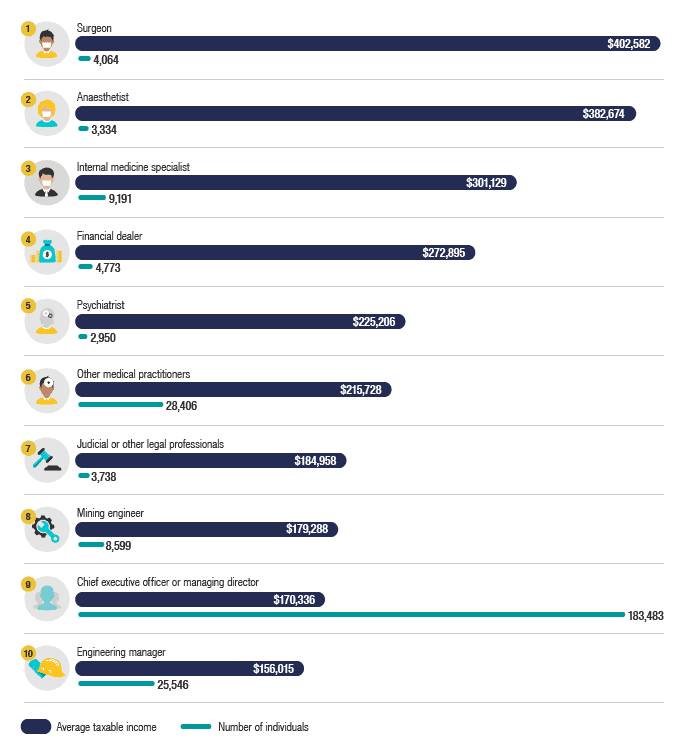
The Australian Tax Office (ATO) recently revealed statistics for the highest-paid jobs in Australia based on their average taxable income.
In this guide, we are going to talk about Australia’s top 10 highest paying job in 2020.
It’s important to note that these top 10 jobs are based on average taxable income which means it’s based on average and people might be earning more or less depending upon their skills and experience in the industry.
10. Engineering manager
📄 Field – Engeering
💪🏼 What they do – Engineering Managers are responsible for planning, organising, controlling and coordinating the engineering and technical operations of the business.
💼 Number of professionals working – 25,546
💵 Average Pay – $156,015
📈 Future Growth – Strong
🎓 Qualifications required – Engineering managers will need a bachelor or postgraduate degree in a relevant engineering field. Some engineers might a Certificate or Diploma qualifications as well.
9. Chief executive officer or managing director
📄 Field – Business/ Management
💪🏼 What they do – Chief Executives and Managing Directors are responsible for determining , creating and reviewing the business strategies, policies and programs. They also provide the overall direction and management to the business.
💼 Number of professionals working – 183,483
💵 Average Pay – $170,336
📈 Future Growth – Stable
🎓 Qualifications required – To become a CEO or a managing director, there is no specific need for a formal qualification. But a bachelor’s or masters degree in accounting, business and management field can be highly regarded.
8. Mining engineer
📄 Field – Engineering
💪🏼 What they do – Mining is a huge industry in Australia. The typical role of a mining engineer includes planning, coordinating and directing the extraction of minerals, petroleum and other natural resources from the earth.
💼 Number of professionals working – 8,599
💵 Average Pay – $179,288
📈 Future Growth – Strong
🎓 Qualifications required – To work a mining engineer, you’ll need a bachelor’s degree in engineering with specialisation in mining. Postgraduate degrees are also very useful.
7. Judicial or other legal professionals
📄 Field – Law
💪🏼 What they do – These professionals are responsible for hearing and making judgements on legal matters in courts. They also providing advice based on the law and draft legislations.
💼 Number of professionals working – 3,738
💵 Average Pay – $184,958
📈 Future Growth – Moderate
🎓 Qualifications required – You must complete a Degree in law and been licensed to more than 8 years of practice.
6. Other Medical practitioners
📄 Field – Healthcare
💪🏼 What they do – These include professionals like:
Dermatologists,
Emergency Medicine Specialists,
Obstetricians and Gynaecologists,
Ophthalmologists, Pathologists,
Diagnostic and Interventional Radiologists,
Radiation Oncologists.
Depending on their area of expertise, these professionals are required to treat human illness.
💼 Number of professionals working – 28,406
💵 Average Pay – $215,728
📈 Future Growth – Very Strong
🎓 Qualifications required – You will be required to have a degree in your area of specialisation and a specialist training. A registration with the Medical Board of Australia is a must.
5. Psychiatrist
📄 Field – Healthcare
💪🏼 What they do – Psychiatrists are mental health professionals who specialists in the assessment, diagnosis and treatment of various human mental, emotional and behavioural disorders. They can administer medication to patients.
💼 Number of professionals working – 2,950
💵 Average Pay – $225,206
📈 Future Growth – Strong
🎓 Qualifications required – You will be required to complete a medical degree and a training with Royal Australian & New Zealand College of Psychiatrists to become a psychiatrist. You will be required to have a Australian Health Practitioner Regulation Agency registration.
4. Financial dealer
📄 Field – Finance
💪🏼 What they do – Financial dealers work with clients to conduct market transactions and advise on financial matters.
💼 Number of professionals working – 4,773
💵 Average Pay – $272,895
📈 Future Growth – Stable
🎓 Qualifications required – To become a financial dealer, you will be required to complete a degree in finance, accounting commerce. Some financial dealers might have a vocation qualification only.
3. Internal medicine specialist
📄 Field – Healthcare
💪🏼 What they do -These professionals also known as specialists physicians. They are responsible for diagnoses and treatment of internal human disorders and diseases using specialist testing, diagnostic and medical techniques.
💼 Number of professionals working – 9,191
💵 Average Pay – $301,129
📈 Future Growth – Moderate
🎓 Qualifications required – A medical degree and a fellowship with the Royal Australasian College of Physicians.
2. Anaesthetists
📄 Field – Healthcare
💪🏼 What they do – They are usually responsible for managing the levels of anesthetics when the surgery is going on and they have a very important role to play before and after the surgery is over as well. Their primary duty is to make sure that the levels of general or local anesthetic are as per the requirements.
💼 Number of professionals working – 3,334
💵 Average Pay – $382,674
📈 Future Growth – Strong
🎓 Qualifications required – A medical degree is required to become a anaesthetists, followed by 1 year internship, then hospital training as resident doctor. In Australia, an anaesthetist will undergo five years of specialist training with the Australian and New Zealand College of Anaesthetists.
1. Surgeon
📄 Field – Healthcare
💪🏼 What they do – They are responsible for conducting various surgeries for treating diseases, repairing injuries and appearance. All surgeons begin their training as general surgeons and then have the option to enter into a specialty.
💼 Number of professionals working – 4,064
💵 Average Pay – $402,582
📈 Future Growth – Strong
🎓 Qualifications: A 4-year medical degree and then complete further training with the Royal Australasian College of Surgeons before you can specialise as a Surgeon.
After the world-wide university rankings were out over the last few weeks, where record number of Australian universities entered into the Top 200 universities.
Now, the 2020 Graduate Outcomes Survey – Longitudinal results are out and they have provided insight into the Top ranking universities with the best employment outcomes for both undergraduate and postgraduate studies in Australia.
The survey was completed by graduates of 79 different Australian higher education institutions approximately 4 months after completion of their courses.
Overall, survey concluded that employment rate went from 73.3% in 2017 to 90.3% in 2020 for undergraduate and 86.1% in 2017 to 94.1% in 2020 for postgraduate students.
The survey also found that average pay for the graduates increased from $67,000 in 2016 to $75,000 in 2020.
The research was also conducted into the fields of study with medicine field students topped the list with 97.3%, followed by engineering graduates at second place and mathematic degree holders came third for graduate employment outcomes.
Here is a list of all the Top 15 universities for both undergraduates and postgraduates graduate outcomes.
Undergraduate employment rates by University
1 Australian Catholic University – 95.5%
2 The Australian National University – 95.2%
3 University of Canberra – 94.1%
4 Charles Sturt University – 93.9%
5 James Cook University – 93.8%
6 University of New South Wales – 93.6%
7 Charles Darwin University – 93.0%
8 Federation University Australia – 92.3%
9 Bond University – 92.3%
10 University of Technology Sydney – 92.2%
11 University of Wollongong – 91.9%
12 Queensland University of Technology – 91.8%
13 University of Southern Queensland – 91.7%
14 University of Newcastle – 91.6%
15 The University of Queensland – 91.5%
Postgraduate employment rates by University
1 Australian Catholic University – 98.6%
2 The University of Notre Dame Australia – 98.2%
3 Federation University Australia – 98.2%
4 LaTrobe University – 97.9%
5 Macquarie University – 97.3%
6 Queensland University of Technology – 97.2%
7 The Australian National University – 96.8%
8 Monash University – 96.1%
9 University of New South Wales – 96.0%
10 Central Queensland University – 95.9%
11 University of Wollongong – 93.5%
12 The University of Western Australia -95.4%
13 Flinders University – 95.3%
14 Western Sydney University – 95.2%
15 Griffith University – 95.2%
Conclusion
As you can see from the survey results that the competition is fierce among these universities when it comes to graduate outcomes. Australian Catholic University came out as a winner in both undergraduate and post graduate employment outcomes but other were not far either.
While these surveys were conducted just around the start of the COVID times, it is important to understand that there could be some consequences for the graduate employment after this pandemic.
The report mentioned that “following a downturn in economic activity, it can take graduates longer to successfully establish themselves in their careers.”
Drinking alcohol is a part of Australian culture. Most of the celebrations, parties events and catchups are not complete without having an alcohol.
If you get caught serving alcohol to an intoxicated person or minor (under 18s) you could face thousands of dollars of penalties and the business you work for could face the same consequences as well.
While as strict as Australian liquor laws are it can be a great opportunity for an international student to have an RSA certificate which will help them find a part-job in hospitality or any other industry that involves serving, selling or supplying liquor.
So in this article, we are going to give you a comprehensive guide regarding RSA certificate for international students in Australia.
What is RSA?
RSA stands for Responsible Service of Alcohol.
RSA is a short training that you will need to complete if you are going to serve, supply or sell alcohol in Australia.
At the end of this training, you will receive a certificate which states that you know how to serve alcohol in a responsible manner.
Put it simply as soon as you’re going to work with alcohol in Australia you will need to have this certificate.
You cannot legally work in a licensed premises in Australia without having an RSA certificate.
Most of the hospitality jobs where you are going to serve or work with alcohol will require you to have this certificate before you start working over there.
Who needs to have this certificate?
As mentioned earlier, anyone who is going to sell, offer, supply or serve alcohol in any of these premises are required to have this certificate. The premises including, but not limited to:
Bar
Restaurant
Nightclub
Casinos
Liquor stores
Events
Even if you work as a security staff member or just collecting or washing those glasses at the bar or nightclub, you still need to have this certificate.
There could be other settings or workplaces as well where you might need this RSA certificate.
What do I learn in the RSA course?
The name of the unit you are going to complete is SITHFAB002 Provide Responsible Service of Alcohol.
RSA course focuses on many aspects like:
the laws related toserving alcohol in australia
how to sell how to serve alcohol responsibly
how to help customers to drink within appropriate limits
assessing alcohol affected customers and how to deal and refuse serving alcohol
the standard drink sizes
The main aim of this course is usually trying to teach you how to be responsible while serving alcohol to any person in the licensed premises.
Can international students do an RSA certificate?
Yes, you can certainly do an RSA certificate even if you are an international student in Australia.
Previous restrictions
if you are going to do this course, you must do it face to face.
You cannot do this course online.
We have compiled a list of some providers for each state and territory in Australia.
Where to do an RSA course in Australia?
You can do the RSA certificate in classroom environment or online as well.
If you want to do an RSA course, then we suggest checking accredited provider Express Online Training (links below).
If you would like to undertake this course, you can use one of the link below to register:
Please note that if you’re going to work in the hospitality industry for a long time, then you need to refresh the RSA certificate every three years or so. Usually, you can do it online and mostly it is free to do it.
How to get an RSA certificate?
In order to get your RSA certificate, you will need to follow these steps:
First thing, you will need to find out a training provider for RSA certificate in your state territory.
You can find them online or we have some list of education providers listed above.
Once registered, you will need to go and attend the training on the day you have registered for.
After the training is over, there will be a short test that you will need to complete and pass. The test is quite easy to complete.
After completing the test successfully, the test you can get the certificate on the day itself. Some providers might send it to you through post.
But if you are in New South Wales, you get an interim certificate after the successful completion of the training.
Although, you can start working after having this interim certificate, but you will need to get a photo competency card within 90 days of completing the course.
You will need to bring this interim certificate to the Services New South Wales service centers along with an application form and 100 point ID.
You can use the following documents to meet 100 point ID requirement:
25 points – Any card on which your name appears: Medicare card/Library card/Student card
25 points – Documents on which your name and address appear: Car registration/Utility bill/Rental receipts
They will take your photo on the day and after that you will receive your competency card within four weeks of your application.
While in the other states and territories, you can get your RSA certificate on the day itself and you can certainly start working right away after getting ****this certificate.
How long does it take to complete RSA?
As international students are required to do this course face to face so it is different from online providers. Usually, face to face course can be anywhere from 4 to 6 hours depending on the providers.
Online RSA course can be completed within 3 to 6 hours but you get around 4 to 6 weeks to complete it.
How much does RSA costs?
The cost of RSA course varies from one provider to the other.
As an international student you need to do this course face to face and it can cost you anywhere between from $50 to $200.
However if you are not an international student and you want to do this course, it can be done online depending upon the state or territory you are in. The cost of an online RSA course can be anywhere from $30 to $60.
How long does this certificate last?
Interestingly, there is no one specific certificate for the whole Australia.
The laws related to serving liquor varies also from one state to the other.
Usually RSA certificates don’t expire but you might need to do a refresher course after three years or so depending upon your state or territories laws. Please note that these laws can change anytime, so you need to check them with your state and territory.
So if you decide to move interstate, you might need to complete this course again in the state you’re moving in.
All the best with your RSA training and certificate. Let us know in the comments if you have already got RSA certificate or planning to get one.
For more information on different short courses you can do as an international student in Australia, please check this article.
Do international students need to complete the RSA certificate from CRICOS registered provider?
While, there was a requirement for international students to complete RSA and some other short courses from CRICOS registered provider, this requirement has been lifted on 29 June 2021.
It means international students can now complete the RSA certificate and some other short courses in Australia without needing them to study at CRICOS registered providers only.
Getting food delivered at your home is not only a matter of convenience for customers but a great way to earn extra income as well. And after pandemic, it has become even more popular.
One of the most popular ways for International students in Australia to make money is delivering with Uber Eats. So in this article, we are going to give you a comprehensive guide to delivering with Uber Eats in Australia.
Requirements for delivering with Uber Eats in Australia
Own vehicle – have your own vehicle or mode of transport (like car, motorbike or bicycle).
Valid licence – if you are going to do Uber Eats in a car or motorbike, then you need to have a valid licence. Overseas licences are acceptable in certain cities at the moment, though in some states you are required to transition to a full licence within a set period. Note. overseas licences will not be accepted for delivery on motorbike.
Insulated bag – make sure that you have an insulated bag for your delivery. You can buy this insulated bag yourself from various marketplaces
Portable charge – especially when you’re going to be travelling around and you’ll be using your phon a lot, then having a portable phone charger makes sense
Helmet and bicycle lights – if you are going to do the deliveries on a bike, then you must buy a helmet. It is a requirement in Australia when you’re riding a bicycle on the road and lights for your bicycle.
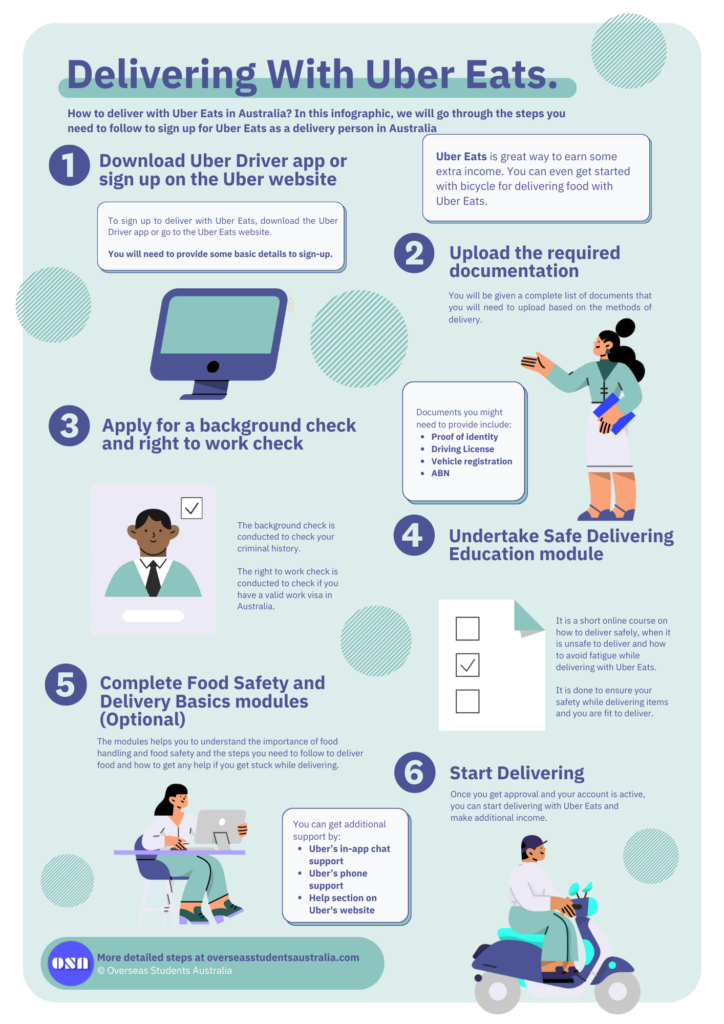
Infographics: Quick Guide on how to sign up for Uber Eats as a delivery person in Australia
Detailed Steps: How to signup for Uber Eats?
You will need to complete some paperwork and final processes when signing up to deliver with Uber Eats.
Step 1: Download the Uber Driver app or Sign Up on the Uber website
To sign up to deliver with Uber Eats, download the Uber Driver app or go to the Uber Eats website.
To sign up for a new Uber Driver account, you will need to provide the following details:
● First Name
● Last Name
● Email address
● Password
● Phone number
● City
Then, you will need to choose your delivery method, whether you want to deliver with a car, motorbike (including scooters) or a bicycle
You will need to agree to Uber’s Terms of Use and consent to the screening process required.
Step 2: Upload the required documentation
Once you sign in to the web app or phone app, you will need to submit and upload the required documents.
You will be given a complete list of required documents based on the methods of delivery.
These documents may include but are not limited to:
Proof of ID: Passport or Australian birth certificate, Immicard, or State issued Photo Card
Driving License (for car, motorbike / scooter): Full Australian licence (or overseas licence with international driving permit in certain Australian states). Note. overseas drivers licences are not accepted for delivery on motorbikes.
Vehicle registration: You will need to provide a registration check of your car or motorbike/scooter(if you are planning to deliver with them).
ABN (Australian Business Number) – If you need to apply for an ABN, then this video might help.
If you get stuck at any step, you can get help from:
Uber’s in-app chat support. It allows you to chat with an agent in real time and discuss and solve issues regarding the sign up process.
Call support: You can also call Uber’s phone support. In Australia, it is +61 1300 091 272
Additional Support: You can also read through some of the common troubleshooting issues and ways to resolve them as well though the help section of the Uber website.
Step 3: Apply for a background check and right to work check
Background and Right to Work Check
Once you upload all the necessary documentation, then you will be required to undergo a background and right to work check which are done together.
This check can take between 2 and 14 business days.
The background check is conducted to check your criminal history. No action is required from you after lodging – the provider will supply a copy of your results to Uber. It costs $43.05 to complete this check. (Price as at Sep 2025)
Right to work check is done in order to verify your work entitlements in Australia. This check is done along with your background check. There is no extra cost involved for it.
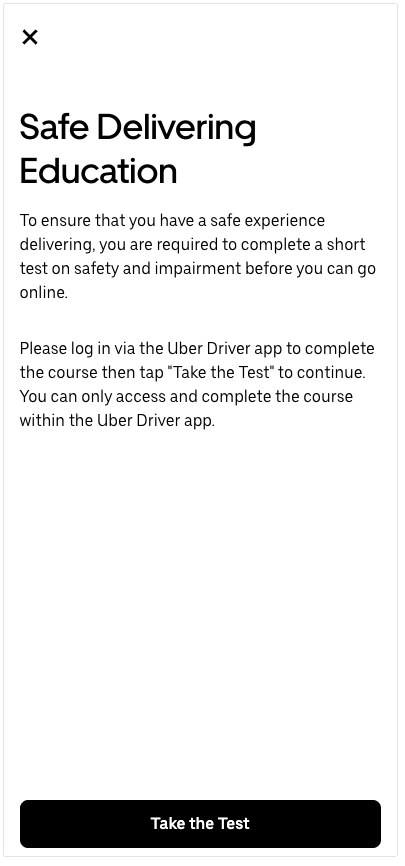
The next step will be to complete a Safe Delivering Education Module, which is an online course on how to deliver safely, when it is unsafe to deliver and how to avoid fatigue while delivering with Uber Eats.
It is done to ensure your safety while delivering items and that you are fit to deliver. This module takes approximately 5 minutes to complete with a short test at the end and is free to complete.
Step 5: Start delivering
Once you get approval and your account is active, you can start delivering with Uber Eats and make some money at your own schedule!
When it comes to delivering food with Uber Eats, you can use 3 different types of transport. You can basically use:
Car
Motorbike
Bike or bicycle
Regardless of whichever type of transport you choose, you must be 18 years or above.
For Car and Motorbike
For a car or motorbike, you must have a full Australian licence or if you are a temporary visitor like an international student, then you can potentially use your overseas license. But the overseas licence must be a full licence (not learners or probationary). Check the Uber website for full & current details.
Uber Eats accepts international drivers licenses in some states. If the overseas driver’s licence is not in English, then you are required to provide a NAATI translation doc along with your driver’s licence when you upload the photo. Please note that EU licences are exempt from this.
Your motorbike or your car should be registered and must have third-party insurance, and it should be newer than 1990.
For Bicycle or Bike
You don’t need to provide any license documents for doing Uber Eats using a bike and that is why bikes are one of the most popular methods for international students.
Obviously, it’s much cheaper and easier to buy a bike than a motorbike or a car, so many international students do prefer to use push-bike or bicycles to do deliveries for Uber Eats.
You can buy a bike for cheap from places like Kmart or you can get a used one from Gumtree as well. If you don’t have the money to buy a bike outright then you can also rent it out from someone else.
Sometimes, universities do have free bicycles for renting, so ask your university or institution if they have some free bikes available as well.
Alternatively, you can also buy or rent an electric bike as well, which many students actually prefer to use. If you can’t afford to buy an electrical bike then you can obviously rent it out from some rental provider. Check out electric bike rental options and prices here
How much does it cost to get started with Uber Eats?
Now, the cost of getting started to work with Uber Eats will depend on a few factors. But to give you an idea, here are some costs that you need to be mindful of when starting with Uber Eats.
🚗 Vehicle – $100 – $150 (bicycle) $1000 – $3000 (motorbike) $5000 or more (car) (approx.)
📃 ABN application – $0 (if you DIY) or $80 (through an accountant) (approx.)
👮 Background check and Right to work check – $43.05 (approx.)
🎒 Insulated Bag – $60 (approx.) Note if you deliver on a bike or motorbike, you will be able to get a free Uber Eats insulated bag when you complete onboarding.
As an international student in Australia, you have limited hours to work (48 hours per fortnight).
So, you can make the most out of it by working at the busiest time of the day.
The busiest times for Uber Eats during weekdays are generally:
● Morning – Breakfast time – 7:30 am to 9:30 am
● Afternoon – Lunch time – 11:00 am to 2:00 pm.
● Evenings – Dinner time – 6:00 pm to 10:00 pm
You can work till late on Fridays and Saturday nights as well, because there are plenty of deliveries in the late nights, especially in larger cities like Sydney, Melbourne, Brisbane, etc.
During weekends (Saturday and Sunday), it can be busy throughout the day as more people tend to order food or groceries using delivery services.
How does the Uber Eats app works?
Ideally, you will be going to the City Center or a place where there are plenty of restaurants around.
There are 4 simple steps you need to follow in order to do the delivery:
Step 1: Accept the delivery – You will get a notification of the order and as soon as you get the notification you accept the order.
Step 2: Pick-up the order – Then you go to the restaurant and introduce yourself and pick up the order from there.
Step 3: Check the order number – Before putting the order in your bag, make sure to check the order number matches the one on the app.
Step 4: Deliver the order – Then you drive and deliver the food to the customer. After delivering the food, confirm that the delivery was successful (usually you have to take a photo) and you are ready to accept the next order.
After delivering the food, you will find other nearby restaurants, so you can get your next delivery easily.
Please note that Uber Eats does Random Identity Verification where you will be asked to take a picture of yourself to verify your identity. So, it is critical that you don’t use your friend’s account or share your account details with others. You will risk getting your account cancelled and your access to the platform removed.
How much money can you potentially earn while delivering with Uber Eats?
So, the important question is “How much money you can potentially earn when delivering for Uber Eats?”
There are actually a few factors that go behind calculating your earning when delivering with Uber Eats. That includes but not limited to:
Base fare: Before you accept a delivery request, you’ll be provided with upfront delivery information. This includes the minimum earnings you’ll receive, your pickup and drop-off locations, the name and location of the merchant, and the total estimated time and distance from when you accept a delivery request to when you drop off the order.
Promotions: Check the map and Promotions section in the app for the latest offers and promotions to help you identify busy areas or times when there’s a high demand for trips. High demand usually means there are more opportunities for trip requests.
Tips: you get to keep 100% of the tips given to you on deliveries. It is recommended that you speak to a tax professional regarding tips
Tolls: if you deliver in a car, you will be reimbursed for eligible tolls incurred between the pick up and drop off location
Your overall earnings when delivering with Uber Eats can vary based on various factors like:
City you are delivering with Uber Eats
How familiar you are with the delivery area and restaurants
Time of the day you are delivering
Number of deliveries you are doing
Number of other riders around the area
Any tips you earn
You can also make extra money by delivering food in “surge zones” that appear on the app during busy/peak times.
Your earnings will be deposited into your linked deposit bank account. If you need access to your money sooner, there are options to cash out next day or even instantly. Eligibility criteria, T&Cs and fees apply.
No boss, no interview, no shifts, no uniform: Many students choose to do Uber Eats because they can work independently. It’s relatively easy to get started and no experience is needed.
Flexibility: There’s a lot of flexibility in the hours as you can decide your own work hours. If you feel like taking a day off, you can do that. Also, you can choose your time based on class schedules.
Keep Fit: If you are using an e-bike or push-bike, then it’s a great way to keep fit. You can keep fit and earn money at the same time. Not many jobs allow that to happen.
Get to know the city: When you are riding from one part to the other in the city, you get to know the city really well. You will get to explore some places that you would never have thought of going to otherwise.
Finding the best restaurants: Obviously, you are delivering food, so you get to find some of the best restaurants in your city. Fancy taking someone for a date? You know which restaurant to go.
ESL is no problem
Disadvantages of delivering with Uber Eats
Tiring work: If you’re doing Uber Eats on the bike, it can be really tiring and exhausting. Sometimes you have to go uphill, downhill, and it can be really tiring to do this job.
Repair costs: If there is a breakdown of your bike of your car or motorbike, you will definitely need to get it fixed, and you don’t earn during that lost time.
Should you deliver with Uber Eats or not?
It will solely depend upon what your needs are. As an international student, you may have plenty of bills to pay and Uber Eats is a great way to earn some money.
Finding other work may be difficult as many involve going through an interview process, whereas you can simply sign up to deliver with Uber Eats through the app.
So our recommendation is that if you are looking to earn money around university studiesthen Uber Eats could be the way to go for you.
Important things for working in Australia as an international student
Make sure that you abide by your student visa conditions.
You can only work 48 hours per fortnight when your studies are in session.
You can work unlimited hours during your official school holiday period.
Everything is recorded on the Uber Eats app, so it’s quite easy for ATO, immigration and other authorities to track down your work hours.
Be mindful of your tax obligations as an independent contractor
Construction industry is one of the most well-paid industries in Australia. Even working as a general labourer you can earn potentially up to $30 per hour or even more.
So in this article, we are going to give you a complete guide about the white card for international students in Australia.
What is a White card?
White card is a mandatory work card required to work in the construction site.
It is a short course that you need to complete if you are going to access or work in a construction site.
The main aim of this course is to actually teach you about safety at the workplace.
Obviously, the construction industry is quite a dangerous industry to work in and many accidents and injuries happen in the construction industry.
So to avoid and reduce the number of those injuries and accidents, it is important for everyone to learn about how to stay safe in those work environments and that is why you will need to have a white card.
So in this course, you will learn about:
Workplace health and safety regulations and requirements
Some of the hazards in the construction industry and how to control them
Workplace health and safety communication and reporting processes
Responding to some of the workplace health and safety emergencies and incidents
Also, there are substantial fines and penalties if you don’t have this card and you get caught working in a construction site.
Who needs it?
Basically anyone who is planning to work in the construction industry or want to have access to the construction site must have this white card.
It is a compulsory requirement to have this card so it is not an optional thing.
If you are going to work at a construction site as a
anyone who basically needs access to the construction site will need this card.
so regardless of your visa status, you will need to have this card
The minimum age to get the white card is 14 years old.
How to get a White Card?
In order to get a white card, you will need to undertake a short course which is known as White Card Course. The actual name of the unit you are completing is CPCCWHS1001 Prepare to work safely in the construction industry.
The course can be done face to face and online as well. This course is quite easy to complete.
While most of the states and territories in Australia require people to actually take this course face to face some states actually allow it to be taken online
You need to do a face to face course in:
Victoria
Australian Capital Territory
South Australia
Northern Territory
New South Wales
Most of Queensland
You can do an online course in:
Western Australia
Tasmania
Some rural areas in Queensland
As per the new update from Australian government, providers of certain courses doesn’t require to have a CRICOS to deliver these courses to international students in Australia. It includes white card courses as well. It means international students can complete these short courses from non-CRICOS registered providers as well.
In the past, there was a ruling that international students can do some of the short courses from CRICOS registered providers only but those restrictions are no longer applicable.
What are the steps to do a White card course?
Here are the step for completing the course:
1.Find a registered provider in your state or territory.
2. Register with them to do this course.
3. On the day of the course, bring a Photo ID on the day of training.
Some documents you can use to provide this can include:
Australian birth certificate
Australian drivers licence
Medicare card
ATM card
Utility bill like water, electricity bill
4. Usually, you are required to wear safety shoes on the training day.
5. You also might need to bring some PPE equipment.
6. During the course, you will learn about safety with:
examples
presentations
videos
class activities
practical demonstrations
7. After learning, there will be a test at the end of the day and you must pass this test in order to get a white card.
8. The test for the white card is not overly difficult.
9. If you pass the test, usually you will be issued with a white card or a statement of attainment depending upon the state or territory you are doing this course.
Please note that if you are in New South Wales or in Victoria, you will be issued a statement of attainment on the day of completion of the course and then you receive a white card or the plastic card within 60 days.
You can start working right away after completing this course as you don’t need to wait for your plastic card to come in order to start working.
You just need to show your statement of attainment to your employer and you can start working.
While, if you are in some other states or territory, then you will be issued a white card on the same day of completing the course.
How long does it take to complete the White Card Course?
This course is usually one day course that lasts around a minimum of 6 hours. These 6 hours include time for registration and the breaks.
Some providers of providing White Card Course in Australia?
Here are some providers of the white card course for international students in Australia:
If you would like to undertake some of the courses we mentioned in the video, you can use one of the link below to register:
The cost of the white card course depends upon the institute you are going to do this course with.
The cost of the course varies from one state to another and the providers as well and it ranges anywhere from $100 to $250.
It’s always a good idea to check the reviews of the provider before signing up for any course.
How long does the white card last?
The good news is that there is no expiry date for this card. So once you have completed this course you don’t need to renew this card ever again.
However, under the new law, it is recommended that if you haven’t worked in the construction industry for two or more years then you should undertake a new course to refresh your knowledge.
The white card is also valid throughout Australia. So if you have completed a white card course in any state, you can use the same card for other states as well.
How to replace a White card?
If your card is damaged or you have lost it then you can contact your provider to get a new replacement card. It costs extra money to get a new replacement card.
Well, we hope you find some value in this article, where we give you a complete guide about the white card in Australia.
If you want to learn more about various types of short course you can do in Australia, then we suggest you check this article.
Don’t like reading long articles, check this video for a complete guide about White Card:
“When will border reopens in Australia for international students?”
A 40 billion dollar question asked repeatedly by international students, agencies, universities and the state governments.
Since March 2020, Australian borders are closed to everyone except Australian citizens and permanent residents.
It is estimated that more than 100,000 international students are stuck outside Australia since the travel ban was introduced in March.
While many more new applicants are waiting for the borders to reopen so they can finally make their way to study in Australia.
So in this article, we will try to uncover some facts and information we know about the reopening of the Australian borders so far.
First group of international students has arrived in Australia
A group of 63 international students have arrived in Australia eight months after the border closure were annouced in March 2020.
A charter flight from Singapore which landed in Darwin, Australia on 30 November 2020 were carrying the students from 5 different countries including:
China
Hong Kong
Indonesia
Japan
Vietnam
Students had to go through health screening before boarding the flight in Singapore.
They now will have to serve 14 days mandatory quarantine in Darwin before starting their study at Charles Darwin University.
The students paid the cost of the charter flight and the Charles Darwin University will be paying for the quarantine costs.
Other Pilot Programs to test international student arrival in Australia
As per the Education minister’s request, states and territories were asked to give their submissions for the safe arrival of international students in Australia.
But as reported byThe Sydney Morning Herald, none of the states or terriory met the deadline for the international students quarantine plan.
South Australia
Because of the new outbreak of the COVID-19 in Adelaide, South Australian government has paused the pilot program to bring international students.
Although, that program was pushed back due to international arrival concerns.
It is now known that students from the selected Asian countries (possibly students from Singapore, Japan, China, Thailand, Vietnam, Malaysia, Indonesia and Hong Kong) and they will meet in Singapore where a charter flight will take them to Adelaide in South Australia.
The students will be required to do a 14 days mandatory quarantine as per the requirement by Australian Government for returning travellers.
This Pilot program was proposed by 3 South Australian Universities (Adelaide University, University of South Australia and Flinders University).
This program will allow maximum of up to 160 students for Adelaide University, 90 for University of South Australia and 45 for Flinders University.
At the moment, students whose study was interrupted by COVID-19 will be allowed to return to Australia under these pilot programs.
You can find further details about the program here.
New South Wales
NSW’s government is working on their plans to bring international students back in Australia and is expected to give their submission by this week.
Australian Capital Territory
ACT is also expected to handover their plans by this week as well. ACT was one of the first place to propose international students’ arrival in July but the plans got delayed to rise in the number of cases in Victoria.
Norther Territory
After successful implementation of the first pilot project in Australia, NT’s government is planning to put their proposal to Australian Government this week.
Victoria
The plans are underway to work on the proposal submission for bringing international students back safely in Australia.
Queensland
Universities are working on a proposal along with Queensland government but there is no submission to the federal government yet.
Western Australia
There has been no specific timeline given by the Western Australian governement for the return of international students.
Tasmania
Tasmania have not provided any specific deadline as well.
Update on international student’s arrival in Australia
⚠️ Please note that these are the estimates and assumptions used in the budget 2020-21 by the Australian Treasury.
As per the Australian Treasury estimates, released in the Budget 2020-21, it is estimated that Australia’s international borders could reopen in later parts of 2021.
As per treasury, COVID-19 is a once-in-a-century shock economies all around the world. It has reshaped Australia’s economic and fiscal outlook as well.
The budget papers also added that “A gradual return of international students and permanent migrants is assumed through the latter part of 2021, with small, phased pilot programs beginning to return international students from late 2020”.
As per SBS, Better health outcomes in some of Australia’s major trading partners and the successful implementation of international student pilots could allow an earlier return of international students in 2021.
Australian Prime Minister Scott Morrison added that Australia will reopen its border when it is safe to do so.
Treasury also drew out the best case and the worst case scenario of border closures;
The Best Case: Large number of international students returning from 1st July 2021 with COVID-19 under control and a vaccine rolled out at the same time.
The Worst Case: Rolling breakouts of COVID-19 in Australia will result in strict containment measures which means delay in arrival of international students and tourists.
You can read the full budget documents and overview here.
What’s the situation in Australia?
Update: Victorian government has relaxed some restrictions from 28th September as the COVID-19 cases continue to fall. More details are here.
It has been very challenging times for everyone during this pandemic around the world.
In general, Australia has managed to control the spread of the virus really well with it’s strict lockdown measures.
Most of the states and territories in Australia are reporting very little to no cases over the last few months except Victoria.
The second wave of the Covid 19 in Victoria impacted the planned recovery for the most of the country. It also led to the postponement of the pilot program to bring international students back in Australia.
We discussed about that program here:
Factors that can affect the reopening of Australian borders
Now, how soon or late the Australian borders reopen will depends on few factors like:
How the second wave of the Covid situation pan out in Victoria
Any further outbreaks in other parts of Australia
How quickly the vaccine is ready for this virus
How the virus is controlled and managed globally
How willing Australian government is to take a risk for the economy to let international students come in from overseas.
There could be some other unknown factors as well which impact the reopening of the borders in Australia as it is a continuously evolving situation.
Estimated time frame for Borders Reopening
We wish we had the crystle ball to predict the exact dates of reopening of the border.
There is no official announcement of the dates of reopening of the Australian borders yet. It is hard even for the Australian Government to predict when the borders might reopen.
However, in one of the interviews, Australian Prime Minister, Scott Morrison mentioned that Australian borders will not reopen at least until the end of the year. It means that we don’t expect the international travel to restart at least until 2021.
Further to add, Simon Birmingham, Australian Tourism Minister have previously admitted that we might be looking around mid next year (July 2021) before the borders fully reopen.
Let’s say, even if the pilot project to bring international students in September 2020 is successful, we still don’t see thousands of other students coming back this year.
There could be a possibility that other states and territories might run similar pilot programs, especially ACT and Queensland before the end of the year.
So it safe to say then that International students can come back to Australia in the first semester of 2021? Well, very hard to predict that too.
What should I do?
Since Australian Government announced some changes to the student visas in July 2020, it is clear that granting of visas to international students will recommence.
It will allow students to travel to Australia when the borders reopen. If you don’t mind studying online from offshore, then you can do that till the time borders reopen.
Also, if you are still planning to apply for studying in Australia and you are in a position to do so, then you might consider to apply for a July 2021 or November 2021 intake to be on the safe side.
That being said again, no one knows how the situation will evolve in the next few months.
So, the best thing is to keep yourself updated with the news from trusted sources like ABC and also Department of Home Affairs.
You can also follow us on Facebook or Instagram as we will post the updates as soon as we get more info over there or sign up for our monthly newsletter.
Well, we hope you got some value from this article and we will keep updating this article as soon as we get further updates regarding that.