We often get asked about the first week expenses in Australia that international students should budget before arriving to study here.
Now, your first week’s expenses as an international student in Australia will vary depending on the city you’re moving to, the type of accommodation you’ll be staying in, and your lifestyle.
In this article, we will provide a rough estimate of how much you will need to pay for these expenses.
1. Airport Transfer
First thing first, you would need to go to your accommodation from the airport.
You can use various types of airport transfer options like public transport, charter buses, airport buses, taxis and ride sharing services like Uber.
There may be a free airport pickup service offered by the university or institution you will be attending. Make sure you verify that with your university or institution.
For public transport transfers, it can cost around $10 to $25. You can also use private buses like Sky Bus which can cost around $30 or alternatively you can also use a taxi service or a ride-sharing service like Uber, Ola, or Didi. You will be paying anywhere from $20 to $200 for these services depending on the distance you need to travel.
If you have friends or family that can pick you up at the airport, that would be great as it would help you save money for the airport transfer..
2. Accommodation
Many international students coming into Australia will be booking temporary accommodation at the start.
It could be a hotel, an Airbnb, or a hostel, and during that time you should be prepared to pay between $250 and $400 for the week.
However, if you have made arrangements to stay in long-term accommodation, you will be expected to pay at least a two-week bond, which is a security deposit and is refundable at the end of your tenancy. You would also be required to pay one month’s rent.
If you have friends or family who you will be staying with in Australia, that would be awesome as it can help you save money and share the accommodation expenses. You could be paying anywhere from $150 to $300 per week for the shared accommodation.
3. Mobile SIM and Internet
You should be able to get a prepaid SIM when you first arrive in Australia. Prepaid SIMs cost between $15 and $30 a month.
They come with unlimited calling within Australia and a lot of data that can help you access the internet. Some of the sims also come with free international calling to certain countries as well.
For the internet, you can also ask your accommodation provider if they provide these services as a part of the accommodation. Sometimes they might require you to pay extra fees for using these internet services.
Good home internet plans start from around $50 per month. But you can share these expenses if you are living in shared accommodation.
4. Transport Expenses
Most of the states and territories you will be coming into have specific transport cards that you need to use for travelling on public transport.
It is completely free in some states or directories, but most of the time you will be required to pay $5 to $10 to purchase this card.
For example, in Melbourne, they make use of the Myki card, which costs $6.
During your first week, you might also be traveling a lot as you need to visit your university, you might start looking for a job or accommodation or just travelling to see around the area.
So you might be spending $20 to $50 for your first week of travel, and this varies based on the city you’re coming into and how many times you use public transport.
5. Food Expenses
If your accommodation provides you with facilities where you can cook food then we highly recommend that you cook your own meals as it is a cheaper option than eating out.
You will also need to buy groceries and that can cost you around $80 to $150 for your first week, and it varies based on what you intend to cook and how much you know about cooking.
If you are going to be eating out, especially lunch and dinner, it can be an expensive affair in Australia.
Even if you stay on budget. you will still be spending about $20 to $30 per day if you eat out most of the meals.
Food delivery services like Uber Eats are also very popular in Australia but it can be an expensive exercise as well.
You can check out our blog post that walks you through what you can eat under $10 in Melbourne Australia here and more blogs of other cities are coming soon. So make sure to follow us on Instagram for updates here.
6. Study Material Expenses
Each semester, you might need to buy some new books.
You can start with secondhand books or books available from the previous students, as this will obviously be much cheaper.
But you will be expected to pay between $50 and $100 for each book.
You can borrow some books from the library, however it can be really challenging for everyone to borrow those books at the same time. So you must be quick in getting these books loaned from the library.
Estimated Total First Week Expenses in Australia for International Students
In total, our estimated total cost as your first week expenses in Australia will be around $500 to $1200.
Again keep in mind that these numbers can vary based on the factors like city, lifestyle, accommodation and personal preferences.
Here is a quick summary of how these expenses might look like:
1. Airport transfer fee – Free – $10 to $200
2. Accommodation rent –
Hotels, Airbnb, Hostels – $250 to $400 per week
Long term accommodation (Including Bond ( 2 weeks rent + 1 month rent) – $700 to $1000 for the month
friends and family – Free to $300 per week
3. Mobile sim and internet – Prepaid Sim – $15 to $30
4. Transport
Transport card – $5 to $10
Transport Travel cost – $20 to $50
5. Food
Cooking – $80 to $100,
Eating out – $20 to $30 per day
6. Books – $50 to $100 per book
7. Total Estimated Cost- $500 to $1200
Other things you need to do in first week
Here are some things you also need to do in your first week that don’t require spending money:
Opening your bank account
Applying For TFN
Applying For ABN
Creating your Resume
Orientation at your school
We have several videos on our YouTube channel that can walk you through some of these things you need to do in your student life.
Students looking at their options for higher education abroad should give serious thought to Australian colleges and universities. It’s hardly surprising since the country has a top-notch educational system and awards degrees that are respected internationally.
When academic quality is top-notch, it is not easy to get admission to one of these institutions.
To begin with the process, you need to check if you already have the credentials required to continue your studies in Australia.
In general, institutions set out the academic criteria and English proficiency standards.
The English language requirements are tailored to non-native speakers, given that all courses and other kinds of communication are taught in English at Australian institutions.
Apart from that, there are requirements for things like visas and medical insurance.
The minimum required level of English proficiency and academic achievement level vary from institution to institution and degree to degree.
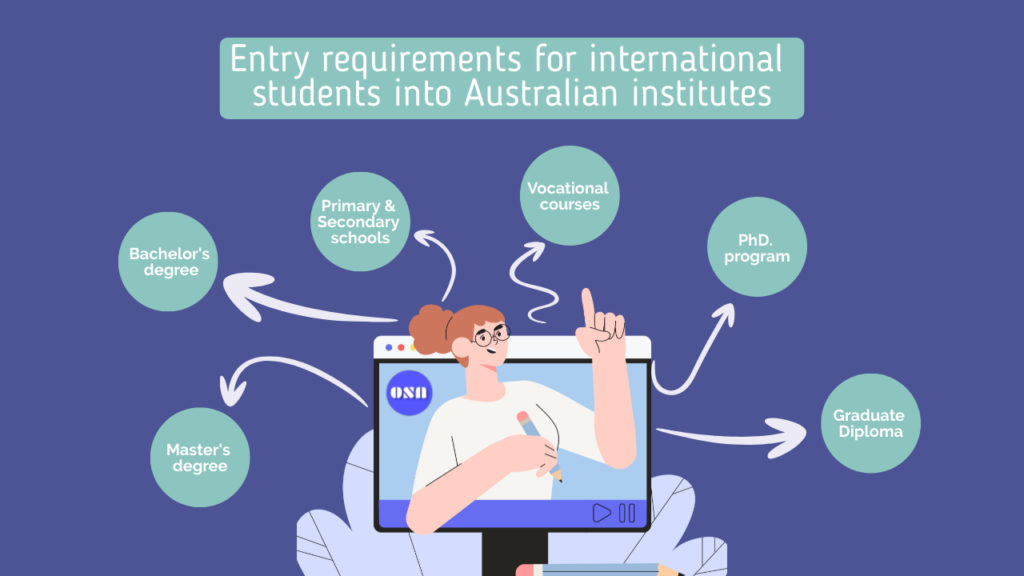
In this article, we will discuss the basic entry requirements for international students enrolling in Australian schools, colleges, and universities.
A brief guide for applying for admission into Australian educational institutes
You may start the application process after you’ve chosen a program and an institution.
Before submitting an application, prospective students should verify that they meet the minimum educational and English proficiency standards.
The majority of Australian overseas students apply directly by mail or online or through an educational agent. The application form will include the course(s) you want to enroll in, as well as provide required information and documentations.
The basic information required in most of the application forms are:
Your personal information;
Verified proof of English language proficiency;
Transcripts of past academic qualifications
References.
Many schools need a non-refundable application fee, often between $50 and $100 Australian Dollars (AUD), to be sent with the application.
Make sure you meet the criteria for a student visa on the Department of Home Affairs website before submitting an application.
Once you’ve submitted your application, the educational institution will examine it. It can take a few weeks before your application is processed (or longer for post graduate programs).
You will get an offer letter and an acceptance form if you are chosen. You should read the complete offer letter before making a choice in order to be well-informed about the conditions.
You must first fulfill the conditions in the offer letter in order to get a Confirmation of Enrollment from the institution (CoE).
After being approved and receiving the CoE from your educational institution, the next step is to apply for a student visa. Use your letter of offer or your CoE to apply for a student visa.
You will also be required to submit a GTE statement and get OSHC cover for your studies in Australia.
Now let’s look into more specific entry requirements into different courses in Australia.
Entry Requirements to study in primary and secondary school in Australia
Each school might have different admission criteria but to give you a general idea, following are the entry requirements.
Students in Prep through Year 6 can enroll in the Primary School program by meeting the following criteria:
The program must run for a minimum of six months.
Students whose first language is not English must either participate in a Young Learners Program or present documentation of their proficiency in the language.
Whereas if we talk about secondary education in Australia, it is offered by government and non-government institutes. Depending on the state or region and the duration of elementary school, it is offered for five to six years.
In Australia, secondary education consists of two study levels and starts in years 6 or 7.
Secondary school (lasts 3 to 4 years – Years 7 to 10 or 8 to 10)
Senior secondary school (lasts for two years – Year 11 and Year 12)
The requirements for enrolling in secondary school in Australia vary from one state or territory to the next, as do the specific schools you want to attend.
The application procedure considers several elements, including your academic record, extracurricular activity, athletic abilities, and other factors.
Candidates from other countries will be judged on how well they meet the English language standards. The student may enroll in a high school preparatory course to improve their English proficiency if they do not already fulfill the standard. We have already covered a separate article on getting secondary education in Australia; check it out here.
English Requirements:
Year 7 & 8 = IELTS 4.0 – TOEFL = 31
Year 9 = IELTS 4.5 – TOEFL = 32
Year 10 = IELTS 5.0 – TOEFL = 35
Year 11 = IELTS 5.5 – TOEFL = 46
Year 12 = IELTS 6.0 – TOEFL = 60
If you are under the age of 18, you will also need to have welfare arrangements sorted before arriving in Australia for your studies.
Entry Requirements for VET (Vocational courses) in Australia
Instead of going to university, international students can choose to undertake vocational education programs. These vocational programs are offered by various Tafes and private institutions, which both public and private universities offer, providing real-world learning experiences.
These programs provide real world experiences to the students, which hence equip them with skills to start working as soon as they graduate.
In order to ensure quality education in these programs, Government agencies keep an eye on these education providers and audit them regularly for compliance purposes.
Typically, students will attend 15 to 20 hours of in-person training weekly.
When students graduate from VET institutions, their credentials are recognised in Australia and often in other nations worldwide
Some basic entry requirements for vocational programs are as follows:
International students who want to enroll in the VET system must complete a level of study comparable to years 10, 11, and 12 in Australia. In your native country, you must have attended and graduated from at least the third year of high school.
International students may need to pass an English exam to enroll in a vocational program.
While some courses would need job experience, others could have prerequisite subjects.
A portfolio might be required for admission to courses like painting and design.
For English Proficiency, you must provide proof that you are at least at the following levels of English proficiency:
IELTS: You will need to score an overall of 5.5, no band less than 5.0
TOEFL: You will need to score an overall of 55 with individual section scores no less than (Listening: 9, Speaking: 16, Reading: 10, Writing: 18)
PTE: You will need to score an overall of 42-49 with no section score less than 40
CAE: You will need to score an overall of 162 with no individual band less than 154
Entry Requirements for Graduate Diploma and Graduate Certificate in Australia
A Graduate Certificate program is a 6 months full time program (one semester) and usually includes 3 to 4 units of study. The typical length of study for a graduate diploma at a university is 12 months and usually includes 8 units of study (two semesters).
A Graduate Certificate and Graduate Diploma is the next step for students after finishing a Bachelor’s degree in Australia.
The entry requirements for Graduate Certificate is a Bachelor’s degree and for Graduate Diploma is a Bachelor’s degree along with Graduate Certificate.
Apart from that, international students are usually required to provide proficiency of their English levels by providing a result for one of the following:
IELTS: You will need to score an overall of 6.5, no band less than 6.0
TOEFL: You will need to score an overall of 79 with individual section scores no less than (Listening: 19, Speaking: 19, Reading: 18, Writing: 22)
PTE: You will need to score an overall of 58-64 with no section score less than 50
CAE: You will need to score an overall of 176 with no individual band less than 169
Entry Requirements for Bachelor’s degree in Australia
International students can only apply for a bachelor’s degree in Australia after twelve years of elementary and secondary school.
International students are suggested to apply for admission early, so they have plenty of time to get necessary visas and arrange travel arrangements.
Standard admission entry requirements for a Bachelor degree in Australia are as:
Application fee: Most universities will require application fee of around $100 to $200 to apply for their courses
Academic Transcripts: You will also need a score of between 60% and 70% on the Australian equivalent of the High School Leaving Exam (HSLE) to apply to a Bachelor degree program in Australia (12th grade).
English Test Results: A good score on an internationally recognised English language test that proves you’re proficient enough to study in Australia.
Others: Further requirements such as surveys, letters of recommendation, work experience, portfolio’s etc.
In regards to the English proficiency, as a general guide, you will be required to provide a proof of one of the following levels:
IELTS: You will need to score an overall of 6.0, no band less than 6.0
TOEFL: You will need to score an overall of 67 with individual section scores no less than (Listening: 12, Speaking: 18, Reading: 15, Writing: 21)
PTE: You will need to score an overall of 50-57 with no section score less than 50
CAE: You will need to score an overall of 169 with no individual band less than 169
Entry Requirements for Master’s Degree in Australia
For getting into Master’s degree in Australia, having an undergraduate degree is a must.
The typical cutoff for eligibility to apply for a Master’s degree at Australian universities and Institutions is 60% or GPA of 4.0. The Australian Bachelor (Ordinary) Degree equals a foreign undergraduate degree such as a B.Sc., B.Com., or B.A.
If you are planning to do a Masters degree by research, then you might be required to have an equivalent to the Australian Bachelor (Honors) Degree or previous research experience.
Some other requirements are as follows:
Application Fee: You will expected to pay $100 to $200 as an application fee
Academic Transcripts: You must present the results of your earlier academic life. At the time of admission, you must present your Secondary School Certificate (Year 10 transcripts), High School Certificate (Year 12 transcripts). In addition, you must submit the Transcript of Records, which lists all of the subjects you studied for your Bachelor’s and the marks and grades you earned in each of them.
Entrance Exam Results: You may also submit your results from any university entrance exams you’ve taken as evidence if you have! Some university courses like MBA might need students to undergo an entrance exam like GMAT, GAMSAT, LSAT etc.
English Test Results: A good enough score is required in an internationally recognised English proficiency test for an overseas student. Most universities in Australia accept the IELTS, PTE, or TOEFL examinations to measure your proficiency in English. A letter from your former university that confirms that you completed your undergraduate degree entirely in English and don’t need to take any additional exams may also be accepted by certain universities.
Attending Interviews: Interviews could be conducted by some universities in order to check the communication skills, professionalism and reasons for those specific courses.
Here is a general guide for the English proficiency scores that you need to provide for your Master’s degree in Australia. Please note that these numbers can vary from one institution to the other :
IELTS: You will need to score an overall of 6.5, no band less than 6.0
TOEFL: You will need to score an overall of 79 with individual section scores no less than (Listening: 19, Speaking: 19, Reading: 18, Writing: 22)
PTE: You will need to score an overall of 58-64 with no section score less than 50
CAE: You will need to score an overall of 176 with no individual band less than 169
Entry Requirements to PhD (Professional Doctorate Degree) in Australia
Getting entry into PhD programs in Australia is different from getting entry into most other courses. Most of the PhD programs in Australia are research based.
Before you submit your formal application to the university, you will need to find a research supervisor. This will be someone who will be the lead researcher in your preferred institution and area of study.
Then you need to submit a brief research proposal to this prospective supervisor. If the supervisor accepts your research topic, then you will receive an expression of interest from this provisional supervisor.
From here, you can start a formal application to the university. But if the supervisor doesn’t accept or support the application, then you will need to find another supervisor.
Most universities will not accept the formal application from PhD students until they have a research supervisor.
Once you have expression of interest, then you will need to meet the following requirements. Please note that each university sets its own requirements and might require you to meet further requirements than listed below here:
A Bachelor’s and a Master’s degree in the relevant field of study.
Evidence of your prior research experience certified from your previous university or universities.
Approved expression of interest for your research proposal from academic supervisor
References from the academic or professional world
Universities might require students to go through an interview for getting accepted into Doctorate degrees.
Provide proof of your English proficiency by undertaking IELTS/PTE/TOEFL/CAE test.
You must provide proof that you are at least at the following levels of English proficiency:
IELTS: You will need to score an overall of 6.5, no band less than 6.0
TOEFL: You will need to score an overall of 79 with individual section scores no less than (Listening: 19, Speaking: 19, Reading: 18, Writing: 22)
PTE: You will need to score an overall of 58-64 with no section score less than 50
CAE: You will need to score an overall of 176 with no individual band less than 169
We hope we were able to give you a general idea of what it looks like to apply for an admission to different programs in Australia. You can also check out the following related articles that we covered regarding studying in Australia.
The opportunity to study in Australia is a much sought-after experience that students worldwide look to make a reality. But there are things you have to think about before moving.
If you’re moving to Australia to study, here is a checklist of things you’ll need to consider before you arrive.
Research Locations
Australia is a vast and diverse country with several climates and cultural differences. Before deciding on your course, research the locations on offer and ensure that wherever you are studying is somewhere that will suit you.
For example, if you’re looking to study marine biology, the coast of Queensland, with its diverse maritime ecosystem, will be the perfect location. Meanwhile, anyone studying business or finance would be better off looking in Australia’s financial capital, Sydney.
After the decision is done, there is another one. You have to find a proper place to live in your location. No need to say that you have to go online. With modern sites, like Rentola, offering a vast range of outstanding student accommodation across Australia, finding somewhere to live will be nice and easy.
There is something to suit everyone, whether people are looking for rural or urban ways of life.
Get the Right Visa
If you aim to study for longer than three months in Australia, you must get a study visa. The application process is straightforward and can be completed online, and when granted, the visa is automatically linked to your passport.
A regular visitor’s visa often covers courses lasting less than three months. However, it is prudent to check this before you travel.
So, while you won’t need to wait endlessly at embassies to pick your visa up, they are relatively expensive. Make sure you have the money readily available when submitting your application.
Health Insurance
Depending on your course provider, you will likely need to organize health insurance. Study abroad programs generally include health insurance as part of their offering, but university study will require you to organize health insurance.
Under Australian law, all students are required to obtain Overseas Student Health Cover (OSHC). Insurers provide several types of cover, so it pays to do your research and pick the policy that best suits your needs.
If you’re unsure whether health insurance is included as part of your course, speak to your provider before you travel.
Set Realistic Budgets
There’s no getting around the fact that Australia is an expensive country to live in. Melbourne and Sydney are almost ever-present in the list of top 10 most expensive cities worldwide.
Whether housing, food, or home supplies, be prepared to pay top dollar.
Take time before you travel to research prices, create a realistic budget and make every effort to stick to it. There will sometimes be unforeseen expenses that crop up. However, it’s estimated that students should allow $6,000 to 7,000 on top of tuition and accommodation expenses annually.
Topsy-Turvy Seasons
For anyone living in the northern hemisphere, one of the most significant cultures shocks Australia will provide is the switch in seasons. While Christmas is often spent basking in temperatures over 100 Fahrenheit and with shrimps broiling on the barbecue, be prepared for the shock of winter.
As May, June, and July approach and you’re used to wearing short sleeves and basking in the glow of warm sunshine, the southern cities in Australia do get cold during the Aussie winter. So make sure you prepare and pack accordingly, just as you would for a European or North American winter with plenty of layers and winter woollies.
Striving for a Grade HD
The grading system in Australian education can take some getting used to. Rather than Grade A being the pinnacle and what students strive towards, they aim for a Grade HD.
There are five grades in Australia. They are:
HD – High Distinction
D – Distinction
C – Credit
P – Pass
F – Fail
There’s every chance your first instinct will be an acute disappointment when you see a Grade C or D on your first few assignments before realizing that you’ve done a fine job.
Find Work
The cost of living and studying in Australia is well-known. However, it is possible to help fund your education while living there by getting work, just as you might at home.
A study visa in Australia usually allows you to work a certain number of hours weekly. While the cost of living is high compared to other parts of the world, the good news is that the minimum wage also pays much more than it does elsewhere.
As well as helping to bridge that funding gap and improve your quality of life while in Australia, it’s a great way of meeting people and making new friends in foreign climes.
Get an Australian Bank Account
If you have a study visa and are going to be studying for longer than one semester, it’s sensible to get an Australian bank account.
This will be essential if you are also working around your studies to help make ends meet.
Withdrawing money from your bank at home and using a bank card from another country will incur fees that will soon add up and begin to eat into your much-needed funds. If you can save a little each month, many Australian banks offer attractive interest rates for savers.
Do you get confused with acronyms or abbreviations that you see while studying in Australia or even before planning to study in Australia? And thanks to social media and messengers apps, we are using them more than ever before.
So what is an Acronym?
Acronym is an abbreviation formed from the initial letters of other words and pronounced as a word.
And so what is Abbreviation then?
Abbreviation is a short form of a phrase or a word.
Hope that’s clear now!
In this article, we look at a list of 70+ popular Australian acronyms that international students in Australia should know about.
We divided these acronyms in different areas where you might come across them in Australia.
Australian grading acronyms
These are some of the acronyms you will come across in the Australian grading system:
HD – High Distinction
D – Distinction
C – Credit
CP – Credit Pass
P – Pass
F – Fail
NYC – Not Yet Competent
C – Competent
ATAR – Australian Tertiary Admission Rank
If you want to know more information on Australian grading system, then we suggest you check this guide.
Education acronyms
You will come across some of these education acronyms in Australia:
AQF – Australian Qualification Framework
CRICOS – Commonwealth Register of Institutions and Courses for Overseas Students
ECOE – Electronic Confirmation of Enrolment
ESOS – Education Services for Overseas Students
RPL – Recognition of Prior Learning
RTO – Registered Training Organisations
VET – Vocational Education and Training
Government Departments acronyms
These are the common Australian government department acronyms you might come across:
ABF – Australian Border Force
ABS – Australian Bureau of Statistics
ATO – Australian Taxation Office
DHA – Department of Home Affairs
DFAT – Department of Foreign Affairs and Trade
DoH – Department of Health
FWO – Fair Work Ombudsman
Language acronyms
Some of these acronyms are commonly used in language classes or courses in Australia:
ELICOS – English Language Intensive Course for Overseas Students
ESL – English as Second Language
IELTS – International English Language Testing System
PTE – Pearson Test of English
AMEP – Adult Migrant English Language Program
States acronyms
Lists of all the Australian states and territory acronyms:
ACT – Australian Capital Territory
NSW – New South Wales
NT – Northern Territory
QLD – Queensland
SA – South Australia
TAS – Tasmania
VIC – Victoria
WA – Western Australia
Tax acronyms
Common Australian Tax acronyms:
ABN – Australian Business Number
ACN – Australian Company Number
GST – Goods and Services Tax
PAYG – Pay-as-you-go
TFN – Tax File Number
University acronyms
Most common Australian university acronyms:
ACU – Australian Catholic University
ANU – Australian National University
CDU – Charles Darwin University
CQU – Central Queensland University
CSU – Charles Sturt University
ECU – Edith Cowan University
JCU – James Cook University
QUT – Queensland University of Technology
RMIT – Royal Melbourne Institute of Technology
SCU – Southern Cross University
UC – University of Canberra
UTS – University of Technology, Sydney
UNSW – University of New South Wales
UWA – University of Western Australia
VU – Victoria University
Visa acronyms
Some of the Visa acronyms that you will come across in Australia:
OSHC – Overseas Students Health Cover
GTE – Genuine Temporary Entrant
HAP ID – Health Case Identifier
VEVO – Visa Entitlement Verification Online
PSWP – Post Study Work Permit (Visa)
PR – Permanent Resident
Other popular Australian acronyms
Here are other acronyms you will come across when living in Australia. These can vary from sports to national events and everyday life:
AFL – Australian Football League
AKA – Also Known As
ANZAC – Australian and New Zealand Army Corps
ASAP – As Soon As Possible
BBL – Big Bash League
DIY – Do it Yourself
DOB – Date of Birth
OHS – Occupational Health and Safety
WHS – Workplace Health and Safety
Let us know if you find any other acronyms that you don’t know about, so we can include that in the list of these acronyms. Please make sure to send us your comments and ideas via Instagram DM here.
From 1st July 2022, the minimum wage has been increased by 5.2 percent. So, the new minimum wage is $21.38 cents per hour or $812.60 per week. which will be roughly 40 dollars extra per week if you are working full time.
It is estimated that around 180,000 people will benefit from this increase
It is such a positive news for all the international students as most of the international students usually work on these minimum wage rates.
You can read the update from Fair Work Commission’s website.
3. Increase in Superannuation Guarantee
For those student, who don’t know what is superannuation, it is basically your retirement fund and your employer have to pay you a certain fixed percentage of superannuation on top of your salary depending upon how many hours you work.
If you want to know more about Superannuation, then check our article on that.
So that percentage of superannuation guarantee is increasing from 10 percent to 10.5 percent.
It effectively means you will have more funds in your superannuation fund account.
You can read the detailed update on ATO’s website.
4. Superannuation Guarantee for everyone
In the recent past, there was a condition that if you earn less than 450 dollars in a month your employers don’t need to pay you superannuation.
But that condition is now scrapped so basically everyone will receive these superannuation payments regardless of how many hours they have worked or how much money they earned during the month.
There’s only one exception to this that if you are under 18 and you work less than 30 hours then you’re not entitled to superannuation for that month.
As some of you are already aware that some international students who had the temporary graduate visas got stuck overseas because of the COVID-19 pandemic border closures in Australia.
So these students who had this temporary graduate visa will be able to apply for a replacement temporary graduate visa from 1st July 2022.
With these new replacement visas students will be able to get the same length of stay as per the original Temporary graduate visa.
Australian government is definitely doing the right thing by giving these temporary graduate visa holders additional time to stay in australia because obviously it wasn’t their fault that they got stuck overseas because of the border closures
6. Pathway to PR for Temporary Skill shortage visas
Temporary skills shortage visa holders (subclass 482) will have access to a new pathway for getting Australian permanent residency.
So this is a new pathway to PR for these temporary skill shortage visa holders who helped Australia during COVID-19 pandemic.
They will be able to apply for this pathway through TRT (Temporary Resident Transition) stream of the subclass 186 of employer nomination scheme.
These visa holders must have lived in australia for at least 1 year between 1st February 2020 and 14 December 2021.
This pathway will be only available for the next two years, so the people who are keen to apply for this visa they need to make sure that they apply within these two years.
Each year, thousands of students choose to study in Australia.
Many of them wonder if there are some intakes that they should avoid and some intakes that they should consider opting in.
In this article, we will look into the best and worst intake for studying in Australia as an international student.
We will also talk about some specific reasons for choosing the best and the worst intakes.
First, let’s understand the common intakes in Australia for international students.
Common University Intakes in Australia
Universities in Australia usually have three major intakes.
February
July
November
Please note that some universities might have a March intake instead of February and some of them might have an October or December intake instead of November.
So, keep that in mind that sometimes it may vary based on the university.
Common VET (Vocational Education) Intakes in Australia
Vocational Courses intake varies from one institution to another.
But to give you an idea, there could be 4 to 8 major intakes during the year.
Example of 4 intakes in VET courses during the year could be:
February
April
July and
September
Again, keep it mind, it varies based on one institution to the other.
Common English Courses Intakes in Australia
English courses could have multiple intakes during the academic year in Australia.
To study English courses in Australia, including ELICOS, you can enrol on a weekly, fortnightly or monthly basis.
It will depend upon the type of course you’re choosing and the college you choose to study English course.
Worst intake to come into Australia for studies
We are calling “November” intake (or October intake in some universities) as the worst intake to come into Australia for your studies.
Here are the specific reasons behind it:
Option to take time off during summer semester
November Semester is also known as the summer semester, where you have the option to take time off from your study.
In short, it means that you will have 3 to 4 months time off from your studies.
But if it is your first semester to study, then obviously you can’t choose that option.
Most of the students who start their studies in February and July intake usually plan to opt out of this semester. Here are some reasons for that:
Unlimited work hours for international students
During the study period where an international students course is in progress, they are not allowed to work more than 48 hours per fortnight.
However, international students are allowed to work full-time hours during the time their course isn’t in session.
Many students eagerly await the opportunity to work unlimited hours during the November semester, when they have the option to take time off.
But, if you are coming in November intake, then you don’t have that option, and you will still have to abide by the 48 hours per fortnight work limit.
Summer time in Australia
There is a reason why they call the November semester a “Summer semester”.
You guessed it right! Because it is summer here in Australia.
It goes without saying that Australia has some of the best beaches in the world and the best time to go to a beach is…… You guessed it right again. Summer!
Plus, there are so many other places and events that you could visit, attend and enjoy during that time of the year.
Coming in November intake means you could be missing out on all this fun.
Of course, you can still enjoy the summer here in Australia while studying, but it is not the same if you have a whole semester break and can go travelling and doing other activities without worrying about assignments and exams.
Plenty of jobs available during summer
During summer, you can easily find some part-time work in the hospitality and event sector as there are many sporting events and other events that happen during summer.
While there might be plenty of job options that you could choose from during Christmas holidays and school holidays (falls inside the whole summer semester), most of these jobs will expect you to have some sort of full-time availability.
As employers look for people who they can roster for full-time hours, as it is the busiest time of the year for them.
And if you are coming as a international student in November intake, and you can only work 40 hours per fortnight, then that is a drawback for you.
Limited number of lectures or tutorial sessions
Many lecturers and tutors will be taking their time off during summer break.
It means, most likely, they won’t be working during the November semester.
Great for them, but not so much for you as an international student.
As there is a chance, you will have a limited number of lectures and tutorials offered during that term.
In February and July intakes, there are usually plenty of options available for lectures and tutorials to choose from. So, you can choose lectures and tutorials based on your work, lifestyle and family, etc.
Not having too many options to choose from in the November intake means you will be limited to what the university offers in that semester.
Fewer people on campus
Last but not the least!
During this November intake, there will be fewer people on campus.
Whether it is students, administration teams or lecturers, you will see that there will be less number of people on the campus
Orientation for the new students will not be as glamorous as you would expect in the February or July intake.
Support services will also be limited due to the limited number of people working in those services.
Best intake to come for studies in Australia
Now when it comes to the best intake, we are calling “July intake” as our pick for the best intake to come for your studies in Australia.
The main reason for choosing July intake over February intake is that after completing your July semester, many universities allow you to take time off during the summer break in November.
So, if you choose July intake, then you can opt out of the November semester and do all those things which we mentioned above. That will not be a possibility if you come in February intake as November is the only summer semester. So, you can’t choose to take time off in July intake if you started studying in February intake.
Very important: Before enrolling, please check with your university, if they allow you to choose a summer semester off after studying only one semester. Some universities may have a policy that you must study 2 semesters before getting a term off.
Hope you found this information useful.
If you’re coming to Australia for your studies, we recommend you to download our Free Overseas Students Guide here.