Do you love the idea of caring and sharing knowledge with young kids? Are you a patient, creative and fun person? Then, the career as a primary school teacher might be a perfect fit for you!
This is an important profession that involves educating young children and helping them develop gradually in their social, emotional, intellectual and physical functions.
So in this blog, we are giving you a complete guide on how to become a primary school teacher in Australia.
Overview of the Industry
Primary school teachers play an important role in society by guiding children through various developmental stages.
It is a very delicate profession that needs absolute scrutiny and proper skills in place. Normally, the ages of children under this educational system range from 6 to 12 years and the duration of this education level in Australia is 7 years.
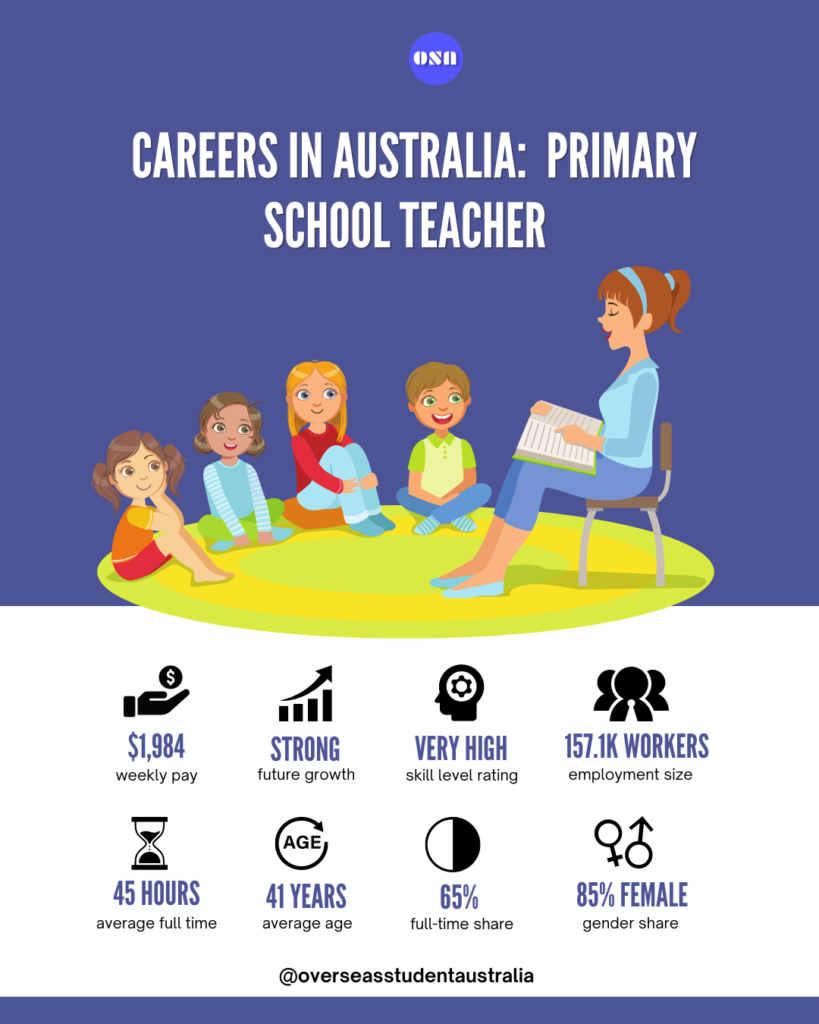
Over 157,000 primary school teachers are now employed in Australia, and there is projected to be a decent demand for these professionals in the coming years.
Size of the industry
This is a highly skilled professional with over 157,000 primary school teachers in the Australian workforce. Projections show a growth of 5.1% by 2026.
Popular Locations
About 42% of the primary school teachers population in Australia live outside capital cities. New South Wales and Victoria have a large share of employers of primary school teachers.
Here below is the percentage of primary school teachers in different areas of Australia by state and territory:
New South Wales 31.1%
Victoria 26.2%
Queensland 20.2%
Western Australia 10.8%
South Australia 7.1%
Tasmania 2.1%
Australian Capital Territory 1.7%
Northern Territory 1.0%
This is why it is necessary to consider a potential career path when selecting a city to study. Click here to find out how to choose a city to study in Australia.
Industries where primary school teachers are needed
The education and training industry employs 99.3% of the primary school teachers workforce in Australia, the largest of all their employers. Here are the other industries where primary school teachers work:
Public Administration and Safety
Healthcare and social assistance
Administrative and supportive services
Hours of work
In Australia, around 65% of employed primary school teachers work full-time hours in all their jobs. The full-time teachers work an average of 45 hours per week in their primary job, which is very similar to the average working hours for all jobs in Australia (44 hours per week).
About two-thirds of workers regularly work overtime or extra hours (either paid or unpaid).
Age
The average age of primary school teachers is 41 years, which is slightly higher than the all-jobs average of 40 years in Australia. A large share of workers (28.7%) are within the age bracket of (25 to 34) years.
Gender
With over 157,000 primary school teachers in Australia, women account for 85% of the entire workforce, while men account for 15%; this is 37% above the all-jobs average (48%) for women and 33% above the all-jobs average for men.
What are some of the skills required to become a primary school teacher in Australia?
Here are some essential skills you must have to be a qualified primary school teacher in Australia:
Caring
Emotional intelligence
Social skills
Creative thinking
Communication skills
Education and training skills
Coaching
Monitoring and Coordination
Listening skills
Administrative skills
Note that skills can be improved through training or experience.
What are the tasks and duties of a primary school teacher in Australia?
Here are some of the tasks and duties performed by primary school teachers:
Engaging students in recreational activities like sports, music, speech, games etc.
Supervising the children’s whereabouts and welfare on trips
Rafting out learning structures for students
Attending to administrative duties
Maintaining discipline among children in the classroom and the general school
Engaging the children in educational and developmental conversations
Give reports to parents on their children’s progress during PTA meetings
Do teaching and educational activities according to standard
How much do primary school teachers earn in Australia?
Primary school teachers’ pay is quite relative depending on their employer, their experience, the number of subjects to be taught to the children, qualifications and so on.
On average, a primary school teacher’s full-time earnings are $1,984 per week, which is much higher than the job’s average pay ($1,593).
The average hourly pay for a primary school teacher is $54, which is more than all job’s average pay ($41 per hour).
Essential steps on how to become a primary school teacher in Australia
Here is a step-by-step procedure on how to become a primary school teacher in Australia:
Step 1: Complete a Bachelor’s degree
At the very least, a bachelor’s degree is required to become a teacher in Australia. You must complete a bachelor’s degree in any primary education-related field such as Bachelor of Education (Primary).
Work-study allocations would also help you gain adequate teaching experience. The bachelor’s degree program runs up to 4-years of full-time study depending on the university, where both practical and theoretical experiences are received.
The average cost of getting a bachelor’s degree in Education ranges from $25,000 to $35,000 per year.
Alternatively, students can also do a 3-year Bachelor degree in any discipline along with 1 year Graduate Diploma in Teaching as well.
International students who are planning to become Primary School Teachers in Australia, must demonstrate high English Language skills by undertaking an IELTS test (with a minimum score of 7.0 in Reading and Writing and 8.0 in Speaking and Listening).
You are exempt from an English Test as an international student if you have already completed 4 years of higher education (university) in Australia, Canada, Ireland, New Zealand, UK or USA.
Step 2: Complete a Postgraduate degree
In a situation where you have completed a bachelor’s degree in a different discipline, you can opt for a Master of Teaching in specific fields relating to primary education.
The most popular course is Master of Teaching (Primary). This course will help you with the needed professional skills to speed up your learning process.
Step 3: Get Registered
You must be registered with a Teachers Registration Authority in any state you wish to work at. This is a necessary step to take before you can be qualified to teach.
The need for registration is unique to the state where you intend to teach.
Step 4: Get your Working with Children Check
Before you step into the class to teach young children in a primary school, you might need to obtain a Working With Children Check, depending on the state and territory you are planning to work in.
In some states and territories in Australia, you might not need a separate Working with Children Check if you have got the Teacher’s Registration.
Top institutions to get a degree in Education in Australia
These are some of the most popular universities to get your degree in Education to become a primary school teacher in Australia.
University of New South Wales
University of Sydney
The University of Queensland
Monash University
University of Adelaide
Griffith University
Deakin University
Future growth of the primary school teacher career in Australia
Teaching has a strong projected growth of up to 5.1% by 2026, making it a decent career path. This particular teaching specialty is necessary in the Australian educational system because it forms the foundation of development.
As a primary school teacher, you can work in a public school or private school. Sometimes, primary school teachers further specialise in tending to children with special needs or home-based learners.
And this is everything you need to know about becoming a primary school teacher in Australia. Let us know the next career you would like us to cover in the comment section below.
Are you great at problem-solving? Do you love calculative adventures that involve maths, physics and technical skills?
If your answer to these questions is Yes, then you are in the right place!
In this blog, you will discover all the vital information you need on how to become an electrician in Australia.
Overview of the Electrical Engineering Sector
Electricians are important and in high demand in Australia.
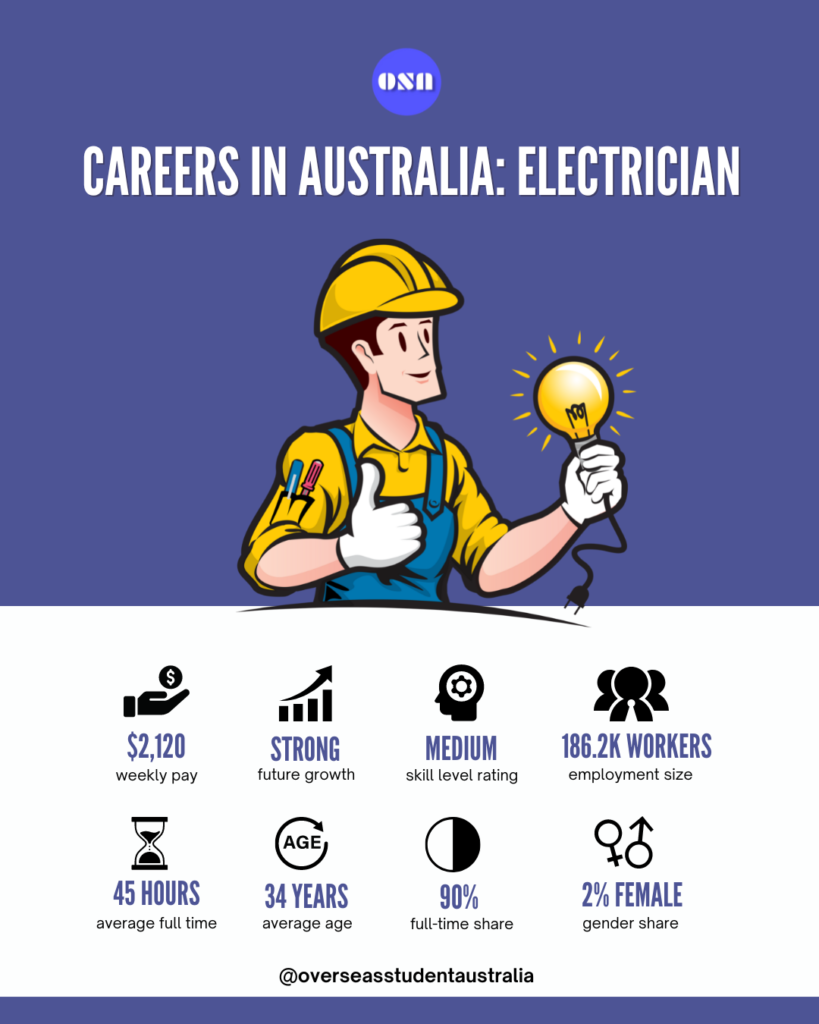
There are over 186,000 electricians now employed in Australia, and there is still massive demand for these professionals, making this industry a sweet spot to start a career in.
Electricians build, assemble, fit, analyse, diagnose, support and repair electrical systems, circuits, equipment, parts and appliances. They work for domestic (homes), industrial (plants), and commercial (businesses) purposes.
This is a great career path for you if you are hard-working, technical and have good maths skills.
Size of the industry
There are over 186,000 electricians in Australia. Projected statistics show strong growth of 10.2% by 2026. This is clearly a reliable career path to walk in.
Popular Locations
Electricians are in high demand in different locations in Australia. Around 44% of electricians live outside capital cities. Here below is the percentage of Electricians in different areas of Australia by state and territory:
New South Wales 29.2%
Queensland 22.7%
Victoria 22.1%
South Australia 14.2%
Western Australia 6.7%
Tasmania 2.0%
Australian Capital Territory 1.7%
Northern Territory 1.3%
This is why it is vital to consider a potential career path when selecting a city to study. Click here to find out how to choose a city to study in Australia.
Industries where electricians are needed
A massive 68% of the entire electrician workforce work in the construction industry. Other industries account for the remaining 32% of electricians in Australia.
The industries include:
Manufacturing 7%
Mining 6.2%
Electricity, Gas and Water and Waste services 5.6%
Other industries 13.2%
Hours of work
In Australia, around 90% of employed Electricians work full-time hours in all their jobs. Full-time workers work an average of 45 hours per week in their primary job.
This is like the working hours average for all jobs in Australia (44 hours per week). About a third of workers regularly work overtime or extra hours (either paid or unpaid).
Age
The average age of Electricians is 34 years. This is younger than the all-jobs average of 40 years. A large share of workers (30.6%) are within the age brackets of (25 to 34) years.
Gender
With over 186,000 Electricians in Australia, women account for a drastically low 2% of the entire workforce, while men account for the remaining 98%.
This is 46% below the all-jobs average (48%) for women and 50% above the all-jobs average for men.
What are some of the skills required to become an electrician in Australia?
Here are some essential skills you must have to be an electrician in Australia:
Critical thinking
Electrical know-how Skills
Building and construction
Mechanical and technical skills
Mathematical skills
Customer service skills
Physical handling skills
Analytical skills
Practical and administrative skills
Note that skills can be improved through training or experience.
What are the tasks and duties of an electrician in Australia?
Here are some of the tasks and duties performed by electricians:
Diagnosing faults in electrical systems and networks using proper equipment.
Proper installation of appliances and tactical positioning of switchboards.
Re-wiring faulty circuits and electrical boards.
Analysing blueprints, wiring diagrams and specifications to find methods of operation.
Giving professional advice to clients or customers on issues relating to their electronics and electrical systems.
Proper lightening, wiring and fixtures
How much do electricians earn in Australia?
Electricians salaries differ depending on their level of education, skill and experience in the industry.
Average full-time earnings are $2,120 per week, which is much higher than the all-job average pay ($1,593). The average hourly pay for electricians is $49, which is more than the entire job’s average pay ($41 per hour).
Essential Steps To Becoming An Electrician In Australia
To work as an electrician in Australia, you need proper training backed up with accredited licensing.
It is essential to know that before taking any course, you need to have a minimum education requirement of Year 10 or Year 12 (High School Certificate) or its equivalent.
If an international student decides to complete the below listed courses, then they must meet the Year 12 equivalent academic requirements and English test requirements (e.g.overall score of 5.5 in IELTS test).
Here is a step-by-step procedure on how to become an electrician in Australia:
Step 1: Complete a Certificate III in Electrotechnology
To become an electrician in Australia your first step is to complete a Certificate III in Electrotechnology.
A certificate III in Electrotechnology provides students with the knowledge of selecting, installing, setting up, repairing and managing electrical networks.
You are required to complete a Certificate III in Electrotechnology through a school-based apprenticeship or NECA education.
For local students, this certification accompanied by your apprenticeship would be completed within 4 years of full-time study and cost an average of $12,000 to $18,000..
For international students, this certification would be completed within 2 years of full-time study and cost an average of $10,000 to $15,000 per year.
Some students also usually undertake Certificate II in Electrotechnology to enhance the basic knowledge, but it is not a prerequisite for Certificate III in Electrotechnology.
Step 2: Complete Apprenticeship training
This step involves acquiring both on-site and off-site experience in the industry. It is necessary to complete apprenticeship training to become a qualified electrician.
You would be employed as an apprentice with an electrical employer where you would learn both practical and theoretical aspects of the occupation whilst undergoing a Certificate III in Electrotechnology course.
It takes 4 years for a full-time apprenticeship along with the completion of your Certificate III in Electrotechnology.
Important note: International students can’t undertake apprenticeships in Australia. Please speak to the school (some institutes listed below) for relevant training for this course.
As a part of the course, international students may be required to undertake practical vocational placements to learn about the practical component of the profession.
Step 3: Get A Licence
There are a series of licences and requirements that must be met before you become a licensed electrician in Australia. These licences vary from state to state. For example, to work as an electrician in Victoria you need the following certifications:
Licensed Electrician’s Assessment (LEA)
Licensed Electrician’s Theory (LET)
Licensed Electrician’s Practical (LEP)
Safe Work Practice (SWP)
Here are the requirements to become licensed electricians in Queensland and New South Wales.
What are some of the popular institutions to study electrotechnology certificates in Australia?
For domestic students, these are popular institutions for Electrotechnology courses:
Swinburne University of Technology
Tafe New South Wales
Tafe Western Australia (TAFE)
University of Technology Sydney
Royal Melbourne Institute of Technology
Tafe Queensland
The University of Adelaide
For international students, there are few providers providing Electrotechnology courses including:
Australia Superior Training Centre
Australia Study Centre
Ausinet
Future growth of Electrical Engineering career in Australia
Electricians are in high demand because their skills are needed in various industries like construction, mining, domestic, commercial, manufacturing, waste and water, etc.
This is a promising career path with projected strong growth for the next 5 years. Recent technology has heavily changed this industry as new specialisations are open from IT to using special tech software such as Auto CAD, Simulink, Proteus etc.
With proper training, experience and continuous learning, you will gain mastery and recognition in this industry.
And this is everything you need to know about becoming an electrician in Australia. Let us know the next career you would like us to cover in the comment section below.
Have you been wanting to travel outside of Australia but are unsure which countries will suit your budget?
The good news is that there are many countries where the Australian dollar goes further, and you can enjoy state-of-the-art hotels, delicious foods, and fun recreational activities without breaking your bank.
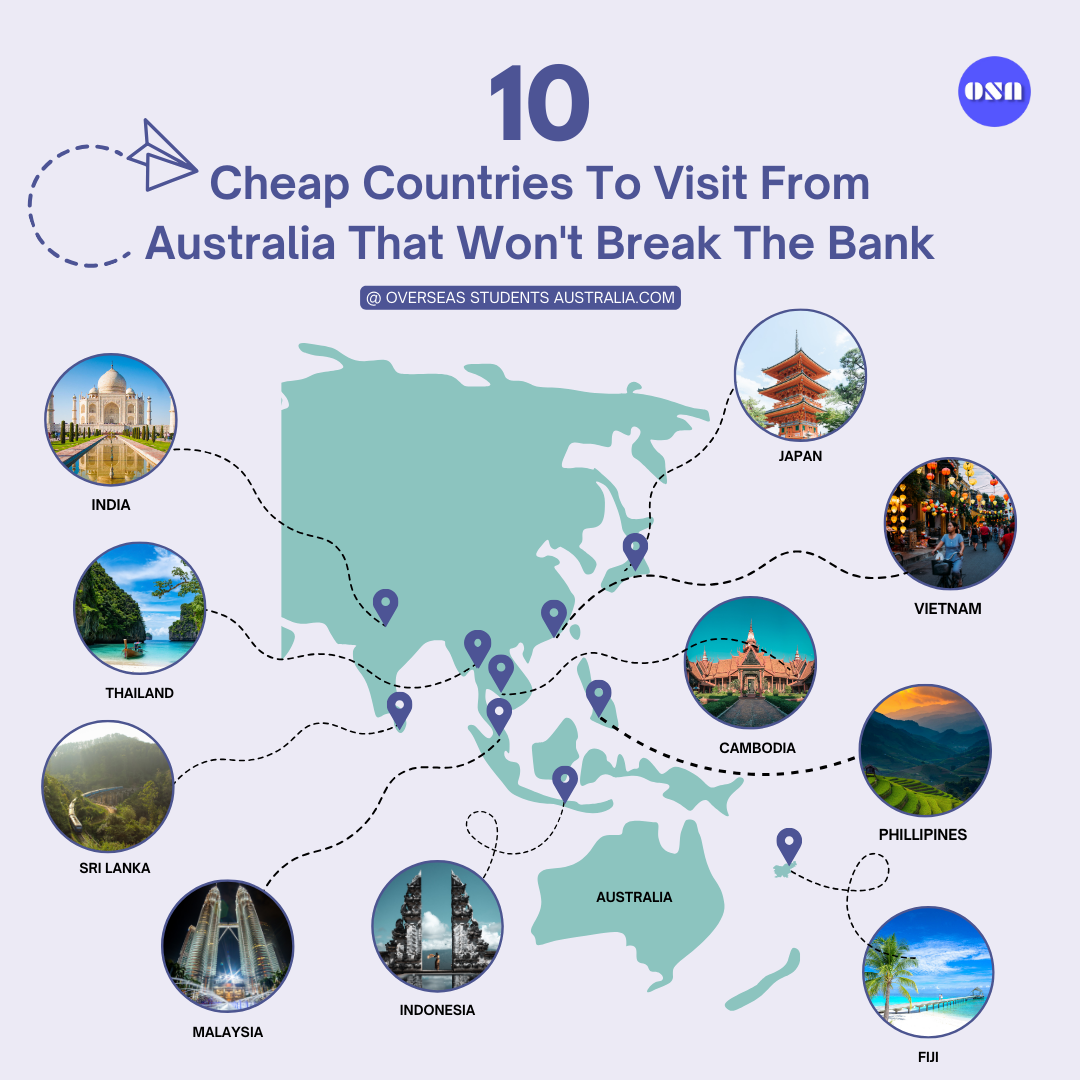
Here are the 10 cheap countries to visit from Australia that are budget-friendly and won’t leave you bankrupt.
1. Bali, Indonesia
Bali is popularly known as The Island of Gods.
This beautiful island located near the equator of the earth is endowed with the beauty of nature and has an optimal temperature all year round, making it one of the best places to visit.
This country is a great tourist centre for foreigners because of its incredible temples, evergreen forests, and unique culture.
You can get well-furnished and hospitable accommodation at dirt cheap prices, you eat delicious cultural cuisines and engage in tons of recreational activities.
How to reach
All major city airports serve direct flights to Bali. This island is approximately 4,425 kilometers away from Australia (Melbourne) with an approximate flight time of 5.5 hours. Return Plane tickets start from $258 and the average per night spend is AU$60.
Cheapest time to travel
The months of February, May, August and September are the cheapest months to travel to this amazing island.
Must visit attractions
Some of the must-visit places include
Tanah Lot Temple
Uluwatu Temple
Tirta Empul
Sacred Monkey Forest
Tegalalang Rice Terraces
Jatiluwih Rice Fields
Beaches of Bali – Kuta, Nusa Dua, Sanur
In this tropical paradise, you can also visit the local spas for the relaxing Balinese massage (must do activity), water parks, and beaches with your friends or families, clubs, and restaurants too.
If you want to have a thrilling adventure, you might consider taking a hike to climb the volcano on Mount Batur. Also, their yoga sessions are a must-try if you’re into yoga.
Generally, the Balinese people are very hospitable and friendly, so you might feel at home while enjoying your stay on the island.
2. Bangkok, Thailand
You can hop on a flight to Thailand from any of the major cities in Australia.
Bangkok is known for its great cradles of Buddhism and uniquely built temples that serve as hot tourist spots for foreigners. With a constant temperature of 30 °C, visiting its white sand beaches is a must for tourists.
How to reach
This island is approximately 5,788 kilometers away from Australia (Melbourne) with an approximate flight time of 9 hours. Plane tickets start from $262 and the average per night spend is AU$80.
Cheapest time to travel
The cheapest months to visit Singapore are March, May, October and November.
Must visit attractions
Some of the popular areas to visit around Thailand include:
Chang Mai
Phuket
Khao Yai National Park
Railay
Ko Pha Ngan
Sukhothai Historical Park
Aside from enjoying delicious Thai food at local restaurants at ridiculously cheap prices, visiting the temples in Bangkok should be at the top of your to-do list.
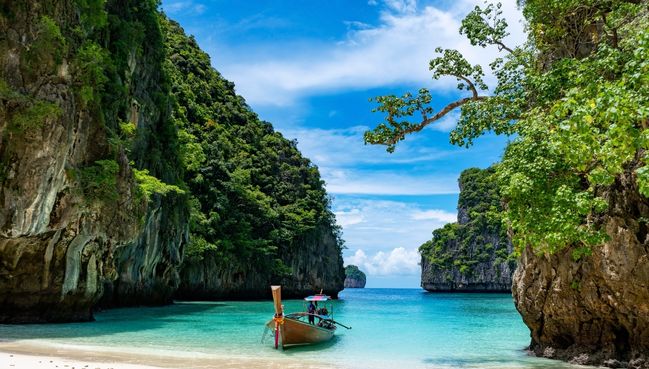
You can pay a visit to the colorful Sri Mahamariamman temple, the intriguing wooden Pattaya temple, and the three great Wat Pho, Wat Arun, and Wat Mahathat temples.
Many travellers head to the islands of Koh Samui or Phuket for more sightseeing and recreation. You will need to take another affordable flight from Bangkok to any of these places. Some airlines fly directly to these islands from Australia as well.
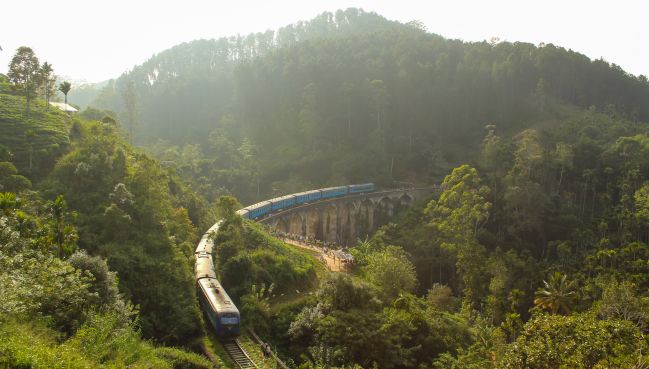
Sri Lanka is also known as Pearl of the Indian Ocean.
It is a beautiful island nation, located just south east of India.
If you are interested in history, culture, food, nature or adventure, then Sri Lanka will absolutely help to tick the boxes in quite an affordable way.
How to reach
It’s approximately 8,348 kilometers away from Australia (Melbourne) with an approximate flying time of 10 to 12 hours (direct). Return Flight tickets start from $590 and the average per night spend is AU$40 to $50. With flights available from all major Australian cities with direct and stop overs options.
Cheapest time to travel
It is cheaper to fly in the months of May and October to visit this beautiful island nation. Although keep in mind that these are usually rainy season so you may encounter heavy rainfall during these months.
Must visit attractions
Some of the most popular attractions to visit in Sri Lanka include:
Sigiriya (Ancient rock fortress)
Temple of the Sacred Tooth Relic (Sri Dalada Maligawa)
Galle Fort
Yala National Park
Polonnaruwa
Dambulla Cave Temple (Golden Temple of Dambulla)
Adam’s Peak (Sri Pada)
Nuwara Eliya
Ella
Mirissa
Sri Lanka is home to many UNESCO heritage sites and ancient monuments, architecture.
Sir Lanka is also known for its affordability with cheaper accommodation and dining options available for budget seekers.
4. Cambodia
Cambodia has made it to our list of cheap countries to visit this year.
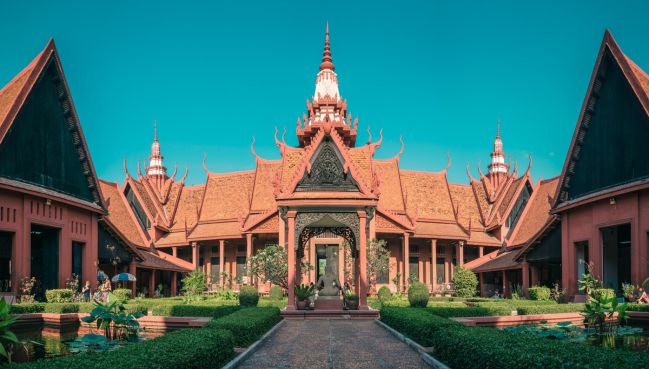
Cambodia offers bang for buck for budget travellers with dirt cheap accommodation, food, travel and attraction costs. Along with its rich cultural heritage, natural beauty and warm hospitality, it’s one of the must visit destinations.
How to reach
Cambodia is approximately 6,975 kilometers away from Australia (Melbourne) with an approximate flight time of 8 to 9 hours. Plane tickets start from $434 and the average per night spend is AU$40 to $60.
Cheapest time to travel
The cheapest months to visit Cambodia are April, May, September and October. These are considered cheap as it is rainy season in the country with moderate to heavy rainfall.
Must visit attractions
Here are some popular attractions to visit in Cambodia:
Angkor Wat
Phnom Penh
Siem Reap
Sihanoukville
Battambang
Kampot and Kep
Tonle Sap Lake
Preah Vihear Temple
Visit temples like Angkor Wat, museums, and historical sites and if you are into visiting natural landscapes then you can visit Cambodia’s pristine beaches, tropical islands and scenic countryside.
You can enjoy activities like hiking, swimming, snorkeling, and wildlife spotting without breaking the bank.
You will be mesmerised by the food like the Khmer curry, fish amok, and noodle soups at very reasonable prices.
5. Nadi, Fiji
Fiji is popular for its majestic palm trees, therapeutic hot springs, sandy beaches, and Mud pools.
A visit to this tropical paradise can be made possible if you plan your budget right. The good thing about Fiji is that the weather is close to perfect with temperature not dropping below 20 °C even through cold months.
How to reach
This island is approximately 3,159 kilometers away from Australia (Sydney) with an approximate flight time of 4 hours and 30 minutes. Return air tickets start from $455 and the average per night spend is AU$150.
Cheapest time to travel
The cheapest months to visit Nadi, Fiji, are March, August, October and November.
Must visit attractions
Some of the best attractions to visit in Fiji includes:
Wailoaloa Beach
Blue Lagoon Cruise
Sabeto Hot Springs
Navua River
Kula Wild Adventure Park and Kila Eco Adventure Park
Denarau Island
Sunbathing on the Wailoaloa beach and relaxing at the Sabeto Hot springs are places to go for recreation; visiting the local restaurants and trying out their national cuisines are also must-try. Also don’t forget to try their national drink, Kava.
6. Vietnam
Everything from transportation to dining is very much affordable in Vietnam as it is one of the cheapest countries in the world to visit.
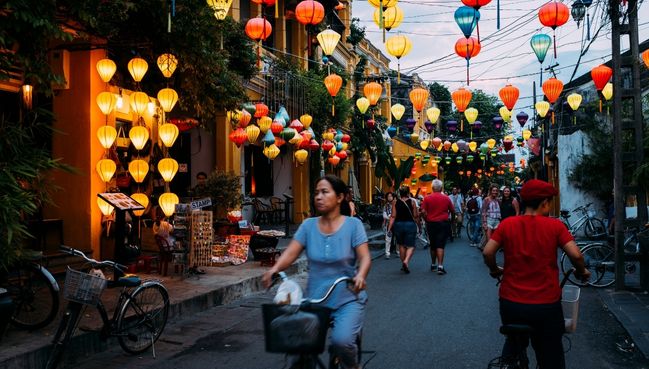
It is a local paradise that consists of rural villages and cities which draws in a lot of tourists on a tight budget due to the economical-friendly nature of the country.
How to reach
This backpacker’s paradise is approximately 6,900 kilometers away from Australia (Melbourne) with an approximate flight time of 9 hours and 7 minutes. Return airfares start from $329 and the average per night spend is AU$40.
Cheapest time to travel
The cheapest months to visit Vietnam are March, April, August and September.
Must visit attractions
Unique landmarks such as
Ho Chi Minh City
Hanoi
Phong Nha Ke,
Hoi An Ancient Town,
Bang National Park,
Cu Chi Tunnel,
The Marble Mountains, and
Ha Long Bay
Also, don’t forget to visit their beaches, and local restaurants to try their traditional cuisine and many more.
As a traveller, you can do a complete North (Hanoi, Sa Pa, Ninh Binh), Central (Da Nang, Hoi An) South (Ho Chi Minh,Phu Quoc) trip.
🗺️ 🛫 Planning to go for holidays soon? Search them here. ⤵️
7. Philippines
The Philippines has gained international popularity for its magnificent beaches and coastlines, great diving spots, and unique terrestrial landmarks with over 7,000 islands to see.
The Philippines is also a place where the Australian dollar goes far; you can have a taste of cheap street food for as low as $2 and sophisticated restaurant meals at $10 only, not to forget the ridiculously cheap accommodations of just $10 per night for a single room. This tropical island also has a lot of great monuments with a lot of excavation sites.
How to reach
Many direct flights are available for traveller form all major Australian airports to cities like Manilla and Cebu.
The Philippines is approximately 6,130 kilometers away from Australia (Melbourne) with an approximate flight time of 8 hours. Return airfares start from $282 and the average per night spend is AU$60.
Cheapest time to travel
The cheapest months to visit the Philippines are April, July, August and September.
Must visit attractions
Some of the best things to do in Phillipines include:
Manila
White Beach, Boracay
Coral Garden
Fort Santiago,
National Museum of the Philippines,
Rizal park,
Krus ni Magellan
Batad Rice Terraces, Banaue
Corregidor Island
Diving in the saline waters of the oceans and sunbathing at the popular beaches are just some of the recreational activities to enjoy in the Philippines.
Visiting the tropical islands within the Philippines is also a great spot for viewing astonishing landmarks, so you might want to give that a try as well.
8. Malaysia
This is one of the most popular destinations for tourists in Southeast Asia: with its awesome ancient archeological landmarks, modern cities, white sand beaches, and great hiking spots such as Mount Kinabalu, you just can’t get enough of Malaysia.
The most popular and the cheapest city to travel to Malaysia is Kuala Lumpur.
How to reach
Kuala Lumpur, Malaysia is approximately 6,435 kilometers away from Australia (Melbourne) with an approximate flight time of 8 hours. Return Plane tickets start from $261 and the average per night spend is AU$55.
Cheapest time to travel
June, July, August and October are the cheapest months to travel to Malaysia.
Must visit attractions
You can visit popular tourist spots in Malaysia like:
Batu caves
KL tower
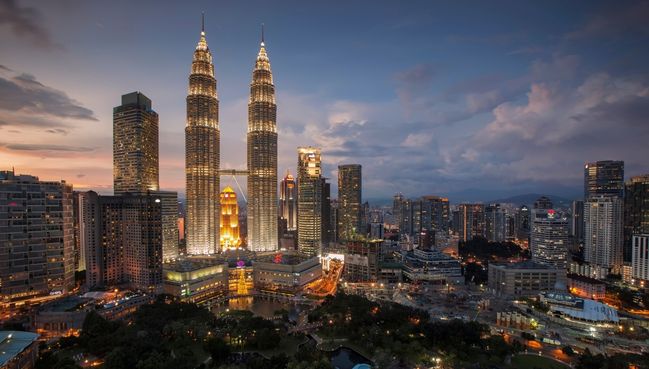
Petronas twin towers
Petaling street flea market
Langkawi sky bridge
Mount Kinabalu, Sabah
Pinang Peranakan Mansion
Going to the bustling city of Kuala Lumpur, which is mostly frequented by foreigners and tourists, is another great sight to see. With a well-planned tour guide, you can see the whole of Kuala Lumpur in just 2 days.
Don’t forget to try the world-famous Roti Canai, Nasi Lemak, Satay, Hokkien Mee Noodles while in Kuala Lumpur.
Island hopping from Kuala Lumpur is also getting popular among foreign tourists. Some of the popular islands including Tioman Island, Redang Island,Pangkor Island, Penang Island and Sipadan Island.
9. Kyoto, Japan
Visiting Japan can come as a two-way street in terms of cost; the accommodation might be a bit pricey, but the food is on the cheap side which makes up for it.
Anime lovers, hold on tight as it might be a dream coming true for you all. Apart from that, if you love Japanese culture and art then it’s a big win as well.
Japan is also nicknamed “The Samurai Blue” because the color of their playing kits has always been blue since the 1930s.
How to reach
Japan is approximately 6,848 kilometers away from Australia (Melbourne) with an approximate flight time of 9 hours and 47 minutes. Return Plane tickets start from $458 and the average per night spend is AU$100.
Cheapest time to travel
February, May, June and September are the cheapest months to travel to Kyoto, Japan.
Must visit attractions
Some of the other popular places to visit in Japan include:
Tokyo
Osaka
Nara
Mt Fuji
Hiroshima
Yakushima
Izu Peninsula
Aside from seeing the beautiful cherry blossoms and boarding the infamous bullet trains, trying out futuristic technological developments like Automatic vending machines, and virtual reality games, and visiting Anime and Manga studios.
Japan is also known for its unique cultural appreciation such as Calligraphy, embroidery weaving, traditional arts, flower arranging, tea ceremonies and so much more, so you might want to try out the traditional side of the samurai blue.
Another country where the Australian dollar goes far, making it an ideal destination for those on a strict budget. The cost of living in New Delhi, India should not be more than $400 per month, so visiting this country is already a guarantee that your bank won’t break.
To get all the thrill and fun-filled experience in this country, the best visiting time is from October to March. This is because the weather during that time is best appreciated and most welcoming.
How to reach
India is approximately 7,809 kilometers away from Australia (Melbourne) with an approximate flight time of 12 hours and 50 minutes. Return Plane tickets start from $746 and the average per night spend is AU$60.
Cheapest time to travel
January, March, June and July are the cheapest months to travel to New Delhi, India.
Must visit attractions
Some of the best places to visit Indai Include:
Taj Mahal, Agra
Golden Temple, Amritsar
Goa
Mumbai
Ganga River, Varanasi
Ladakh
Dharamsala
Darjeeling
While in Delhi, you can visit tons of local markets, old architecture like Red Fort, Qutub Minar or just catch up on local spicy food. Make sure not to get the Delhi Belly though (Famous term for getting sick after eating local food).
Many traveller also do the golden triangle from New Delhi that includes the city Delhi itself, then visiting Agra for Taj Mahal and then going to the pink city of Jaipur
If you want to go away from the hustle and bustle of these larger cities, then you can also do activities such as Hiking in the Himalayas, doing Yoga in the City of Rishikesh, and sightseeing in the lake city of Udaipur.
Plenty to see and do there for less.
Bonus Countries
Apart from the above listed countries, there are few more budget friendly countries that you can travel from Australia. These are:
Laos
Nepal
Turkey
Morroco
Albania
Final Thoughts
Deciding on which country to visit solely depends on your budget, and what you would love to experience.
Since many of these countries offer a wide array of exciting adventures to explore and so many cultures things to experience, picking one to go to might be a bit difficult.
But we hope this guide helps you make a decision on which one to visit. (or may be all)
In case, you want to make bookings for your holidays to these cheap countries, than you can check Skyscanner website.
Well, that’s all you need to know about the cheapest countries to visit from Australia. Let us know which country you would like to visit in the comment section below.
Frequently Asked Questions by Travellers in Australia
How long is the flight time to Bali from Australia?
The flying time to Bali varies from each city. Here is a quick guide about flight time to Bali from different Australian cities: – Flight time from Melbourne to Bali – Approximately 6 hours – Flight time from Sydney to Bali – Approximately 6 hours 30 mins – Flight time from Brisbane to Bali – Approximately 6 hours 15 mins – Flight time from Perth to Bali – Approximately 3 hours 45 mins – Flight time from Adelaide to Bali – Approximately 5 hours 20 mins – Flight time from Darwin to Bali – Approximately 2 hours 35 mins
What are the closest countries to Australia for travel?
Here are the closest countries to Australia for travel: – Indonesia – New Caledonia – New Zealand – Fiji – Papua New Guinea – Vanuatu
Which country is the best for cheap travel from Australia?
Here are the list of cheap countries to travel from Australia: – Thailand – Indonesia – Vietnam – Laos – Cambodia – India – Philippines
So you must have been asked this question: “What’s your New Year’s Resolution?”
While some of you might have got your goals for the new year ahead already sorted, many of you don’t.
Your answer: Because I’m a student. Right!
No stress!
As always, we have got your back.
If you don’t have a new year’s resolution in place or even if you do, we’re sure you’ll find this quick guide to International Students’ New Year’s Resolution pretty handy with actionable tips included.
Let’s get in.
What is a New Year’s Resolution?
As the curtain falls on the previous year, many people, including students, reflect on life in that year. This includes their achievements, failures, learning and everything in between.
So at the end of the year or at the start of a new year, individuals make new goals, promises to themselves for improving their life in some way, shape or form. This is known as New Year’s Resolution.
This could be in various parts of an individual’s life, including:
Academic
Relationships
Finances
Career
Health
And many more
Can someone else actually make a resolution for me?
The answer is No. But!
If you are unsure and need help, then you can certainly consult with a career coach or seek help from someone who has got more experience than you to help you with goals.
But eventually, you will need to sit and put them together. After all, they are your goals.
That’s why we are creating this guide, based on the ideas of our team members who were international students once upon a time. They have seen it all before you.
And the ideas are quite relevant to the international student’s life in Australia.
This can help you with your own resolutions.
Now let’s get into the resolution thingy.
International Students New Year’s Resolution Ideas
We have divided these resolutions into various categories and chosen our Top 3 in each of these categories.
1. Resolution: I will build my network
Resolution Type: Career
I will meet at least 5 new people in person each week and try to exchange details for further professional interactions.
I will be proactively looking to build my network on LinkedIn by connecting with 5 people each week.
I will attend all the networking events organised by my university/institute
2. Resolution: I will invest in myself
Resolution Type: Professional Development
I will undertake at least 3 short courses or certifications that will help improve my skills or knowledge during the year.
I will get a mentor in my field of study to help me progress in my chosen career.
I will start writing a journal every day of my life. I will write about my achievements, failures and learning each day.
I will improve my time management to balance work, study and life balance.
I will learn to build a strong portfolio and resume for my career
Tip: Get a free time management template from here.
3. Resolution: I will look after my health
Resolution Type: Health
I will stop eating instant noodles or instant unhealthy food.
I will go for a run for 20 minutes at least 4 times each week.
I will sleep for 7 to 8 hours each night (no more or less).
I will schedule regular health check ups (at least once every 6 months)
I will priortise mental health and seek support when required
4. Resolution: I will learn more this year
Resolution Type: Academic
I will study to learn, not to just get a degree
I will ask 1 question at the end of each class from my teachers
I will study 1 hour each day regardless of if there are any exams or assignments.
I will have at least 95% attendance in each term
5. Resolution: I will manage my money well
Resolution Type: Financial Management
I will not be doing an impulse buying of any items.
I will find a job that pays me more than my current one (or ask for a pay rise).
I will create a budget for the month and stick to it.
I will seek to learn more about financial management during the year.
Tip: Get a free budgeting spreadsheet or budget planner from here.
6. Resolution: I will control my social media cravings
Resolution Type: Digital Detox
I will not use my mobile phone in the toilet.
I will not do mindless scrolling of the social media feeds.
I will switch off my phone before sleeping and will buy a small alarm clock.
7. Resolution: I will build healthy relationships
Resolution Type: Relationships
I will be calling my family or friends overseas at least once per week.
I will listen to others before speaking or giving my opinions
I will get rid of all the toxic relationships from my life
8. Resolution: I will help others
Resolution Type: Cultural Integration
I will volunteer once a month at a local charity or volunteer organisation
I will help one random person each month (either donation, food or just help in lifting bags for elderly people)
I will help my fellow students if they are stuck with study queries.
Tip: Don’t give your assignments to others at any cost. We explained that here.
Final Words
Now these resolutions are no way set in stone. Which means you are free to choose the ones that are relevant to your life (or may be all).
We hope that these resolution ideas gave you enough to think about your own personal resolutions for the year. (We don’t mind if you want to copy some of these for yourself).
We suggest you sit down, and analyse it for yourself and make your own resolutions.
Delivery with Amazon flex has become a well-known side hustle for international students to make extra income.
One main need is for you to have your car, so if you fit into this requirement then Amazon flex driving could be your next side job for extra money.
In short words, Amazon flex hires available or on-demand drivers to deliver packages from their delivery stations to customers.
In this blog, we are giving a complete guide about how to become an Amazon Flex Driver in Australia.
Let’s go!
What is Amazon Flex?
Amazon Flex is a part of Amazon Australia’s effort to deliver products to their customers with quick delivery.
So, Amazon decided to hire gig economy workers to deliver these parcels while reducing their reliance on other courier services like Australia Post, Star Track, Toll etc.
Requirements for working as an Amazon Flex Driver in Australia
Before you can work with Amazon Flex, certain requirements need to be met.
Age – You must be at least 20 years or older.
Valid Driver’s licence – You must have full unrestricted Australian Driver’s licence. Overseas driver’s licences are not acceptable when applying for Amazon Flex.
Background check – Before you are allowed to work in Australia, a background check must be issued and also a right-to-work check.
ABN – When you are delivering with Amazon flex, you are considered to be running your own business. So, you need to get your ABN (Australia Business Number) and you can learn to apply for an ABN here .
A car – when delivering with Amazon Flex, the only mode of transport acceptable is delivery by car. So, in case you don’t have or can’t afford a car, you have a choice to rent one.
Insurance: You must meet the minimum insurance requirements, including Compulsory Third Party insurance.
A smartphone – This is the most basic requirement. You need to have a smartphone to access the Amazon Flex App and select your blocks for delivery and get payment notifications. Getting a good Android or IOS device that meets Amazon flex specifications is a plus.
Amazon Flex App – you need to download the Amazon Flex App and open a profile with Amazon flex before working with them.
Bluecard training: If you are going to deliver with Amazon Flex in New South Wales, then you need to complete Bluecard training as well.
Detailed steps on how to sign up as an Amazon Flex Driver in Australia
When signing up to deliver with Amazon Flex, some necessary details and paperwork may be needed.
Here is a step-by-step guide on how to sign up as an Amazon flex delivery driver:
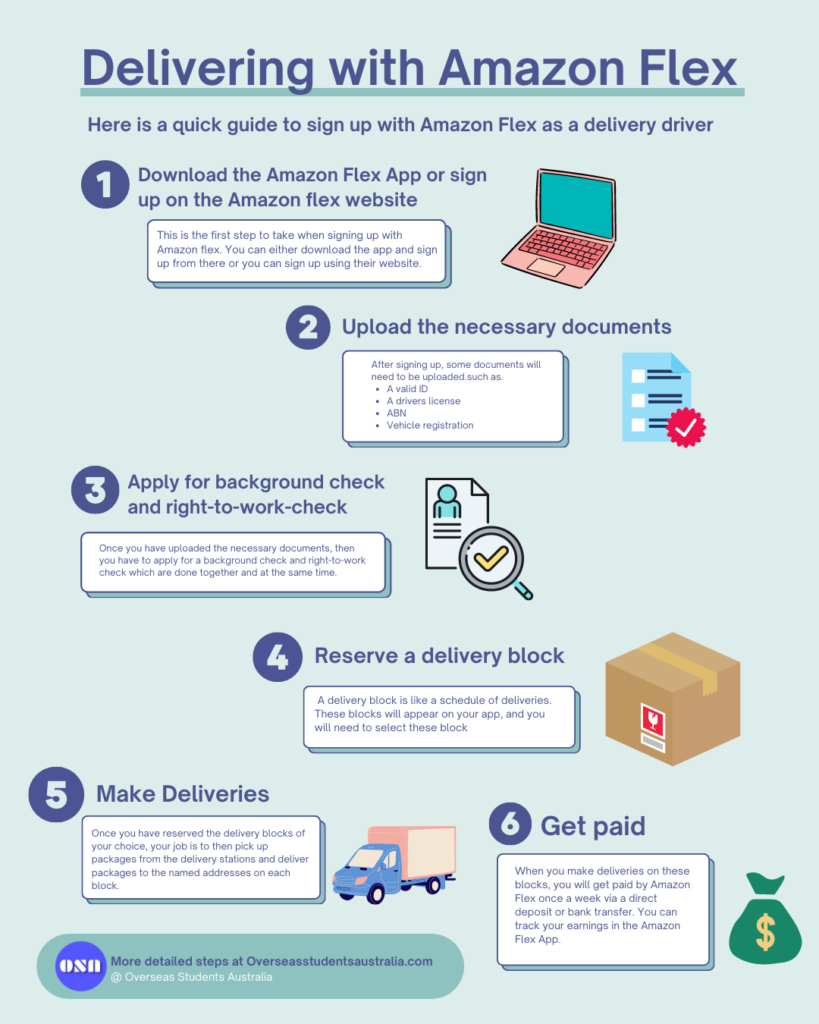
Step 1: Download the Amazon flex App or Sign up on the Amazon flex website.
This is the first step to take when signing up with Amazon flex. You can either download the app and sign up from there or you can sign up using their website.
You can use your existing Amazon.com.au details to sign up or you can create a new account.
When you download the app, some details will need to be provided to sign up with Amazon flex.
First name
Last name
Email
Password
City
Phone number.
Once signed in, you will be required to select the region and provide the correct vehicle type you will be using for the deliveries.
Step 2: Upload the necessary documents
A section may be shown to you for the necessary documentation to be uploaded. These documents will be related to your personal identification, driving license, insurance and tax requirements, etc.
These documents could include but are not limited to:
A valid ID – Passport, Australia Birth certificate, government-issued photo card, or a immicard may be required.
Australian driver’s licence– A valid Australian driver’s license may also be needed.
ABN– An Australian Business Number is also required since you are considered to be running your own business.
Vehicle Registration and insurance – Proof of your vehicle registration and insurance covers may also be a requirement if you plan to deliver with them.
You will also need to watch some of Amazon Flex’s videos to learn best practices for delivering with Amazon.
Step 3: Apply for a Background check and right to work check
Once you have uploaded the necessary documents, then you have to apply for a background check and right-to-work check which are done together and at the same time.
This background check is done through Accurate, Amazon’s background check partner and this can take up to 3 to 14 business days or even less at times.
The reason for a background check is to check for your criminal history or record and once you have applied for this check, the results will be sent to Amazon flex.
The optimal turnaround time for a background check is 3 to 14 business days.
If you need support during the signup process or background check, then you should get in touch with Amazon Flex support. You may contact them through email at [email protected] or by phone at 1800 290 564, which is open every day from 8:00 am to 9:00 pm PT.
Amazon will inform you of the reasons for its decision if it rejects your application, including:
A car or smartphone that doesn’t meet their specifications.
Incomplete documentation
Failed background check
The right-to-work check is done to check for your work entitlements in Australia. This is done together with the background check and there is no cost for this.
If you are based in New South Wales, you will need to also complete Blue Card Training as well after completing your background check. At the time of writing this blog, this cost is covered by Amazon Flex.
Step 4: Reserve a Delivery Block
Unlike food delivery services like Uber Eats or ride-sharing services like Uber, you can’t do deliveries all day or whenever you want.
So after your account has been set up, and you have uploaded the necessary documents. Your next step is to reserve a delivery block.
You will need to reserve a delivery block that matches your schedule. A delivery block is like a schedule of deliveries. These blocks will appear on your app, and you will need to select these blocks.
Amazon offers these blocks throughout the day at different frequencies.
You simply need to look for an available delivery block that works best for you and reserve it. This lets Amazon know when you are available for delivery and customers when packages are meant to arrive. You can select as many available blocks as you can deliver.
With each delivery block, your reserve comes with the expected earnings for that delivery and the amount of time it will take you to complete the delivery from your current location.
Step 5: Make Deliveries
Once you have reserved the delivery blocks of your choice, your job is to then pick up packages from the delivery stations and deliver packages to the named addresses on each block.
The Amazon Flex App will help navigate where these blocks are located and the estimated time for delivery from your location.
Step 6: Get paid
When you make deliveries on these blocks, you will get paid by Amazon Flex once a week via a direct deposit or bank transfer. You can track your earnings in the Amazon Flex App.
Modes of transport
When delivering with Amazon Flex, the only mode of transport acceptable is by car or a van.
This is because other modes of transport may not accommodate the packages needed for delivery or guarantee their safety.
You normally carry many delivery packages at the same time, not just one, and this makes the use of a larger car the most ideal mode of transport for it.
You can check your vehicle eligibility requirements using the Amazon vehicle eligibility calculator here.
Before you deliver for Amazon Flex with your car, you need to have a full Australian Driver’s licence and also have a car that meets the Amazon flex car requirements. These include:
A four-door, midsize Sedan, SUV, large passenger vehicle, or cargo Van
Valid car insurance and compulsory third-party injury cover
Please note that two-door passenger vehicles, trucks and utes with open beds or trays are ineligible for deliveries with Amazon Flex.
How much it costs to get started as an Amazon Flex Driver?
Now, the cost of getting started to work with Amazon flex will depend on a few factors. But to give you an idea, here are some costs you need to be mindful of when starting with Amazon flex.
A large car or a van approx. $8000 or more.
A Smartphone approx. $300 or more.
A background check and right-to-work check. $40
A phone data plan approx. $50 or more.
ABN application is $0 if you do yours on your own or $80 if it’s done through an accountant.
How much money can you potentially earn while driving for Amazon Flex?
The main question for anyone who wants to venture into this side job is how much they can earn.
According to Amazon Australia website, sedan drivers earn a minimum of $114 for a 4-hour block, $171 for a 6.5-hour Large Passenger Vehicle block and $225 for an 8-hour Cargo Van block in Australia.
If you take the minimum amount for the sedan car, then it comes to $28.50 per hour, for large passenger vehicle, it comes out to be $26.30 per hour and for Cargo van, it works out to be $28.12 per hour.
Remember, you can check your earnings via the Amazon Flex app.
Depending on these factors and how many deliveries you made in a week, you get paid by Amazon flex through a direct bank deposit.
Which locations can I deliver with Amazon Flex?
Currently, Amazon Flex is available in most major metro cities, including:
• Sydney
• Melbourne
• Brisbane
• Perth
• Newcastle
• Gold Coast
• Adelaide
• Gosford – coming soon, March 2023
You can look up for specific locations in each of these cities via Amazon’s website.
Advantages of being an Amazon Flex Driver
You will be your own boss – This is one of the best benefits of being an Amazon flex driver since you will be one who makes decisions, directs your actions and works for yourself.
High and reliable compensation in comparison to equivalent occupations – You will get paid handsomely according to how many deliveries and hours you work, which can be comparable to the payment of many full-time jobs.
Very little client contact – You will need to make little to no contact with clients, since your job is just to deliver packages and take signatures of clients for evidence of delivery.
Adaptable schedule benefits – you deliver with the time frame that works best for you, according to the hours you are free and to your schedule.
Disadvantages of being an Amazon Flex Driver
Difficult to regularly find shifts – This is mostly due to competing with several other drivers to get blocks and find shifts for delivery.
To get shifts, you must outbid hundreds of other drivers, unlike ride-sharing applications – Before you can get a shift, you will have to place your bid for it on time in order to outbid other hundreds of drivers who may also bid for it.
The time frames may not always be sufficient to finish a greater number of deliveries – At times, the time frames for each delivery might be too tight for you to meet up, since you would have to make other deliveries in close variations of hours.
Are you tech-savvy? Do you have what it takes to produce diverse application software through the use of computer languages?
If so, then being a Software Engineer might be where your dream career lies.
Software development is a highly sought-after professional skill that involves the development, testing, designing, and maintenance of application software.
In this blog, you will get all the necessary information you need on how to become a Software Engineer in Australia.
Overview of Software Engineering in Australia
Software Engineers, also known as software developers, are professional personnel who are tasked with the duty of developing, testing, designing, and maintaining application software.
This software can range from simple mobile and desktop applications to high-class international online platform applications.
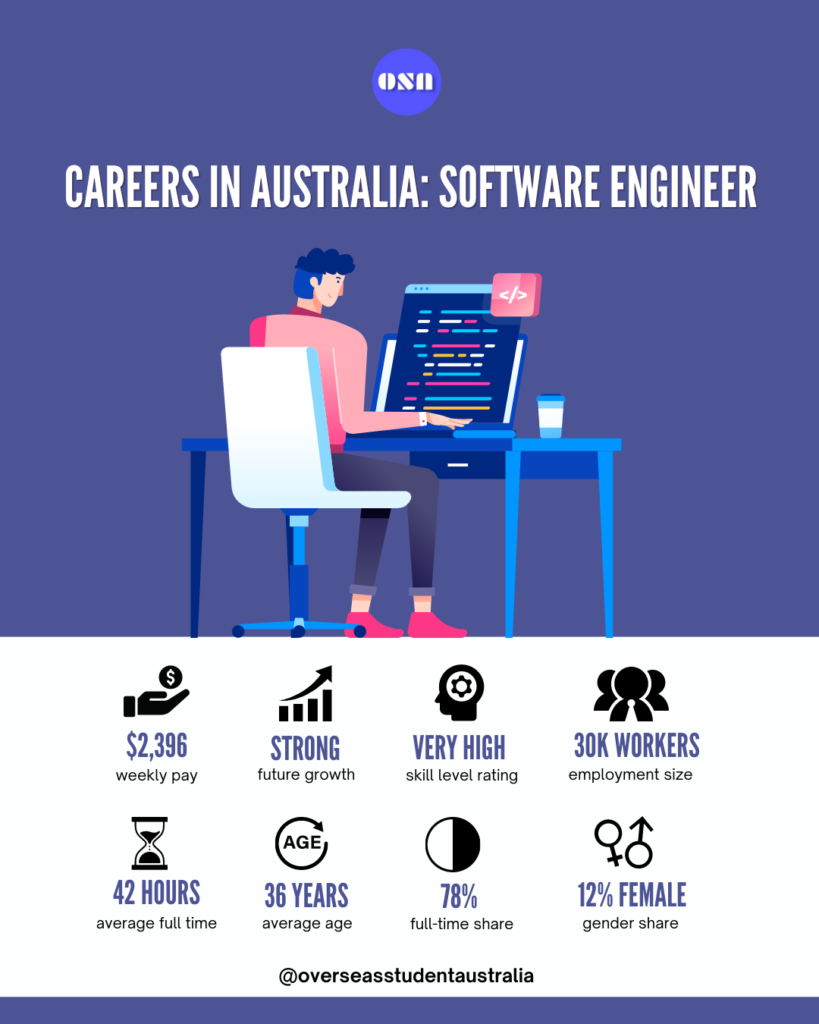
There are over 30,000 Software Engineers now employed in Australia, and there is still a great demand for these professionals in various industries.
Size of the industry
There are now over 30,000 of these highly skilled professionals in the Australian workforce.
Statistics have shown that this profession has a massive projected job growth of 27.0% in the next 5 years, making this a perfect career path to go into.
Popular locations
A massive 91% of the software-developing workforce in Australia lives in the capital cities, compared to the all jobs average of 62%.
New South Wales and Victoria have a large ratio of employment compared to their population sizes.
Here below is a percentage of Software Engineers in different areas of Australia, broken down by state and territory.
New South Wales: 41.7%
Victoria 30.1%
Southern Australia 5.1%
Queensland 12.4%
Western Australia 5.9%
Australian Capital Territory 4.0%
Northern Territory 0.2%.
Tasmania 0.6%
This is why it is necessary to consider a potential career path when choosing a city to study. Click here to find out how to choose a city to study in Australia.
Industries where Software Engineers are needed
The professional, scientific, and technical industries employ 56.3% of the software engineering workforce, which is the largest share of all their employers.
Other industries account for the remaining 43.7% of the workforce.
These industries include:
Financial and insurance 9.7%
Manufacturing 4.5%
Information and Telecommunication 6.9%
Other industries: 19.3%
Hours of work
In Australia, about 92% of the software development workforce works full-time.
This is 26% above the all-jobs average of 66%. Full-time workers work about 42 hours a week, which is like the average of all jobs at 44 hours a week.
Age
The average age of Software Engineers is 36 years, which is lower than the all-job average age of 40 years. A large share of workers, around 92%, are in the age bracket of 35 to 44 years.
Gender
With over 30,000 software Engineers employed in Australia, women account for 12% of the entire workforce, which is 36% below the all-jobs average for women (48%), while men account for 88% of the entire workforce.
What are some of the skills required to become a Software Engineer in Australia?
Becoming a software Engineer requires a mixture of both communicative and technical skills.
Here are some essential skills you need to have to be a qualified software Engineer in Australia.
Systems Evaluation
Operation Analyis
Reading Comprehension
Critical Thinking
Writing
Programming
Computer Science
Coding
Project Management
Problem-Solving
Flexible
What are the tasks and duties of a Software Engineer in Australia?
The tasks and duties of a Software Engineer can vary from developing software applications to communicating with the board and other team members about the project updates.
Here are some of the tasks and duties performed by a software engineer:
Manage execution, coordinate tests, and notice the start of the framework to approve execution.
Use methods like examining, modelling, and organised investigation, along with bookkeeping standards, to guarantee the arrangement is proficient, practical, and monetarily doable.
Talk with the board and clients to decide the requirements of the framework.
Foster propositions and methodologies for programming plan exercises.
Give exhortation, direction, and skill to take care of issues with plans or tasks.
Provide pricing and proposals for software purchases and updates.
keep up with and overhaul programs.
Run tests to make sure projects and PC frameworks are working appropriately.
Provides guidance, direction, and expertise in developing recommendations and methodologies for programming plan exercises, such as monetary assessments and costs for recommending programming purchases and updates.
How much does a Software Engineer earn?
The earnings of a software Engineer typically depend on the experience, specialisation, and qualifications of the professional.
On average, a software Engineer’s full-time earnings are $2,396 per week, which is much higher than all jobs’ average pay of $1,593. The average hourly pay for software Engineers is $60.19, which is higher than all jobs’ hourly pay of $41.
Essential Steps to Become a Software Engineer in Australia
Here is a step-by-step procedure to become a software Engineer in Australia.
Step 1: Acquiring a Degree in Software Engineering
To work as a Software Engineer or engineer in Australia, you have to get your bachelor’s degree, certifications, and qualifications in software engineering from an accredited college or recognised tertiary training institute.
If you want to further specialise in your field after receiving your bachelor’s degree, you can apply for a master’s postgraduate degree.
Bachelor of Software Engineering
You must have finished high school and taken the courses required by your chosen institution to enrol in the Software Engineering undergraduate program at a recognised Australian university.
But before attempting to enrol in a university institution in Australia, you must first fulfil several conditions, which include:
Completion of Grade 12 or equivalent.
An English proficiency exam with the band score required by the target institution (IELTS, TOEFL, PTE). (Students from non-English speaking nations should use this.)
The majority of colleges have certain admissions criteria.
Once you’ve met all the requirements, you’ll be able to enrol in a recognised post-secondary institution to study software development.
A full-time bachelor’s degree program lasts between 3 and 4 years, depending on the tertiary training institution. Students gain both academic and practical knowledge during this time.
The average cost to acquire a bachelor’s degree in software engineering in Australia ranges from AUD 37,000 to 49,000 per year.
Master of Software Engineering
You can pursue a master’s degree after earning a bachelor’s degree in software engineering or a closely related field.
A master’s degree in software engineering requires two to three years of full-time study, which provides specialisation in this field of study.
Some fundamental prerequisites must also be satisfied if you wish to apply for a master’s degree in software engineering in Australia.
Excellent CGPA (3.0 and above)
An English proficiency exam with a band score that the planned institution of study accepts (IELTS, TOEFL, etc.).
A bachelor’s degree certificate in software engineering or any closely related course.
The average tuition fee to get a master’s degree in software engineering in Australia ranges from AUD 38,000 to 42,000 per year.
Step 2: Go for Practical Training
It is always advisable to go for practical training while still in university to gain work experience before graduating.
This will increase your chances of being hired by industries or companies, as well as make you stand out in the crowd.
You can look for internships in different organisations that can help you to acquire practical skills in the industry.
If you can’t find internships, then you should try to create a portfolio with side projects. You can either do it voluntarily for organisations or you can create your own as a side hustle.
Step 3: Join an association related to engineering or computer studies
You can also join associations related to the engineering and computer fields. There are many associations to join in Australia, but here are some you can join.
The Australian Computer Society (ACS)
The Australian Information Industry Association (AIIA)
Association for Computing Machinery (ACM)
IEEE Computer Society (ICS)
An annual fee that ranges from $72 to $374 (incl GST) is required to join these associations.
Step 4: Get certifications
If you really want to level up your career in software engineering, then you will need to keep updating your skills using professional development programs.
As the software industry evolves with every new update, you will need to keep your self up to date with new changes, so ideally you should continue to undertake short courses and certifications in the field.
Some of the popular providers of these certifications include:
Microsoft
AWS
Oracle
What are some of the popular institutions to study Software Engineering in Australia?
Here are some popular institutions to study software development in Australia:
The future growth of software development careers in Australia
Software development is a constantly evolving profession with massive growth projected up to 2026, making it a solid career path.
There are various areas of software development, which means different territories to cover, vast areas of specialisation, and various tools to use.
Most software Engineers become freelancers and are not tied down to a single client, which means more profit and experience.
This profession should be studied with passion, a strong desire and persistence for success, and the ability to evolve and grow.
And that’s everything you need to know about becoming a software Engineer in Australia. Let us know which profession to cover next in the comment section below.