Australia is not only a beautiful country but it presents many opportunities for the students who are willing to take their life to the next level. Studying in Australia can be a very rewarding experience for the students that is why many overseas students decide to choose Australia as a preferred study destination.
Here are 8 facts about studying in Australia:
1. Number of overseas students studying in Australia
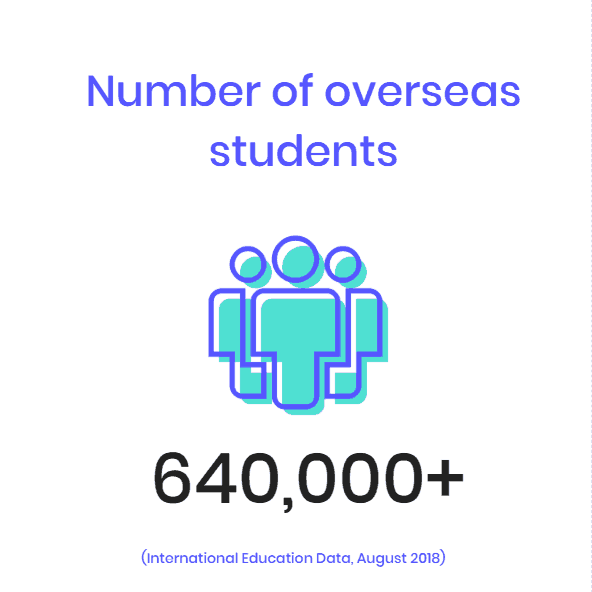
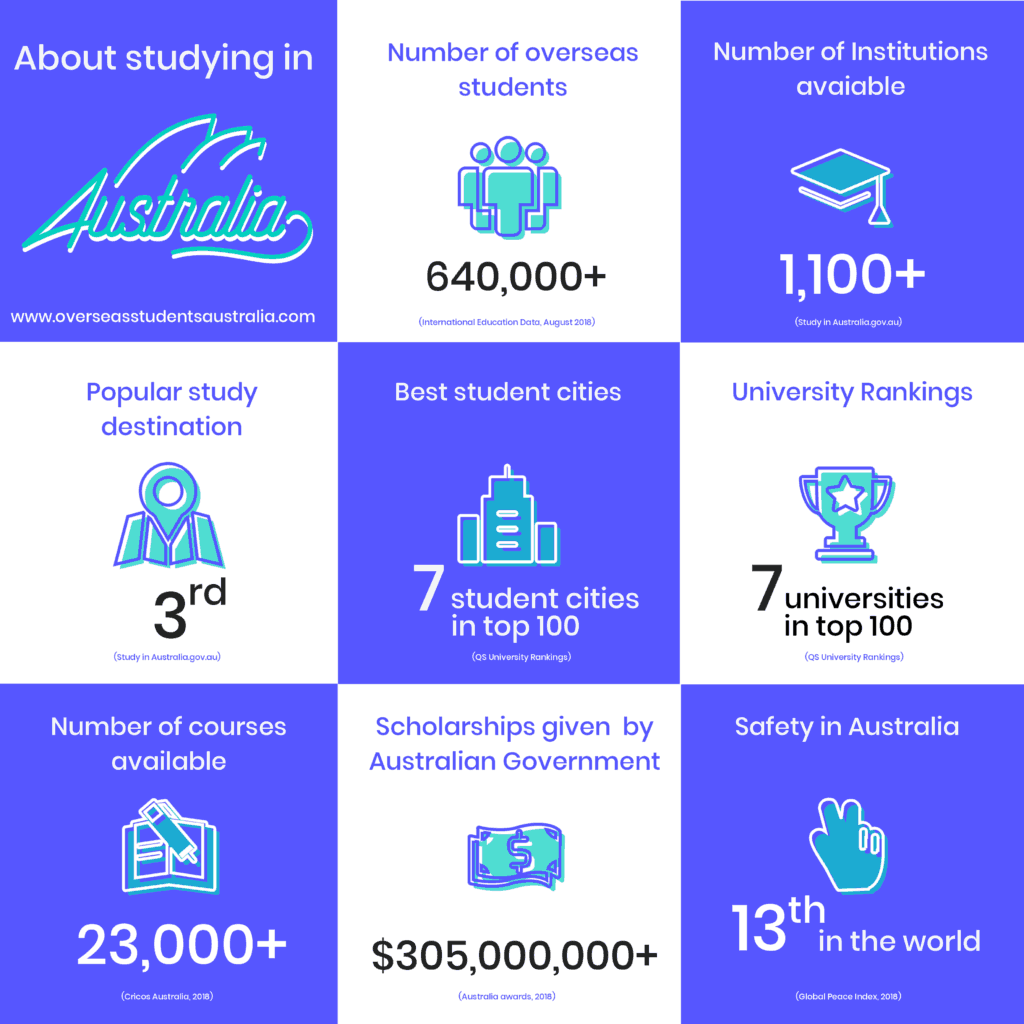
As per the International Education Data released by the Department of Education and Training, approximately 640,362 (August 2018) international students are studying in Australia. The top five countries from where these international students come from are – China, India, Nepal, Malaysia, and Brazil.
2. Number of Institutions available for studying
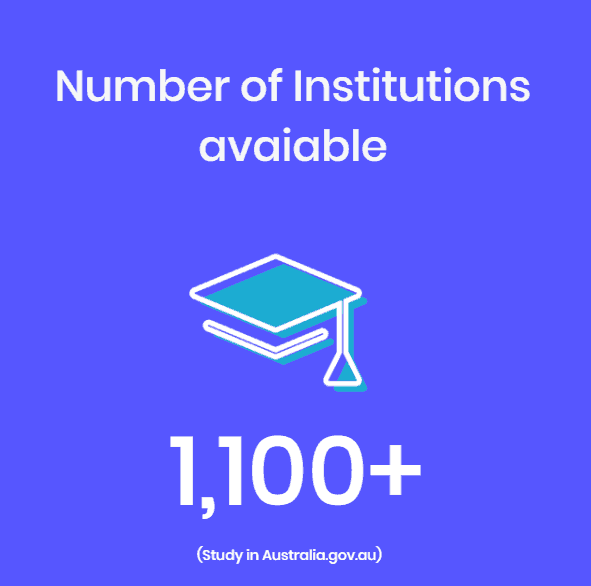
Cricos keeps all the list of international education providers in Australia. According to our research and the data provided by the Study in Australia website, there are more 1,100 institutions that students can choose from when they decide to study in Australia. You can search these institutions on our super-fast search engine as well.
3. 3rd Most popular study destination
After the US and UK, Australia is the third most popular destination for international students to study in the world. Although, as per the research by the Times Higher Education, Australia is set to take over the UK as the second most popular destinations within a year. So, it is quite evident that many international students choose to study in Australia than in other countries.
4.Best Student Cities
QS Best student cities rate the world’s top cities for the international student to study. As per the rankings, 7 Australian cities makes it in the Top 100. So not only, Australian educational institutions rank in the top of the world, Australian cities are equally providing a high-class student experience.
Best Student Cities- Australia
World Rank
Melbourne
3
Sydney
9
Brisbane
21
Canberra
22
Perth
39
Adelaide
41
Gold Coast
87
5. Best University Rankings
QS World University Rankings also provides the list of the World’s top universities and 7 Australian universities makes it to the Top 100 as well. Here is the list for Top 7 universities that make it to the list in 2018. Please note the ranking changes every year so make sure to check the latest ranking when applying for the student visa.
Top Universities – Australia
World Rank
The Australian National University (ANU)
20
The University of Melbourne
41
The University of New South Wales (UNSW)
45
The University of Queensland
47
The University of Sydney
50
Monash University
60
The University of Western Australia
93
6. Number of courses available
Again, Cricos keeps the records of all the courses available for the international students in Australia. As per the data collected, there are more than 23,000 courses available for overseas students to study in Australia.
Students can study from any types of courses like accounting, business, engineering, IT, hospitality, childcare, nursing, aged care, horticulture and many more. You can search pretty much all these courses on our super-fast search engine.
7. Australian Government Scholarships
Australia Awards is an Australian Government’s initiative to help the students from the developing countries and provide them with support for tuition fee, accommodation, airfares, insurance, and other living expenses.
So far this year, the Australian Government has already provided $305 million worth of scholarships and financial aid to international students from over 55 developing countries. In this video, we explain on how to apply for this scholarship and study for Free in Australia.
8. Safety in Australia
As per the Global Peace Index, Australia is one of the safest and peaceful countries in the world, ranking at 13th in the list of 163 countries. The crime rate is generally very low and it is easy and safe for the students to travel around the cities even during the late nights.
And here is the Overall summary about studying in Australia
Need extra funds? It’s important to know what’s involved in applying for a loan.
Australia offers a wonderful lifestyle, and having access to extra funds could help you make the most of it all.
However, special rules apply to non-residents hoping to source a loan. For the full picture, take a look at our seven fast facts for taking out a loan in Australia.
1 Your visa matters
When it comes to lending for, say, a car loan, restrictions apply to non-residents. The type of visa you hold matters because not every type of visa will be accepted by all lenders. In addition, the remaining term of your visa will dictate the term of your loan.
2 Lenders will want to know about your income
Lenders are required by law in Australia to be sure that you can comfortably meet the loan repayments. This being the case, a lender who will accept the terms of your visa will want to know details of your personal income.
3 There are plenty of lenders to choose from
Over 50 banks operate in Australia as well as a large number of credit unions and building societies.
The sheer number of lenders increases the likelihood that you may find a lender who is happy to offer a loan.
4 It pays to shop around
The sheer number of lenders available means that it can take time to know which one is best-suited to your needs.
Interest rates on loans vary widely too, so it’s important to shop around to find the best deal for your situation.
5 Look at the total cost
It can be tempting to choose the lender with the lowest interest rate. But a low rate loan can come stacked with fees including upfront fees and monthly fees.
This highlights the need to consider the total cost of the loan, not just the rate you pay.
6 Don’t assume your own bank offers the lowest rate
If you have an account with a foreign bank operating in Australia, it can seem like an easy option to take out a loan with this bank. However, that can mean paying more than necessary. Chances are you could get a better deal with a different lender.
7 Mortgage brokers are loan experts
In an unfamiliar country, it can be challenging to know how you go about applying for a loan. Even Australians can find this confusing, and that’s why many turn to a mortgage broker for professional help. In fact, 55% of home loans in Australia are arranged through a mortgage broker1.
A broker can let you know how you stand in relation to securing loan finance. Some, like Mortgage Choice, offer a free car buying service that streamlines the process of finding a new car. For more information on how Mortgage Choice can help, click here (they even have Guides in Mandarin).
If you are an overseas student in Australia, chances are that you might be on a tight budget. Saving some money here and there can certainly help in making life easier. So we decided to create this guide in order to rescue you, so you can save money using some of the practical strategies in the various aspects of life. Before we begin, we suggest you join our Facebook Group as we post heaps of freebies there. Let’s start saving money without further delaying:
Textbook and course supplies
For saving money in regard to textbooks, we suggest you either borrow books from the library to study.
But surely those books are either not available in the library or just already been loaned by someone. Then, the best bet is to buy the used/old textbooks from people who have already finished the subject.
Usually, students post ads in university for textbooks or online in university forums or even gumtree.
In regard to things like stationery and other course supplies, if it’s cheaper, get that from your home country.
Otherwise, we suggest you go to Kmart and Officeworks to find cheap supplies.
If you need to have software for your studies like Microsoft Office or Photoshop, then look out for some free alternatives you can instead of paid service. For example, you can use LibreOffice or Google Docs, Sheets or Slides instead of Microsoft Office. There are many other free open source alternatives available for the software these days, so go and search them out.
Accommodation
If you are renting the accommodation through a private landlord or an agent, we always suggest you to try to negotiate for a rent. Yes! You can actually do that. But be reasonable and don’t try to negotiate too hard. The worst case in negotiating nicely is that the person may say no but it is always worth trying.
Secondly, in order to save money, try to share the house with others. If you want to save even more, then you can share a room as well.
Even, if the landlord doesn’t want to negotiate on the rent, they might be open to discuss the share some of the bills like electricity, water, gas and internet. Try to get that included in your rental costs.
Make sure you always compare if renting an apartment by yourself is a better option or living in student accommodation is the way to go as they usually include all the bills, furniture and some extra services like gyms, swimming pools, entertainment activities
Transport
If you really want to save some money on transport then you should try to find the accommodation closer to your university or institution.
Although, sometimes it can be more expensive to live too close to the university or institution, in that case, try to buy the bike (bicycle) from Gumtree or Kmart and ride along. It is not only cheaper but a much healthier option as well.
But if you have to choose public transport, then you should see if the student concession is available to buy the tickets or not in your state or territory you are living in Australia.
Most of the university students are entitled to public transport concessions but again it depends on the state or territory you are studying in, so please check if that is available for you or not.
If possible, try to use public transport in the off-peak hours as the fare costs are much cheaper than.
We also suggest you choose your timetable in a way that you can catch public transport in the off-peak hours
We don’t recommend overseas students to use Taxi’s as they are quite expensive in Australia. If you have to travel somewhere and no other public transport is available, then we suggest you use ride-sharing service like Uber, Ola, Didi, Taxify instead.
Groceries
Try to learn basic cooking so you don’t eat out too often as it can be very expensive on the pocket.
If you cook at home, try to bring your lunch from home as it will save heaps
Always look out for specials of the week from the major supermarkets like Woolworths, Coles and Aldi.
Don’t forget to get those loyalty cards from the big supermarkets as they usually offer special deals and when you accumulate 2,000 points, you can claim up to $10.
Try not to shop a lot at convenience stores like 7-eleven as they can be expensive in Australia (unless you are buying $1 coffee).
If you want to save further 5% on groceries, then you can buy Woolworths gift cards from cash rewards or shop back and save 5% further on your grocery bills.
Always plan ahead and cook enough for yourself and avoid wasting food at all
If you are planning to buy your country specific items then we suggest you find out local grocery shops as they might be selling groceries cheaper than big supermarkets.
Never go shopping on an empty stomach.
Always make a list of items you will need to buy before you go for grocery shopping.
Clothing
One of the best ways to save money when buying clothes is to buy off season. So, buy winter clothes in summer and summer clothes in winters.
Always look out for special offers, sales and deals as they are offered during certain times in a year, for example, boxing day, black friday, cyber monday, Australia day etc.
If you are looking for specific brands then rather than going to the premium stores, you should always look for factory outlet stores, which you can find in the shopping centres like DFO’s.
If you are on a tight budget and would still have to buy some clothes, then we suggest you to head to stores like Salvation Army, Vinnies and local op-shops for affordable and pre-loved items.
If you are shopping online, then we suggest you use cashback websites like Cashrewards, Shopback as you can get cash back on lots of your purchases.
Always look out for eBay promotional codes and Amazon deals for more saving online.
You can also visit some local weekend markets and look for some inexpensive bargains there.
Bills/Utilities
The first saving tip for the bills is a no-brainer as it is always good to use as much as needed and switch off the items when not in use as it will do wonders for the saving those hefty bills
Always shop around for the best possible deal for things like electricity, gas, internet and mobile phone plans. Use government websites to compare and save on gas and electricity.
There are plenty of websites to compare and save money for your utility, internet and mobile phone bills.
If you are using mobile plan and it is up for renewal, then we suggest you to tell your current provider that you will take the business to other providers if they don’t offer a better or cheaper deal. This strategy can also work for the internet provider and utility providers also.
Unless you are on a plan or contract, changing providers are usually very easy and simple. We recommend you switching providers if you get a better deal elsewhere (No hard feelings!)
Banking
If you work and have saved up some money, then look for a bank that offers the best interest rates.
Typically, the big 4 banks don’t give the best interest rates, so we suggest you shop around and find out the best rates for your hard earned money.
As a student, you shouldn’t be paying any account keeping fees
Avoid credit cards as they usually carry yearly costs and the interest rates can be very high if you don’t pay back in time.
If you are transferring money from overseas to Australia or vice versa, check the exchange rates, fees, minimum and maximum amounts you send/receive and see if the banks or other money transfer ways works out better for you.
Eating out
Always look out for deals, special offers, there are lots of websites like Groupon, Scoopon and apps like Liven which can help you save heaps on eating out.
Lots of places especially close to the university campuses will have deals on for the students regularly.
Tips are not necessary in Australia, so you don’t need to tip and save some money there.
Avoid eating out on the weekend as it can be hard to find special deals and offers as restaurants are usually busy.
If you are celebrating your birthday, you can check out these deals and pretty much eat out for Free for few days around your birthday. (Make sure to sign up for the services at least a month before your birthday)
Haircuts and grooming
Look out for some training schools as they might need hair models for their training purposes.
If you want to go to Salon, then find out about their weekly specials. Usually, prices for the haircut are cheaper during the weekdays.
Students also usually get discounts for the haircut, so don’t forget to ask for that before the cut.
Gym Memberships
Look up for promotions and offers available in the gyms around your area.
If you are studying in university or TAFE, chances are they may have gyms available on the campus itself.
Make use of the free trails available as usually there are gyms offering for people to sign up.
Use friend’s referrals as you both might be getting benefit or rewards for the signup.
There are plenty of parks, gardens available in Australia for jogging, running and general fitness, and you don’t need to pay anything for that
Look for some free community fitness classes in your local area by joining some Facebook groups.
Night outs
Always bring cash only when going out in the night.
Leave your debit/credit cards at home as it will allow you to stay within your budgets if you just bring cash only.
Use public transport instead of your own car and taxies.
If you are going for drinks, start at home as it will save you heaps.
Enter the nightclub nice and early as the fees for most nightclubs increase after 11.
Never withdraw money at Casino, nightclubs or bar ATMs as they tend to charge high fees.
And if you don’t have money at all, then stay home.
Movies
Always watch a movie during off-peak hours (usually morning sessions and weekday nights).
Tuesday tends to be the cheapest day for watching movies in cinema.
Look out 2 for 1 deals from various providers or Groupon.
If you like watching movies too often then keeping that Netflix subscription ($9.99) might be the way to go
If you liked this article, then you might also want to check our article on Back to Uni essentials (with free checklist included) here.
You must know your work rights when working in Australia and it is even more important for you, overseas students, as you are more vulnerable to exploitation than any other group of workers in Australia. The main reasons why overseas students are more likely to get exploited at work is due to the language barrier, lack of understanding of the workplaces and culture, lack of work experience and most importantly the work limits of 40 hours per fortnight.
Exploitation can be regarding wages (getting paid less money than the minimum wage set out by Fairwork Australia) or forced to work more hours than your visa limitations or not getting the right working conditions for the work you need to complete. Here in this guide, we are going to discuss some of the options you have as a temporary worker in Australia if you are getting exploited at work.
✅ Same work rights like other workers
First of all, even as a temporary worker (with 40 hours per fortnight limitation), you have some work rights as a local Australia. Fairwork Australia has set out the National Employment Standards (NES) for the workers in Australia and as an overseas student with a valid work visa entitled you to these standards. If you would like to know more about these standards, check them out here.
✅ Steps you can take to avoid exploitation at work in Australia
Step 1- Speak to your employer
If you are getting exploited at work, the first things you can do is to speak to your senior managers and owners of the business. Sometimes, the line managers and supervisor are not following the business processes and procedures and the senior manager, the owner might be unaware of those wrongdoings. If you believe that this is not going to work or the management is not willing to improve then you will need to follow step 2.
Step 2 – Speak to Fairwork Australia
The second step you can take in order to save yourself from the exploitation at work is to speak to Fairwork Australia. Fairwork Australia is an Australian government agency that looks after the employees at the workplaces in Australia. Their role is to set out the minimum wages, look into the exploitation of the workers and ensuring the working conditions are good for the employees. You can speak to them by calling at 13 14 94 or visiting them on their website.
✅ I worked more than 40 hours per fortnight. Will my visa gets affected if I report my employer to Fairwork?
Lots of students don’t report their employers to Fairwork as they fear that their visa might be cancelled if they do. Luckily, Fairwork Australia and Department of immigration have an agreement in place that if overseas students come forward and report their employers to Fairwork for the exploitation at work, immigration will not cancel their visa even if students have worked more than 40 hours per fortnight. You can read this open letter from the Fairwork Ombudsman to international Students in Australia here.
🛑 My employer wants to pay me in Cash. Is it ok?
Getting paid in cash, bank transfer or a cheque is perfectly fine as long as your employer reports these payments to the Australia Taxation Office (ATO). It’s perfectly fine to get paid in cash as long as
– You are getting paid the right wages
– You are working on the books (that is taxes and super reported)
– You are getting a payslip and you and your boss keeping the records
If not, then, this is where the trouble starts. This illegal activity is quite commonly known as “Cash in Hand” in Australia and you should avoid this at all costs.
🛑 My employer asked me to get an ABN for my work. Is it fine?
The reason why many employers these days ask overseas students (especially some industries like cleaning, fruit picking etc) to get an ABN (Australian Business Number) so they can avoid paying superannuation, leave entitlements, taxes and worksafe insurances.
This activity is known as Sham contracting and is also considered illegal in Australia. Only people who run their business needs ABN. Usually, TFN (Tax File Number) is required to work in Australia as an employee. If you are experiencing this situation at work, we suggest you contact Fairwork.
✅ Do I need to pay anything to Fairwork Australia for their services?
No, the services provided by Fairwork Australia including education, advice and dispute resolution are absolutely free of charge.